Why NASCAR Is Running Just 465 HP at Daytona and What It Means for Racing
Table of Contents
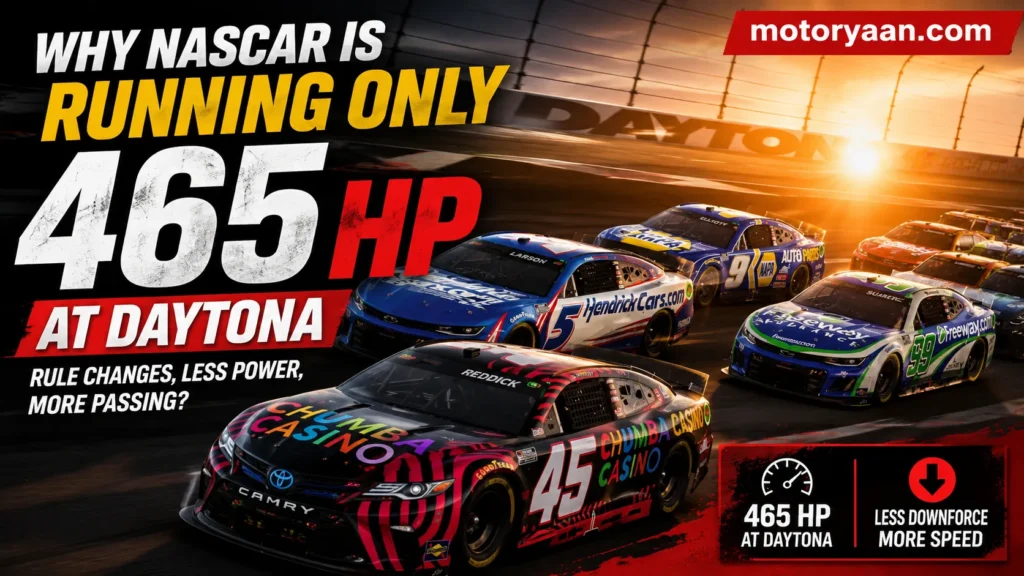
NASCAR is making another major rules change before the Coke Zero Sugar 400 at Daytona International Speedway on August 29, 2026. This time, the focus is on reducing both horsepower and downforce to improve racing and create more passing opportunities on superspeedways.
At first glance, the numbers look surprising. The NASCAR Cup Series cars will produce 465 horsepower, which is actually less than a road going Ford Mustang GT. However, the change is part of a bigger plan to improve the quality of racing rather than increase outright speed.
NASCAR Daytona Cars Will Produce Only 465 Horsepower
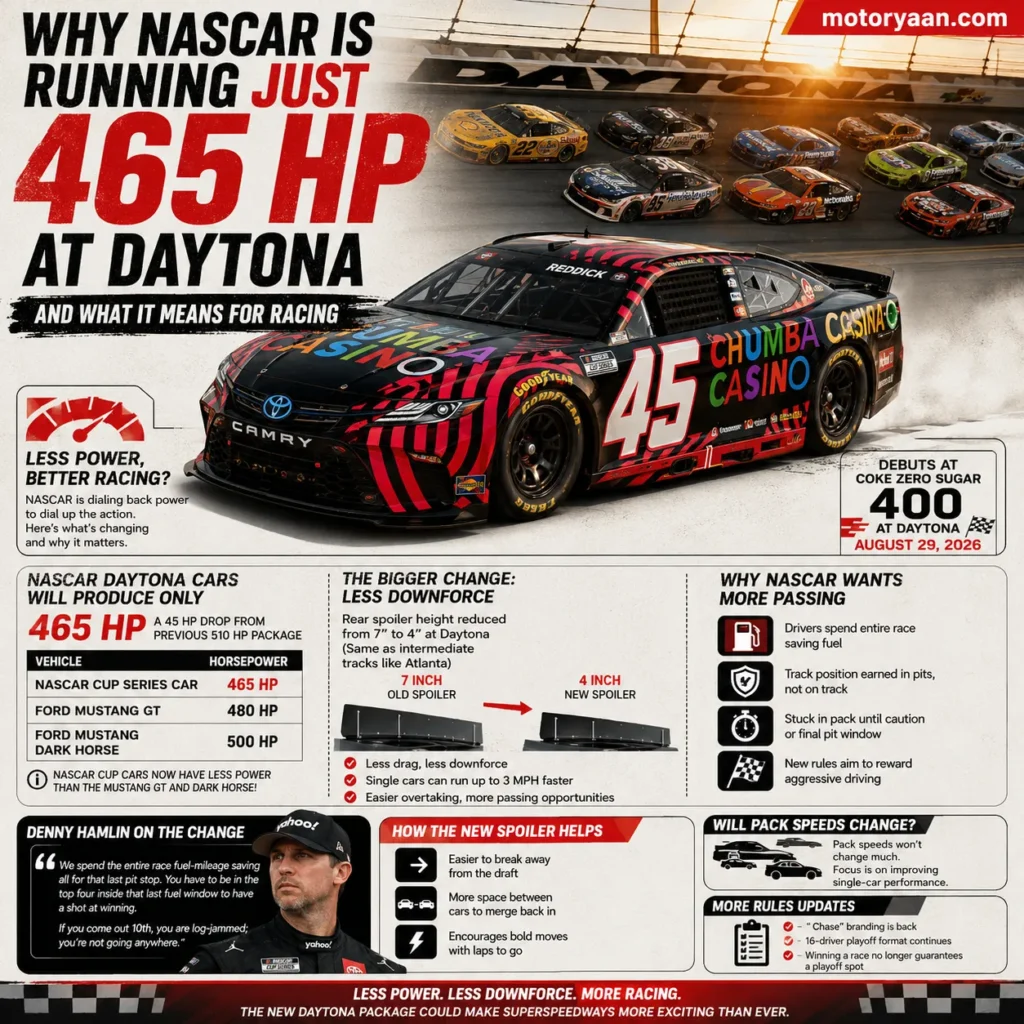
For the upcoming Daytona race, NASCAR has reduced engine output from 510 horsepower to 465 horsepower, a drop of 45 horsepower.
That means:
| Vehicle | Horsepower |
|---|---|
| NASCAR Cup Series car | 465 hp |
| Ford Mustang GT | 480 hp |
| Ford Mustang Dark Horse | 500 hp |
Interestingly, the Ford Mustang Dark Horse branded NASCAR race car will now have less power than both the production Mustang GT and the naturally aspirated Mustang Dark Horse sold to customers.
While that may sound unusual, horsepower is only one part of the overall racing package.
The Bigger Change Is Less Downforce
The horsepower reduction comes alongside a significant aerodynamic change.
NASCAR will reduce the rear spoiler height from 7 inches to 4 inches for Daytona. This is the same spoiler size already used at intermediate tracks such as Atlanta.
The goal is simple.
A smaller rear spoiler creates less aerodynamic drag and less downforce, allowing a single car to build speed more easily.
According to NASCAR, an individual car could run up to 3 mph faster when not surrounded by traffic. That extra speed should help drivers make passes instead of remaining trapped inside large drafting packs.
Why NASCAR Wants More Passing
Superspeedway racing at Daytona and Talladega often depends on drafting.
Cars running together in a large pack gain a significant aerodynamic advantage, making it extremely difficult for a single driver to move forward without help from other competitors.
As a result, many drivers spend much of the race:
- Saving fuel
- Protecting track position
- Waiting for pit stops
- Hoping for a caution period before making a move
That strategy has made track position more important than individual speed.
With the new package, NASCAR hopes drivers will be rewarded for making aggressive moves rather than simply waiting for the final laps.
Denny Hamlin Explains the Problem
Driver and team owner Denny Hamlin, who was part of the working group that developed these rule changes, explained why the current racing style has become frustrating.
According to Hamlin, drivers often spend the entire race focused on fuel mileage until the final round of pit stops.
He said teams already know they need to leave the final fuel window near the front of the field to have any realistic chance of winning.
If a driver exits pit road around tenth place, it becomes extremely difficult to move forward because the pack remains tightly grouped.
How the New Spoiler Could Help
Hamlin believes the shorter spoiler will allow drivers to separate from the draft more easily when they build momentum.
It should also create slightly larger gaps between cars, giving drivers room to merge back into line after attempting a pass.
That could encourage competitors to take more risks instead of waiting until the closing laps.
Hamlin pointed to the recent racing at EchoPark Speedway, formerly known as Atlanta Motor Speedway, as an example of the type of racing NASCAR hopes to create.
He also noted that this is only the first version of the revised package, but early data suggests it could deliver roughly a 33% improvement in the desired direction.
Will Pack Speeds Change?
Interestingly, NASCAR does not expect the speed of large drafting packs to change significantly.
Instead, the focus is on improving the performance of individual cars.
If a single car can gain speed outside the draft, drivers may have more opportunities to overtake without depending entirely on teamwork.
That could make Daytona races less predictable and more competitive throughout the field.
When Will the New Package Debut?
The revised superspeedway package will make its debut during the Coke Zero Sugar 400 at Daytona on August 29, 2026.
It will then return later in the season for the Talladega playoff race on October 25, giving teams another opportunity to race with the updated rules while the championship battle is underway.
NASCAR Also Updated Its Playoff Rules
The aerodynamic package is not the only change this season.
NASCAR has also made adjustments to its postseason format.
The series has:
- Brought back the Chase branding that was previously used from 2004 to 2016.
- Continued using the 16 driver playoff format.
- Changed qualification rules so drivers no longer automatically secure a playoff spot simply by winning a race.
These updates place greater importance on consistent performance throughout the regular season.
Final Thoughts
Running only 465 horsepower may sound like a step backwards, especially when some production sports cars now produce more power than NASCAR Cup Series machines. However, the reduction is designed to work alongside lower downforce rather than stand alone.
If NASCAR’s calculations prove correct, the new package should make it easier for drivers to break away from the pack, complete passes, and race more aggressively instead of spending most of the event waiting for pit strategy or caution periods to decide the outcome.
The Daytona race on August 29 will provide the first real test of whether these changes deliver the closer and more exciting superspeedway racing NASCAR is aiming for.
Sources & References
Official Sources
NASCAR Official Newsroom
https://www.nascar.com/news-media/2026/07/15/nascar-announces-rule-changes-for-summer-cup-race-at-daytona/
Official NASCAR announcement explaining the new 465 hp superspeedway package, spoiler reduction, and the reasons behind the changes.
NASCAR Cup Series Schedule
https://www.nascar.com/nascar-cup-series/
Official NASCAR schedule, race calendar, standings, and event information.
Daytona International Speedway
https://www.daytonainternationalspeedway.com/
Official website for Daytona International Speedway with race schedules, venue information, and ticket details.
Trusted Automotive News Sources
The Drive
https://www.thedrive.com/news/why-nascar-is-only-running-465-hp-at-its-next-daytona-race
Detailed explanation of why NASCAR reduced horsepower to 465 hp and how the changes are expected to improve racing.
Motorsport.com
https://www.motorsport.com/nascar-cup/news/nascar-unveils-new-rules-package-for-daytona-to-improve-racing-effective-immediately/10839028/
In-depth coverage of NASCAR’s new Daytona rules package with technical analysis and driver reactions.
Manufacturer References
Ford Performance
https://performance.ford.com/
Official performance division of Ford with information on Mustang performance models and motorsports.
Toyota Gazoo Racing North America
https://www.toyota.com/racing/
Official Toyota racing website covering NASCAR and other motorsport programs.
Chevrolet Motorsports
https://www.chevrolet.com/motorsports
Official Chevrolet motorsports page featuring NASCAR programs and racing news.
Why is NASCAR reducing horsepower to 465 hp at Daytona?
NASCAR reduced engine output from 510 hp to 465 hp to work alongside a lower downforce package. The goal is to improve superspeedway racing by making it easier for drivers to build momentum, complete passes, and rely less on pack racing.
How much horsepower will NASCAR Cup Series cars have at Daytona?
For the Coke Zero Sugar 400 at Daytona on August 29, 2026, NASCAR Cup Series cars will produce 465 horsepower. This is 45 horsepower less than the previous 510 hp package.
Is a NASCAR Cup Series car now less powerful than a Ford Mustang GT?
Yes. Under the new Daytona package, a NASCAR Cup Series car will produce 465 hp, while a production Ford Mustang GT makes 480 hp and the Ford Mustang Dark Horse produces 500 hp. Even so, NASCAR race cars remain much faster because of their racing chassis, aerodynamics, tires, and setup.
What aerodynamic changes has NASCAR made for Daytona?
NASCAR has reduced the rear spoiler height from 7 inches to 4 inches. The smaller spoiler lowers aerodynamic drag and downforce, allowing individual cars to gain speed more easily when they move out of the draft.
Will the new Daytona package make passing easier?
That is NASCAR's objective. Officials believe a single car could be up to 3 mph faster outside the draft, giving drivers a better chance to overtake instead of remaining locked in large drafting packs.
Why does NASCAR want to reduce pack racing?
Large drafting packs often make it difficult for drivers to move forward without help from other competitors. NASCAR wants to reward aggressive driving and individual performance instead of having races decided mainly by fuel strategy, pit stops, and track position.
What did Denny Hamlin say about the new rules?
Denny Hamlin said drivers often spend most of the race saving fuel and waiting for the final pit cycle because it is difficult to pass once the field is tightly packed. He believes the shorter spoiler should create more passing opportunities and encourage drivers to make bolder moves.
Will overall pack speeds increase with the new package?
Not significantly. NASCAR expects large drafting packs to run at similar speeds. The focus is on improving the performance of individual cars so drivers have a better opportunity to make passes without depending entirely on drafting partners.
When will the new Daytona rules package make its race debut?
The revised superspeedway package will first be used during the Coke Zero Sugar 400 at Daytona International Speedway on August 29, 2026. It will return later in the season for the Talladega playoff race on October 25.
What other NASCAR rule changes were announced for 2026?
NASCAR has also brought back the Chase branding, kept the 16 driver playoff format, and updated the qualification system so winning a single race no longer guarantees a playoff position. Greater emphasis is now placed on season long consistency.