Most Controversial Cars of the 2000s: From Ferrari Luce to Pontiac Aztek
Table of Contents
The automotive industry has never been short on controversial cars. Some models upset loyal fans because of their design, while others triggered debates because of electrification, pricing, or simply changing what a brand stood for.
Recently, the new Ferrari Luce became the latest example. Ferrari’s first EV created a huge online reaction within hours of its debut. But honestly, this is nothing new in the car world. Over the years, several vehicles have faced criticism before buyers even got a chance to drive them.
Some eventually became successful. Others still remain punchlines decades later.
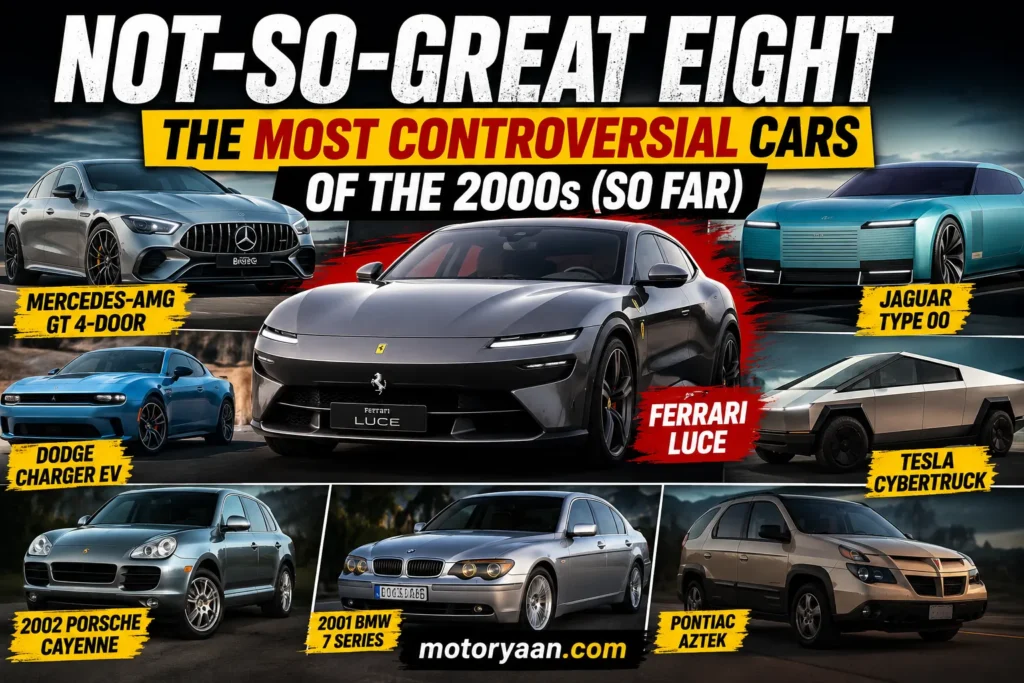
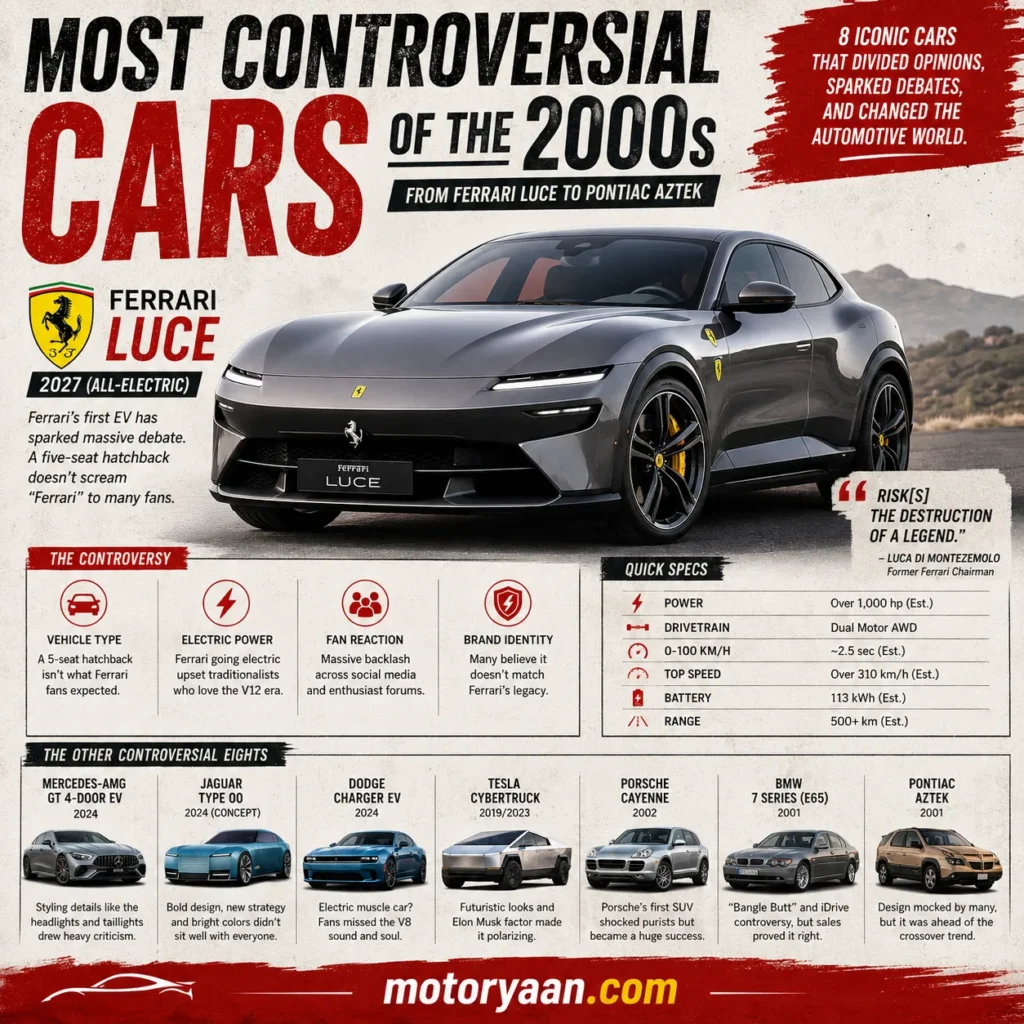
Here are eight cars that divided opinions the most.
Ferrari Luce
Ferrari knew its first EV would create debate. What the company probably did not expect was the scale of the backlash.
The biggest issue is not even the electric powertrain. Most criticism focuses on the body style itself. A five seat hatchback simply does not feel like a traditional Ferrari to many fans.
Ferrari has one of the largest fan communities in the automotive world, even though only a small percentage will ever own one. That means every major decision gets heavily judged online.
Former Ferrari chairman Luca di Montezemolo even reportedly said the car “risk[s] the destruction of a legend.” That alone shows how serious the reaction became.
Many enthusiasts believe Ferrari should have launched its first EV as a two seat supercar instead of a practical grand tourer style model.
Still, the Luce represents where the industry is heading. Whether fans like it or not, electrification is reaching even the most traditional performance brands.
Mercedes AMG GT 4 Door EV
The all electric Mercedes AMG GT 4 Door also faced criticism almost immediately after its reveal.
Unlike the Ferrari, the problem here was not the body style. AMG buyers are already familiar with four door performance cars. Instead, most complaints targeted the styling details.
Many people disliked the headlights and the large rear light setup. The connected front light bar also received mixed reactions online.
From the side profile, though, the car looks clean and modern. Some even compared its proportions to the Porsche Taycan and the Audi e-tron GT.
Mercedes may eventually update the design because the criticism mostly focuses on areas that are easier to revise in a facelift.
Jaguar Type 00
Jaguar has been struggling to redefine itself for years, and the Type 00 concept became one of the brand’s boldest attempts yet.
The reactions were brutal.
Some people described the design as futuristic. Others called it unfinished and awkward. Jaguar designers leaned heavily into extreme proportions and minimal surfaces.
The front end looks unusually flat, and the absence of rear glass made many people question the practicality of the concept.
Oddly enough, some criticism even focused on the bright blue and pink paint choices shown during the reveal.
The bigger concern, however, is Jaguar’s strategy itself. The company plans to become an all EV luxury brand with much higher pricing. Many longtime fans are not convinced this is the right direction.
At the moment, the Type 00 feels more like a statement than a realistic future production car.
Dodge Charger EV
The electric Dodge Charger Daytona controversy was predictable from day one.
Dodge built its modern identity around loud V8 muscle cars. Replacing that formula with batteries was always going to upset loyal buyers.
Ironically, the styling itself actually looks good. The design clearly takes inspiration from the legendary late 1960s Charger models. Power figures are also impressive, with up to 670 horsepower available.
But for many enthusiasts, the sound and feel of a traditional V8 matters more than straight line numbers.
Dodge even added an artificial exhaust sound system to make the EV feel more emotional. The internet still roasted it anyway.
That is the challenge with electric muscle cars. Performance alone cannot replace nostalgia.
Tesla Cybertruck
Few modern vehicles divide opinions like the Tesla Cybertruck.
Its design looks unlike anything else on the road. Some people love the futuristic stainless steel body. Others think it resembles something built in a school workshop.
The Cybertruck also carries the public image of Elon Musk, which adds another layer of controversy.
Tesla first revealed the truck in concept form years before production started. Delays kept piling up, which only increased skepticism.
Even now, reactions remain mixed despite the truck offering strong performance and impressive acceleration.
Sales have not matched the level of online attention, though. In many ways, the Cybertruck became more famous as an internet debate machine than as an actual pickup truck.
2002 Porsche Cayenne
Today, it sounds strange to say the Porsche Cayenne was controversial.
Back in 2002, however, Porsche fans hated the idea of an SUV wearing the Porsche badge.
Before the Cayenne arrived, Porsche mainly focused on sports cars. A heavy family SUV felt completely against the company’s identity.
Things became even more controversial when Porsche introduced diesel versions later.
But buyers loved it.
The Cayenne combined strong straight line speed with surprisingly capable handling. It also arrived exactly when global SUV demand started exploding.
In the end, the Cayenne saved Porsche financially and proved performance brands could successfully enter the SUV market.
Without the Cayenne, many luxury performance SUVs we see today probably would not exist.
2001 BMW 7 Series
The E65 generation BMW 7 Series shocked BMW fans when it launched.
For decades, BMW designs stayed relatively consistent. Then designer Chris Bangle introduced a radically different look.
The rear end became so controversial that people nicknamed it the “Bangle Butt.”
Compared to older BMWs, the E65 looked larger and heavier. The unusual headlight design also divided opinions.
Inside, BMW introduced the first generation iDrive system. The idea itself was smart, but the early execution frustrated many users.
Despite all the criticism, the car sold well. BMW eventually expanded similar styling themes across other models too.
Sometimes buyers complain loudly but still purchase the car anyway. Automakers definitely notice that.
Pontiac Aztek
The Pontiac Aztek remains one of the most infamous designs in automotive history.
The funny part is that the basic idea behind the Aztek was actually correct.
General Motors understood early that buyers wanted SUV styling without the downsides of heavy truck based platforms. The Aztek used a passenger car platform instead.
That formula basically describes today’s crossover market.
Unfortunately, the design ruined everything.
The proportions looked awkward, the plastic cladding was excessive, and the front end became an instant meme long before memes dominated the internet.
Even decades later, the Aztek still appears in conversations about ugly cars.
At least it achieved something most vehicles never do. People still remember it.
Why Controversial Cars Matter
Automotive history shows that controversial cars often push the industry forward.
Some fail badly. Others become massive successes after the initial backlash fades away.
The Porsche Cayenne transformed Porsche forever. The BMW E65 introduced ideas that later became normal. Even the Pontiac Aztek predicted the crossover boom years before rivals fully embraced it.
Not every risky design works, but safe designs rarely change the industry.
And honestly, if nobody complains online anymore, the car probably was not interesting to begin with.
Sources and References
Car and Driver
One of the most trusted US automotive publications covering car reviews, industry news, performance testing, and future vehicles.
MotorTrend
Popular American automotive media platform known for detailed car reviews, comparisons, EV coverage, and automotive trends.
Road & Track
US based automotive magazine focused on performance cars, motorsports, enthusiast culture, and premium vehicle analysis.
Top Gear
Global automotive publication widely followed in the US, UK, Canada, and Australia for car news, features, and opinion pieces.
InsideEVs
Reliable source for electric vehicle news, EV launches, charging updates, and future mobility trends.
Autoblog
Covers breaking automotive news, reviews, spy shots, recalls, and EV related developments for North American audiences.
The Drive
US automotive and enthusiast website known for opinion pieces, industry analysis, and car culture content.
Jalopnik
Automotive news and opinion website popular for controversial automotive discussions, industry commentary, and enthusiast reactions.
Ferrari Official Website
Official Ferrari website featuring company announcements, vehicle details, and official media releases.
Mercedes AMG Official Website
Official AMG performance division website with technical specs, product pages, and performance vehicle updates.
Jaguar Official Website
Official Jaguar global website covering concept cars, EV strategy, and luxury vehicle lineup information.
Dodge Official Website
Official Dodge website with Charger Daytona EV information, specs, and brand announcements.
Tesla Official Website
Official Tesla Cybertruck page featuring specifications, performance claims, and reservation details.
Porsche Official Website
Official Porsche USA website with Cayenne history, current lineup details, and performance information.
BMW USA
Official BMW USA website covering vehicle history, technology, and current model range.
GM Heritage Center
Official General Motors heritage archive with historical information about classic GM vehicles including the Pontiac Aztek.