McLaren Rebuilds the Legendary M6GT Using Original 1960s Body Molds Ahead of Goodwood Festival of Speed
Table of Contents
McLaren Rebuilds the Original M6GT After More Than 50 Years
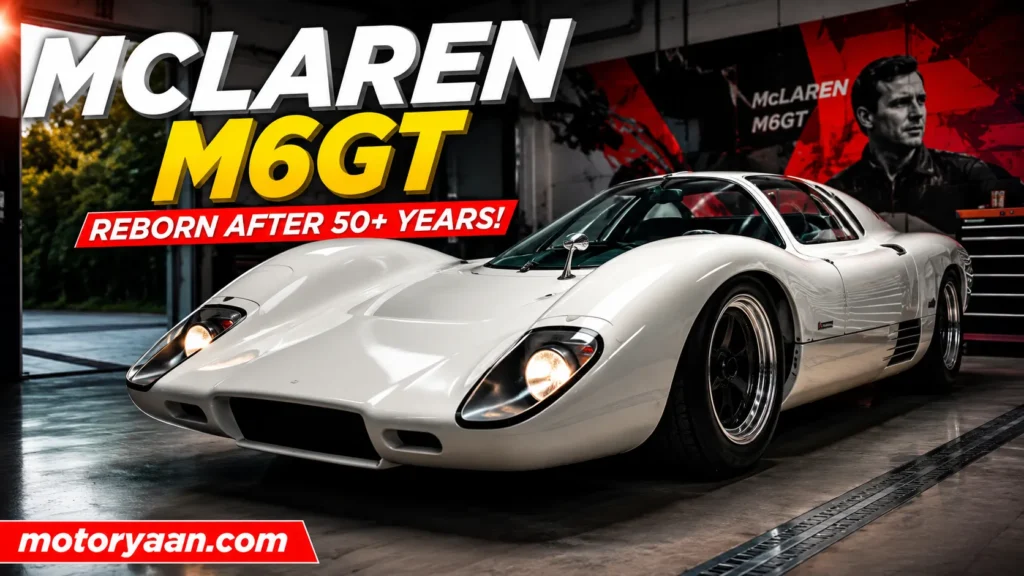
McLaren has brought one of its most important unfinished projects back to life. The company has faithfully rebuilt the legendary McLaren M6GT, the road going sports car that founder Bruce McLaren originally planned to build in the late 1960s.
The new car was created by McLaren Special Operations (MSO) using original body molds, restored period parts, and archive reference material. It is not a modern interpretation. Instead, McLaren says it is an authentic recreation that stays as close as possible to Bruce McLaren’s original vision.
The completed M6GT will make its public debut at the 2026 Goodwood Festival of Speed, which begins on July 9.
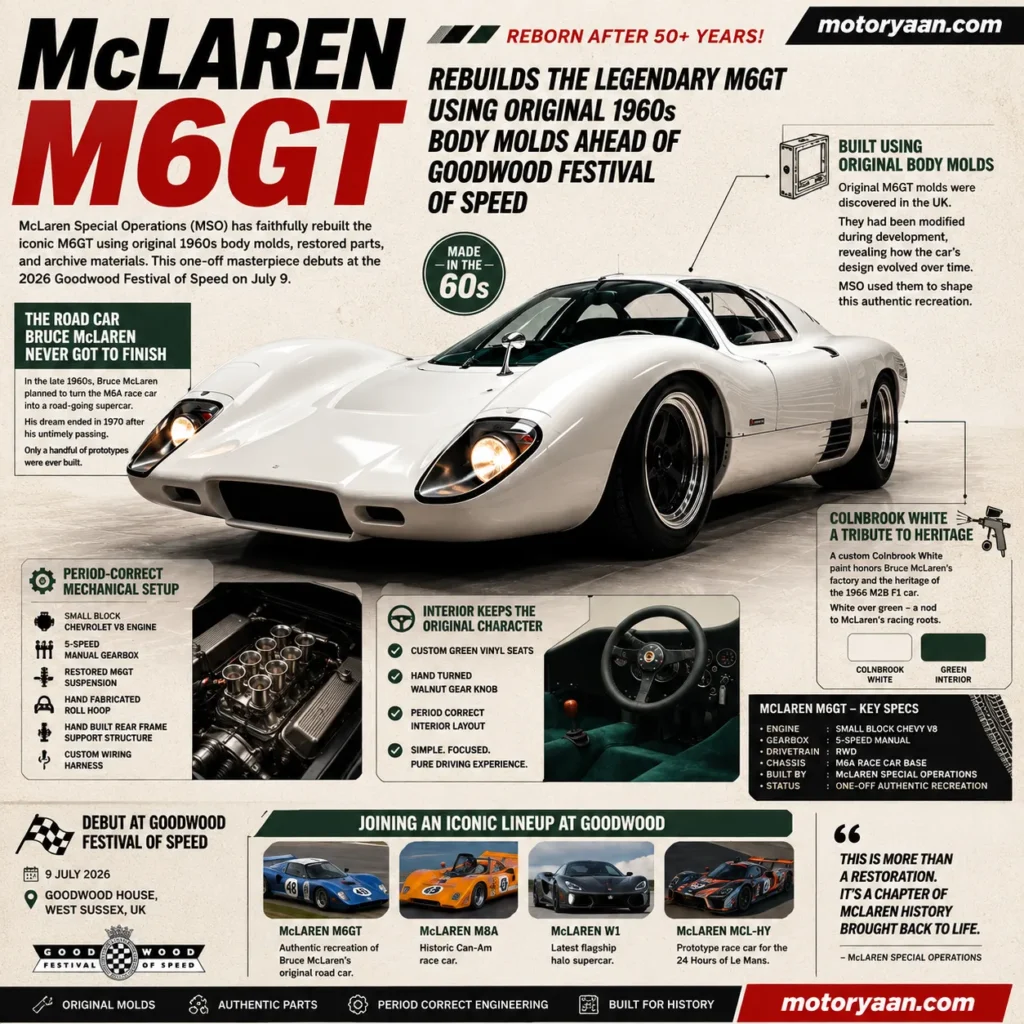
The Road Car Bruce McLaren Never Got to Finish
Many enthusiasts associate McLaren’s road car history with the famous McLaren F1, introduced in 1992. However, Bruce McLaren wanted to build a road car more than two decades earlier.
During the late 1960s, McLaren developed the M6A prototype race car and planned to transform it into a Group 4 racing machine. That project eventually led to the M6GT, which was also intended to become a road legal sports car.
Bruce McLaren partnered with British manufacturer Trojan to put the car into production. Unfortunately, those plans ended after Bruce McLaren lost his life while testing a race car in England in 1970. Only a small number of M6GT prototypes were ever completed.
Built Using Original Body Molds
One of the most interesting parts of this project is how McLaren recreated the body.
MSO began with the chassis from an original M6A race car. During development, the team discovered the original M6GT body molds in the United Kingdom.
Interestingly, those molds had already been modified during the original development program. That suggests Bruce McLaren and his team had continued refining the design before the project was cancelled.
Using those original molds allowed MSO to build bodywork that represents how the M6GT may have looked if production had actually happened.
Period Correct Mechanical Setup
McLaren kept the mechanical package faithful to the original concept.
The rebuilt M6GT features:
- Small block Chevrolet V8 engine
- Five speed manual gearbox
- Restored original M6GT suspension
- Hand fabricated roll hoop
- Hand built rear frame support structure
- Internal clam reinforcement
- Custom wiring harness
The goal throughout the project was authenticity rather than modern performance.
Interior Keeps the Original Character
The cabin also reflects Bruce McLaren’s original design philosophy.
Some standout details include:
- Custom green vinyl seats
- Hand turned walnut wood gear knob
- Period correct interior layout
- Simple driver focused design
Rather than adding modern technology, McLaren preserved the original driving experience.
Special Colnbrook White Paint
The recreated M6GT is finished in a unique Colnbrook White paint.
According to McLaren, the colour honours the factory where Bruce McLaren developed his plans for a McLaren road car. The white exterior combined with the green interior also references the colours of McLaren’s first Formula 1 car, the 1966 M2B.
The company recently celebrated the same heritage with a special Formula 1 livery during the British Grand Prix weekend.
Debut at the Goodwood Festival of Speed
Visitors at this year’s Goodwood Festival of Speed will get to see the rebuilt M6GT alongside several other important McLaren models.
The display is expected to include:
| Model | Purpose |
|---|---|
| McLaren M6GT | Authentic recreation of Bruce McLaren's original road car |
| McLaren M8A | Historic Can Am race car |
| McLaren W1 | Latest flagship halo supercar |
| McLaren MCL HY | Prototype race car developed for future 24 Hours of Le Mans competition |
The event continues to be one of the world’s biggest celebrations of performance cars, combining historic icons with the latest automotive technology.
Why This M6GT Matters
This is much more than a restoration project.
The rebuilt M6GT represents a chapter of McLaren history that never reached production. By using original body molds, restored components, period correct engineering, and historical records, McLaren has recreated one of the company’s most significant “what if” cars.
Instead of imagining what the M6GT might have become, enthusiasts can now see a version that closely follows Bruce McLaren’s original vision.
Sources & References
1. McLaren Automotive (Official)
Official history of the McLaren M6GT, Bruce McLaren’s original road car vision, specifications, and its significance in McLaren’s history.
2. Goodwood Festival of Speed (Official)
Goodwood Festival of Speed 2026
Official event website with schedules, featured cars, tickets, and the latest information about the 2026 Festival of Speed.
3. McLaren Racing (Official)
McLaren Racing at Goodwood Festival of Speed 2026
Official announcement covering McLaren’s participation at the 2026 Goodwood Festival of Speed and its heritage display.
4. Car and Driver
McLaren Rebuilds the Original M6GT Story
Detailed report explaining how McLaren Special Operations rebuilt the M6GT using original body molds, restored parts, and period correct engineering.
5. McLaren Automotive (Homepage)
Official McLaren Automotive website featuring current models, heritage cars, and company news.