

Marathon Petroleum Is Making Biodiesel From Soybeans. Here’s How It Works
Table of Contents
Diesel remains the preferred fuel for many heavy duty trucks across the United States. It offers strong torque, proven reliability, and the ability to handle demanding workloads. However, diesel fuel also comes with challenges, including higher prices than gasoline and higher emissions.
To address those concerns, Marathon Petroleum Corporation has been investing in biodiesel production using soybean oil. The company believes renewable diesel alternatives can help reduce petroleum use while supporting cleaner transportation.
Marathon Petroleum And ADM Partnership
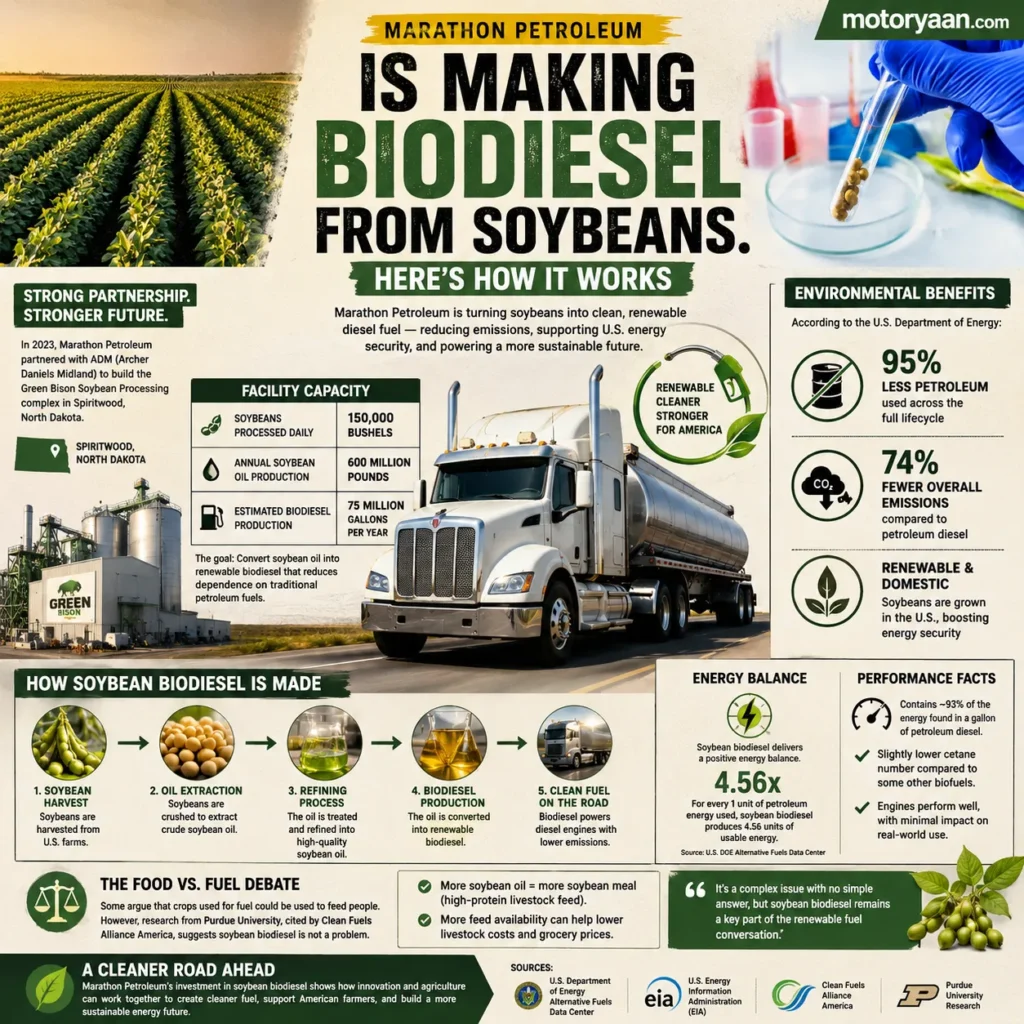
The company’s biodiesel efforts gained significant momentum in 2023 when Marathon Petroleum partnered with ADM, formerly known as Archer Daniels Midland.
Together, the two companies developed the Green Bison Soybean Processing complex in Spiritwood, North Dakota.
The facility has impressive production capabilities:
| Facility Details | Capacity |
|---|---|
| Soybeans processed daily | 150,000 bushels |
| Annual soybean oil production | 600 million pounds |
| Estimated biodiesel production | 75 million gallons per year |
The goal is simple. Convert soybean oil into renewable biodiesel that can be used in diesel engines while reducing dependence on traditional petroleum fuels.
Why Soybeans Are Being Used For Biodiesel
Soybeans are already one of the most important biofuel feedstocks in the United States. According to the U.S. Department of Energy’s Alternative Fuels Data Center, soybean based biodiesel delivers a positive energy balance.
For every unit of petroleum energy used during production, the resulting soybean biodiesel generates approximately 4.56 units of usable energy.
That means the fuel creates considerably more energy than the fossil fuel energy required to produce it.
Corn remains the largest biofuel feedstock in the U.S., but soybeans rank second and continue to play a major role in renewable fuel production.
Environmental Benefits Of Soybean Biodiesel
One of the biggest selling points of soybean biodiesel is its lower environmental impact compared with conventional diesel.
According to data cited by the Department of Energy:
- Vehicles running on pure soybean biodiesel use about 95% less petroleum across their lifecycle.
- Overall emissions can be reduced by approximately 74% compared with petroleum diesel.
- Soybeans are renewable and can be grown domestically, helping improve U.S. energy security.
These advantages explain why renewable fuels continue to receive attention from both industry and policymakers.
Does Soybean Biodiesel Affect Performance?
The short answer is yes, but not dramatically.
Soybean biodiesel contains slightly less energy than traditional diesel fuel.
A gallon of soybean biodiesel provides roughly 93% of the energy content found in a gallon of petroleum diesel.
In real world terms, engines can still perform effectively, but there may be a small reduction in fuel economy compared with standard diesel.
The U.S. Energy Information Administration also notes that soybean oil has a relatively low cetane number compared with other biofuel sources.
Cetane number measures how easily and predictably a diesel fuel ignites in a compression ignition engine. Higher cetane values generally contribute to smoother combustion, better performance, and lower emissions.
While soybean biodiesel remains a viable fuel option, other biofuel feedstocks may offer additional performance advantages in this area.
The Food Versus Fuel Debate
One criticism often raised against biofuels is that agricultural land used to grow fuel crops could instead be used to produce food.
Critics argue that increasing biofuel production may place pressure on food supplies and contribute to higher food prices.
However, the Clean Fuels Alliance America points to research from Purdue University suggesting soybean biodiesel does not necessarily create that problem.
According to the organization, producing more soybean oil for fuel also results in greater production of soybean meal, which is commonly used as livestock feed. Increased feed availability can help reduce feeding costs for farmers and potentially support lower food costs.
As with many topics involving agriculture and energy, opinions differ. The debate continues, but soybean biodiesel remains an important part of the renewable fuel conversation.
Final Thoughts
Marathon Petroleum’s investment in soybean biodiesel highlights how traditional energy companies are exploring alternative fuel sources alongside conventional petroleum products.
The Green Bison facility in North Dakota demonstrates the scale at which renewable fuels can now be produced. Soybean biodiesel offers meaningful reductions in petroleum use and emissions while remaining compatible with diesel engines.
It is not a perfect solution. Energy density is slightly lower than conventional diesel, and questions around long term feedstock availability remain. Still, soybean biodiesel represents one of the most established renewable diesel alternatives currently available in the United States.
Sources and References
1. U.S. Department of Energy (Alternative Fuels Data Center)
Alternative Fuels Data Center Biodiesel Benefits
Official U.S. government resource explaining biodiesel benefits, emissions reductions, and the 4.56:1 energy balance of soybean biodiesel.
2. U.S. Department of Energy Biodiesel Basics
Official guide covering what biodiesel is, how it is made, and how it differs from conventional diesel.
3. U.S. Energy Information Administration (EIA)
EIA Biodiesel and Renewable Diesel Explained
Official U.S. government source explaining biodiesel feedstocks, production methods, and fuel characteristics.
4. Green Bison Soy Processing (Official Website)
Official website of the Spiritwood, North Dakota soybean processing facility jointly owned by ADM and Marathon Petroleum. Includes production capacity and project details.
5. Green Bison Facility Information
Official facility information, location details, and processing operations overview.
6. North Dakota Governor’s Office
Green Bison Ribbon Cutting Announcement
Official government announcement covering the Green Bison facility, soybean processing capacity, and renewable diesel feedstock production.
7. DOE Fuel Properties Comparison
Alternative Fuel Properties Comparison
Official fuel comparison chart showing biodiesel energy content, diesel equivalency, and fuel characteristics.
8. DOE Biodiesel Production Process
Explains the transesterification process used to convert vegetable oils, including soybean oil, into biodiesel.
Frequently Asked Questions
What is Marathon Petroleum doing with soybeans?
Marathon Petroleum is using soybean oil to produce biodiesel through its partnership with ADM. The companies operate the Green Bison Soybean Processing facility in Spiritwood, North Dakota, which supplies soybean oil for renewable fuel production.
What is the Green Bison Soybean Processing facility?
The Green Bison facility is a large soybean processing complex located in Spiritwood, North Dakota. It can process 150,000 bushels of soybeans per day and produce about 600 million pounds of soybean oil annually.
How much biodiesel can be produced from the Green Bison facility?
The soybean oil produced at the facility is enough to support the production of approximately 75 million gallons of biodiesel every year.
Why are soybeans used to make biodiesel?
Soybeans are one of the leading biofuel feedstocks in the United States. They provide a positive energy balance and can be grown domestically, making them a renewable source for fuel production.
What is the energy balance of soybean biodiesel?
According to the U.S. Department of Energy's Alternative Fuels Data Center, every unit of petroleum energy used in soybean biodiesel production can generate about 4.56 units of usable energy from the final fuel.
Does soybean biodiesel reduce emissions?
Yes. Studies cited by the Department of Energy show that pure soybean biodiesel can reduce overall lifecycle emissions by approximately 74% compared with conventional petroleum diesel.
How much petroleum can soybean biodiesel replace?
Vehicles operating on pure soybean biodiesel can reduce petroleum use by roughly 95% across their full fuel lifecycle.
Does soybean biodiesel affect vehicle performance?
Soybean biodiesel contains slightly less energy than conventional diesel. A gallon provides about 93% of the energy content of a gallon of petroleum diesel, so fuel economy may be slightly lower in some situations.
What is a cetane number and why does it matter?
Cetane number measures how easily diesel fuel ignites in a compression ignition engine. Higher cetane values generally help improve combustion quality, engine performance, and emissions.
Does biodiesel production from soybeans create food supply concerns?
The topic remains debated. Research cited by the Clean Fuels Alliance America suggests that increased soybean oil production also creates more soybean meal for livestock feed, which can help support agricultural supply chains.