Why Lotus Used Toyota Engines and How the Partnership Changed the Brand Forever
Table of Contents
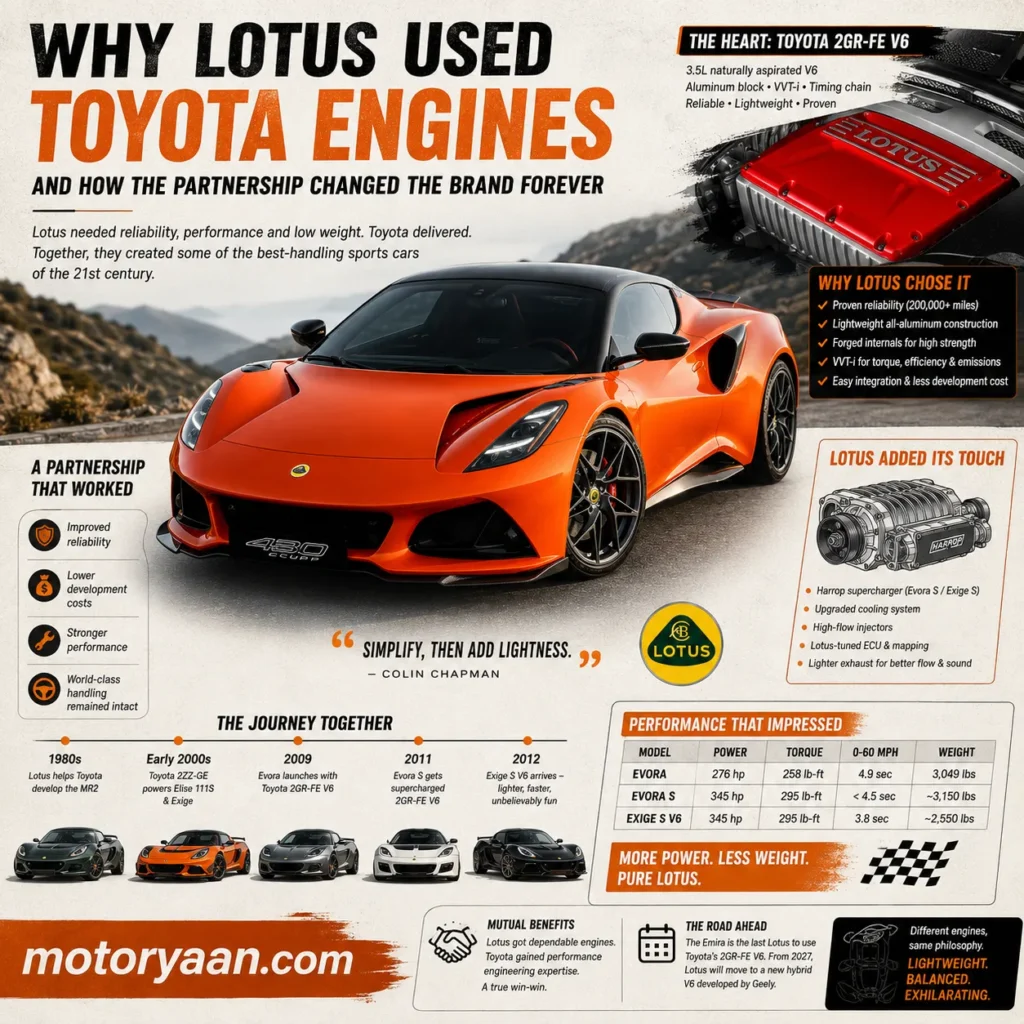
For decades, Lotus built its reputation around one simple idea. Keep the car as light as possible and make it handle better than anything else. The company’s founder, Colin Chapman, famously believed in the philosophy of “simplify, then add lightness.” That approach helped Lotus build some of the best handling sports cars ever made.
However, by the early 2000s, the automotive world had changed. Buyers wanted exciting performance, but they also expected reliability. That is when Lotus made one of the most important decisions in its history by partnering with Toyota.
Lotus Needed More Than Great Handling
The Lotus Elise became one of the company’s most important models. In many ways, its success helped secure Lotus’ future.
To keep costs low, Lotus used the Rover K Series engine. The company focused most of its budget on developing an outstanding chassis instead of designing a new engine from scratch. The strategy worked because the Elise quickly earned worldwide praise for its lightweight design and incredible handling.
However, there was one major problem.
The Rover K Series engine developed a reputation for head gasket failures. Lotus already had a history of reliability concerns, and using an engine known for mechanical issues did little to improve customer confidence.
As reliability became increasingly important during the 2000s, Lotus needed a better solution.
Toyota Became the Perfect Partner
Lotus already had experience working with Toyota. During the 1980s, the British manufacturer contributed to the development of Toyota’s MR2 sports car.
That relationship eventually led to another partnership.
Lotus first adopted Toyota’s 2ZZ GE four cylinder engine for the Elise 111S before expanding it across the Elise lineup and the track focused Exige.
The benefits were immediate:
| Specification | Details |
|---|---|
| Recommended age | 2 to 5 years |
| Minimum leg length | 13.7 inches (35 cm) |
| Recommended maximum rider weight | 66.1 pounds (30 kg) |
| Absolute maximum weight | 77.1 pounds (35 kg) |
The success of the four cylinder partnership encouraged Lotus to continue working with Toyota on future models.
The Evora Needed More Power and Refinement
Towards the end of the 2000s, Lotus wanted something different.
Instead of another lightweight track focused sports car, the company planned a more refined grand touring model called the Evora. It would offer:
- Better cabin comfort
- Everyday usability
- More refinement
- Stronger straight line performance
- Classic Lotus handling
To achieve those goals, Lotus once again turned to Toyota.
The company selected Toyota’s 3.5 litre 2GR FE V6, an engine already used in models such as the Toyota Avalon, Camry and RAV4.
Why Lotus Chose the Toyota 2GR FE V6
The 2GR FE checked almost every box Lotus needed.
Excellent reliability
The engine had already proven itself in millions of Toyota vehicles around the world. It was designed for long service life with regular maintenance.
Many well maintained examples have exceeded 200,000 miles.
Lightweight construction
Lotus has always placed huge importance on keeping vehicle weight low.
The 2GR FE featured:
- Aluminum engine block
- Aluminum cylinder heads
- Lightweight internal components
This helped keep the Evora lighter than many rival sports cars.
Strong internal components
The engine featured durable forged components, including:
- Forged crankshaft
- Strong connecting rods
These parts gave Lotus enough strength to safely increase performance later.
Modern technology
Toyota also equipped the engine with:
- VVT i variable valve timing
- Timing chain instead of timing belt
- Efficient combustion design
These technologies improved torque, fuel efficiency and long term durability.
Lotus Added Its Own Character
Using a Toyota engine did not mean Lotus simply installed it without changes.
The company carried out several modifications to suit its own driving philosophy.
For the standard Evora, Lotus introduced:
- A lighter aluminum exhaust system
- Improved exhaust airflow
- A unique engine sound
- A bespoke ECU calibration
Although the core engine remained largely unchanged, these updates gave the Evora its own personality.
The Supercharged Evora S Raised the Stakes
In 2011, Lotus launched the Evora S.
The biggest upgrade was the addition of a Harrop supercharger, producing approximately 3.5 psi of boost.
To support the extra performance, Lotus also upgraded:
- Cooling system
- Fuel injectors
- Engine calibration
- ECU software
These improvements allowed the engine to deliver significantly more performance while maintaining smooth power delivery.
Performance Comparison
| Model | Engine | Power | Torque | 0 to 60 mph |
|---|---|---|---|---|
| Lotus Evora | 3.5 litre Toyota 2GR FE V6 | 276 hp | 258 lb ft | 4.9 seconds |
| Lotus Evora S | Supercharged 2GR FE V6 | 345 hp | 295 lb ft | Under 4.5 seconds |
| Lotus Exige S V6 | Supercharged 2GR FE V6 | 345 hp | 295 lb ft | Around 3.8 seconds |
The lighter Exige benefited even more from the V6. With roughly 600 pounds less weight than the Evora S, it became one of the quickest and most exciting Lotus models ever produced.
The Partnership Helped Lotus Rebuild Its Reputation
Toyota engines did more than improve performance.
They helped Lotus move away from its earlier reputation for unreliable sports cars.
The partnership provided several long term advantages.
- Better durability
- Lower engineering costs
- Faster product development
- Proven mechanical reliability
- Higher customer confidence
For a relatively small manufacturer, using Toyota’s dependable engines allowed Lotus to compete with much larger performance brands without investing billions into developing completely new powertrains.
Toyota Also Benefited
The partnership was not one sided.
Lotus has decades of experience building lightweight performance cars with exceptional handling characteristics.
Toyota gained valuable engineering knowledge from Lotus over the years, particularly in chassis tuning and suspension development.
One example is the Yaris GRMN, which benefited from Lotus engineering input during its development.
Toyota’s growing reputation for enjoyable performance models under its Gazoo Racing division has also reflected lessons learned through collaborations with Lotus.
The Toyota Engine Era Is Coming to an End
The Lotus and Toyota partnership has lasted for nearly two decades, but it is approaching its conclusion.
The current Lotus Emira continues to use the supercharged Toyota 2GR FE V6, but Lotus is expected to replace it with a new hybrid V6 powertrain developed by parent company Geely from 2027.
With the Elise and Exige already discontinued, the Emira represents the final chapter of Toyota powered Lotus sports cars.
Final Thoughts
The decision to use Toyota engines proved to be one of the smartest moves Lotus ever made. It allowed the company to focus on what it does best, building lightweight sports cars with exceptional handling, while relying on Toyota for proven and dependable powertrains.
From the Elise and Exige to the Evora and Emira, Toyota engines helped Lotus improve reliability without losing the driving experience that made the brand famous. Even as the partnership comes to an end, its impact on modern Lotus models will remain one of the most important chapters in the company’s history.
Sources & References
Official Sources
1. Lotus Cars (Official)
- https://www.lotuscars.com
- Official website for Lotus. Covers vehicle specifications, company history, engineering, and latest news.
2. Lotus Media Site (Official Press)
- https://media.lotuscars.com
- Official press releases, technical specifications, media kits, and product announcements.
3. Toyota Global
- https://global.toyota
- Toyota’s official global corporate website with information about engine technology and company history.
4. Toyota USA
- https://www.toyota.com
- Official Toyota USA website with model information and technical details for US-market vehicles.
Trusted Automotive References
5. MotorTrend
- https://www.motortrend.com
- One of America’s leading automotive publications with road tests, reviews, and technical articles.
6. Car and Driver
- https://www.caranddriver.com
- Trusted US automotive magazine known for performance testing and technical reviews.
7. Road & Track
- https://www.roadandtrack.com
- Covers sports cars, engineering, motorsports, and performance vehicle history.
8. Hagerty Media
- https://www.hagerty.com/media
- Excellent source for automotive history, classic sports cars, and engineering stories.
9. Top Gear
- https://www.topgear.com/car-news
- International automotive publication covering performance cars and manufacturer news.
10. Auto Express
- https://www.autoexpress.co.uk
- Well-known UK automotive publication with detailed technical features and reviews.
Technical References
11. Toyota Global Newsroom
- https://global.toyota/en/newsroom
- Official Toyota newsroom with engineering announcements and powertrain developments.
12. SAE International
- https://www.sae.org
- Industry standard source for automotive engineering papers and technical research.