Renault E Space Concept Wants to Make Minivans Cool Again
Table of Contents
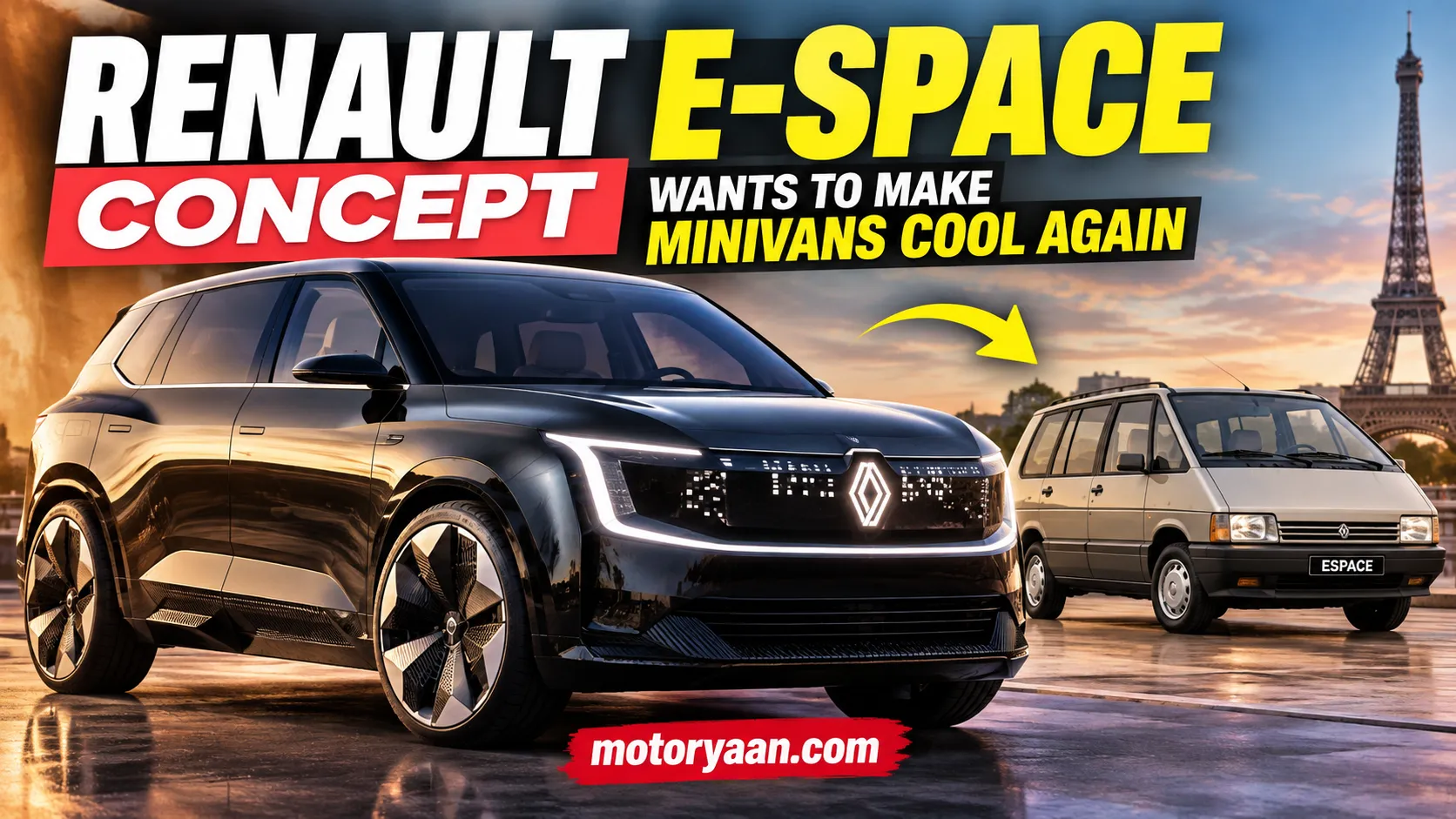
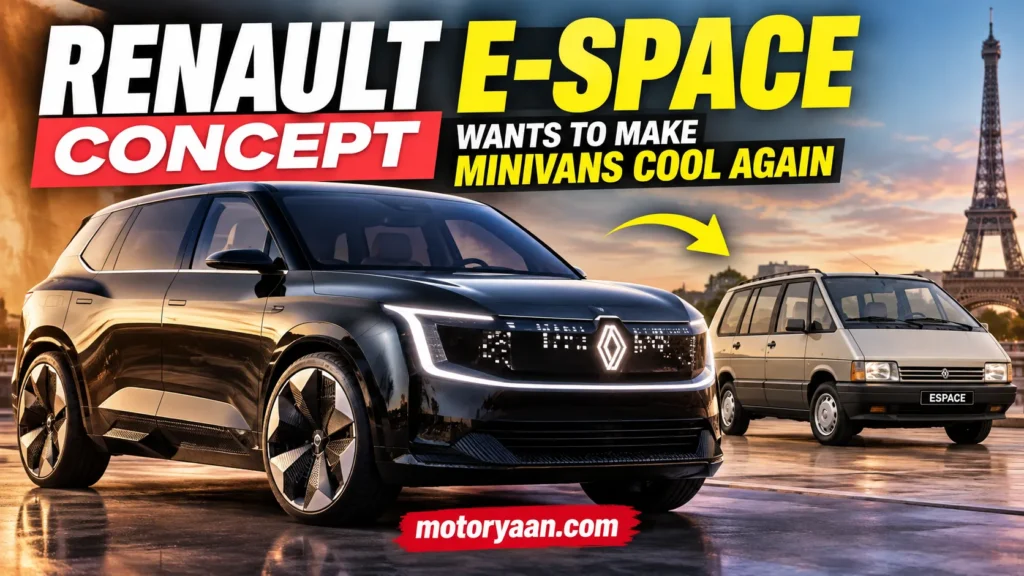
Renault is going back to one of the most important names in its history. The company will unveil the new Renault E Space Concept at the 2026 Paris Motor Show, bringing back the idea behind the original Espace in a completely new electric form.
The original Renault Espace helped pioneer the European minivan market when it arrived in 1984. More than 40 years later, Renault is asking a fairly interesting question: can the minivan become desirable again?
The answer will start taking shape on October 12, when the Renault E Space Concept makes its world premiere in Paris. Renault says the concept reinterprets its “voitures à vivre”, or “cars for living”, philosophy for the electric era.
Renault E Space Concept Brings Back the Original Espace Idea
The timing is almost funny.
Renault still sells an Espace today, but the sixth generation is no longer the traditional boxy minivan that made the name famous. The current Espace is a five or seven seat SUV, with Renault itself describing it as a new SUV generation.
The E Space Concept goes in a different direction.
Renault says it is inspired by the spirit of the original Espace while looking towards the future of electric family mobility. The name itself combines the “E” from Renault’s E Tech electrification branding with “Space”, a reference to the generous and practical character associated with Espace.
So, in simple terms, Renault is taking the old Espace idea and asking what it could look like as an electric family car in 2026.
The Original Renault Espace Was a Big Deal
The first Espace arrived in 1984 and quickly became one of the defining European people carriers.
It was developed with Matra and offered something that was still unusual for a family car at the time: a large, airy passenger compartment without requiring the footprint of a much larger vehicle.
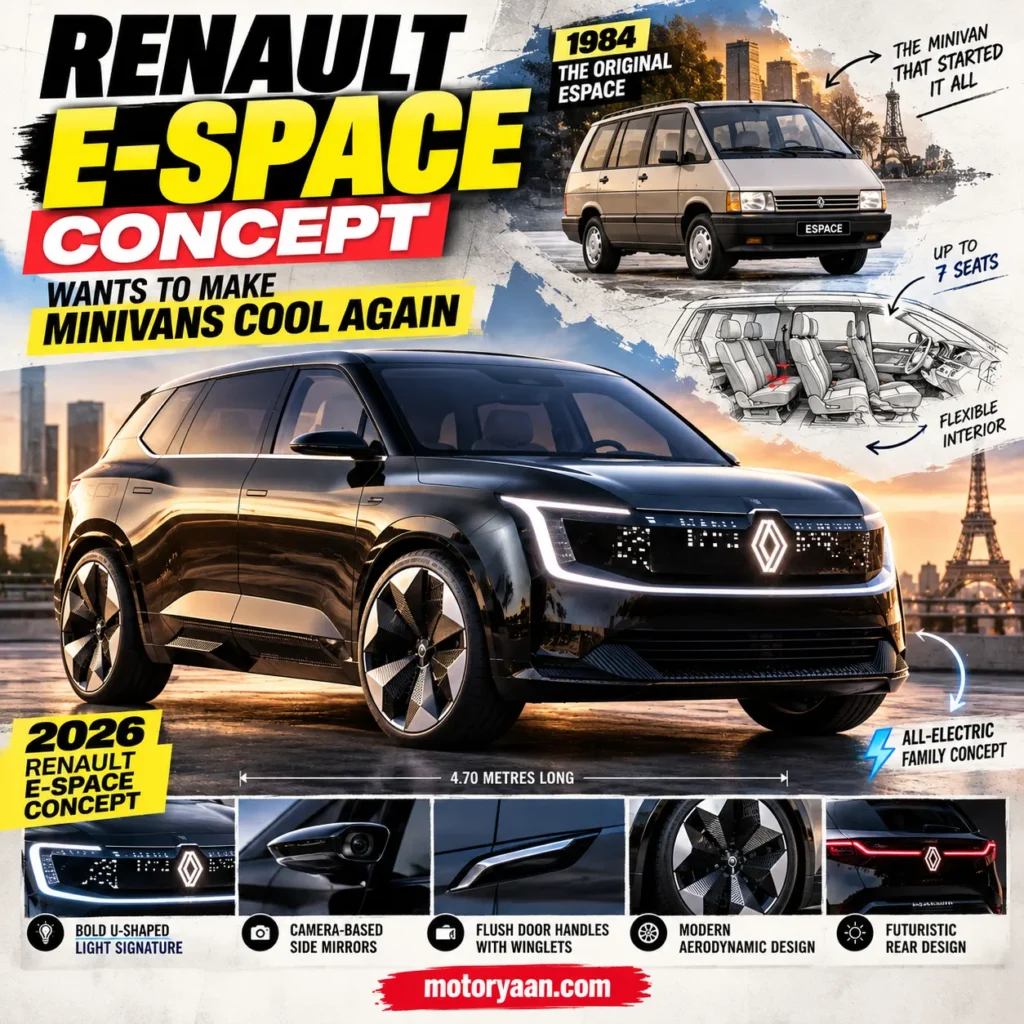
The original formula focused heavily on space and flexibility. It could accommodate up to seven passengers, while its seats could be removed or rearranged to change the interior according to the owner’s needs.
Even the front seats could swivel, helping turn the cabin into something closer to a small lounge on wheels.
That was the whole point of Espace. It wasn’t trying to be a normal hatchback with more seats. It treated the interior as the main event.
Renault’s own historical material describes the Espace as a pioneer of its segment. The company says the model became an iconic name after being continuously reinvented through five generations. By 2019, Renault said more than 1.3 million Espace models had been sold since 1984.
Renault Espace Took Time to Catch On
The original Espace wasn’t an instant success.
According to the historical account supplied with the concept story, Renault sold only nine examples during the first month in France. The unusual shape probably didn’t help.
At the time, European buyers were much more familiar with hatchbacks, sedans and wagons. The Espace looked different from all of them.
But eventually, buyers understood the idea.
Other manufacturers followed Renault into the growing MPV market, and the minivan became an important part of the European family car market.
That makes the Espace interesting for another reason. It wasn’t simply another model entering an established category. It helped create the category in the first place.
Then SUVs Took Over
The irony is that the same segment Renault helped build eventually lost much of its popularity.
MPVs were extremely practical. They offered lots of interior space, flexible seating, good visibility and useful family friendly packaging.
But SUVs won the image battle.
They offered a higher driving position, a tougher looking design and the feeling of greater road presence, while still providing enough practicality for most families.
Renault eventually followed the same trend with the sixth generation Espace. The current model has a clear SUV design and is offered with five or seven seats. Renault says it remains focused on space and long distance family travel, but the body style has changed significantly from the original minivan.
The E Space Concept is therefore an interesting return to the basic idea that started everything.
Renault E Space Concept Design Looks Back to 1984
The new concept clearly takes inspiration from the first Espace.
Its shape uses a boxier, more upright approach than a conventional SUV, while the proportions and glasshouse appear designed around the same basic idea of making the interior feel large and open.
Renault has also mixed the retro influence with plenty of modern concept car details.
Some of the key design elements include:
A modern interpretation of the original Espace shape
A broad U shaped light signature at the front and rear
An illuminated Renault diamond logo
A futuristic front end
Camera based side mirrors
A clean side profile
Modern aerodynamic details
A concept car style approach to the door handles and body surfaces
Renault’s latest information confirms that the concept measures 4.70 metres in length and uses a distinctive Black Rubé exterior colour. The front and rear both feature wide U shaped light strips, while the illuminated Renault diamond appears to float within a pixel inspired design.
The overall length is also interesting because the current Espace measures around 4.72 metres in the French market.
So despite looking like a very different type of vehicle, the E Space Concept occupies roughly the same length category as the current Espace SUV.
Electric Power Is the Big Change
The “E” in E Space is not just there for decoration.
Renault has confirmed that the concept represents its vision of family mobility in the electric era. The company uses the E Tech name for its electrification technology, and the E Space name directly connects that electric identity with the Espace name.
Renault has not released a full production specification sheet for the concept.
That means there is currently no confirmed information about battery capacity, electric range, motor output or charging performance that should be treated as production specifications.
And that distinction matters. This is a concept car, not a production vehicle.
Renault itself warns that the design, specifications, features, name and branding shown on the concept may differ from a final production vehicle.
Could the Renault E Space Become a Production Car?
This is the big question.
Renault has not confirmed that the E Space Concept will directly become a production model.
For now, it is a design and technology statement showing how the company sees the future of family mobility.
That doesn’t make it irrelevant, though.
Renault has already shown that it is willing to revisit historic names and ideas for the electric era. The company is using the 2026 Paris Motor Show to showcase a mix of electric and hybrid models alongside several concept cars. The E Space Concept will be one of the main Renault concepts making its world premiere at the event.
If Renault eventually puts something similar into production, the Volkswagen ID Buzz would be an obvious reference point in the modern electric people mover conversation.
But for now, Renault isn’t saying exactly where the E Space Concept is going.
Renault E Space Concept vs Original Espace
| Feature | Original Renault Espace | Renault E Space Concept |
|---|---|---|
| Launch era | 1984 | 2026 |
| Vehicle idea | Family MPV | Electric family concept |
| Design approach | Boxy and highly practical | Retro inspired futuristic design |
| Seating concept | Up to 7 seats | Not fully confirmed |
| Powertrain | Conventional combustion engines | Electric concept |
| Length | Compact for its space | 4.70 metres |
| Main focus | Space and flexibility | Electric family mobility |
| Production status | Production model | Concept vehicle |
The comparison shows how much the basic idea has changed while the name remains familiar.
The original Espace used clever packaging to create more usable space. The E Space Concept appears to be exploring how that same philosophy could work in an electric vehicle.
Why the E Space Concept Matters
The interesting part isn’t simply that Renault has designed another electric concept.
The more important question is whether the family car needs to look like an SUV at all.
The original Espace proved that buyers could be convinced to choose a vehicle based heavily on interior space, flexibility and practicality. SUVs later made those same qualities fashionable in a different package.
Renault now appears to be testing whether a modern electric people carrier can offer those advantages while also looking desirable.
That is a harder job than simply making a practical vehicle.
Families already have plenty of practical choices. The challenge is making people actually want the practical one.
Renault E Space Concept Debuts October 12
The Renault E Space Concept will make its world premiere at the 2026 Paris Motor Show on October 12.
The Paris show runs from October 12 to October 18, 2026, with Renault presenting the E Space Concept alongside other new models and concept vehicles.
For now, Renault is keeping the most important technical details under wraps.
We don’t know whether the concept will directly lead to a production E Space, how much of its design will survive, or what electric powertrain it could eventually use.
But the message is clear enough.
Renault is looking back at the vehicle that helped create Europe’s minivan market and asking whether that original idea can work again in the electric age.
And if Renault really wants to make minivans cool again, bringing back an Espace that doesn’t look like a traditional family bus is probably a sensible place to start.
As for an Espace F1 comeback, that’s a different story. The original Espace F1 became one of Renault’s most outrageous concept cars, and the idea of another one still sounds like the sort of automotive madness nobody would complain about
Sources & References
Official Renault Sources
Renault Global Media: E Space Concept
Renault E Space Concept official announcement
Official Renault source covering the concept, 4.70 metre length, design, electric family mobility theme and October 12 debut.Renault Global Media: All New Espace
Renault Espace sixth generation official information
Useful for explaining how the current Espace moved toward a 5 or 7 seat SUV format.Renault Global Media: Espace History
Renault Espace historical background
Helpful background source for the Espace nameplate and its evolution over the years.
Automotive Sources
Motor1
Motor1 automotive coverage
Useful independent automotive reporting and a good source for additional context around Renault’s concept cars.Car and Driver
Car and Driver
Strong US focused automotive publication, useful for reaching your primary American audience.MotorTrend
MotorTrend
Major US automotive publication covering new vehicles, concepts and industry developments.The Drive
The Drive
Useful independent US automotive source, particularly for concept cars and enthusiast focused coverage.Autocar
Autocar
Established automotive publication with strong European and international coverage, useful for Renault’s European history.
Renault E Space Concept FAQ
Here are the key questions about Renault's new electric E Space Concept and its connection to the original Espace.
What is the Renault E Space Concept?
The Renault E Space Concept is an electric family vehicle concept inspired by the original Renault Espace. It explores how the Espace idea of space, flexibility and family mobility could be reinterpreted for the electric era.
When will the Renault E Space Concept be unveiled?
Renault will unveil the E Space Concept at the 2026 Paris Motor Show on October 12, 2026. The concept is scheduled to make its world premiere at the event.
Is the Renault E Space Concept an electric vehicle?
Yes. The E Space Concept represents Renault's vision of family mobility in the electric era. However, Renault has not released a complete production specification sheet covering the battery, range, motor output or charging performance.
How long is the Renault E Space Concept?
The Renault E Space Concept measures 4.70 metres in length. That puts it close in size to the current Renault Espace SUV, which measures around 4.72 metres in the French market.
Is the Renault E Space Concept a minivan?
The concept revisits the minivan and MPV philosophy associated with the original Espace, but it is currently a concept vehicle rather than a confirmed production minivan. Renault has not confirmed its final production body style.
What inspired the design of the Renault E Space Concept?
The design takes inspiration from the original Renault Espace launched in 1984. It combines a boxier and more upright shape with modern concept car details, including U shaped light signatures, an illuminated Renault diamond and camera based side mirrors.
What was special about the original Renault Espace?
The original Espace focused on interior space and flexibility. It could accommodate up to seven passengers, while its seats could be removed or rearranged. The front seats could also swivel, giving the cabin a more lounge like layout.
When was the first Renault Espace launched?
The first Renault Espace was launched in 1984. It was developed with Matra and helped pioneer the European MPV and minivan segment.
How many seats did the original Renault Espace have?
The original Renault Espace could accommodate up to seven passengers. Its flexible seating arrangement allowed the interior to be changed depending on how the vehicle was being used.
Is the current Renault Espace still a minivan?
No. The sixth generation Renault Espace moved away from the traditional minivan shape and became an SUV. The current model is available with five or seven seats.
Will the Renault E Space Concept become a production car?
Renault has not confirmed that the E Space Concept will become a production model. For now, it is a concept showing the company's ideas about future electric family mobility.
What electric specifications does the Renault E Space Concept have?
Renault has not yet confirmed production level specifications such as battery capacity, electric range, motor output or charging performance. It is important not to treat unconfirmed figures as final specifications.
Why is Renault bringing back the Espace idea?
Renault is revisiting the Espace philosophy because the original model was built around interior space, flexible seating and family practicality. The E Space Concept explores whether those qualities can be made desirable again in an electric vehicle.
What makes the Renault E Space Concept different from the current Espace?
The current sixth generation Espace is an SUV, while the E Space Concept goes back toward the space focused family vehicle idea associated with the original Espace. The concept also uses an electric design direction and several futuristic styling elements.
What are the main design features of the Renault E Space Concept?
Key design details include a modern interpretation of the original Espace shape, U shaped front and rear light signatures, an illuminated Renault diamond, camera based side mirrors, modern aerodynamic details and a clean futuristic body design.