2025 Jeep Wagoneer S Review
The 2025 Jeep Wagoneer S is an important model for Jeep. Oddly enough, this is not Jeep’s first electric vehicle, but it is their first EV designed specifically for the North American market and developed by the North American arm of Stellantis. It also shares a surprising amount under the skin with the new Dodge Charger electric models, even though both vehicles look very different on the outside.
The shared platform gives the Wagoneer S a modern electric personality. At the same time, it also makes clear that this EV is not fully polished yet, especially when you compare it with something like the Hyundai Ioniq 9, which is Hyundai Kia’s 14th EV for North America. Stellantis, in contrast, is only on their fourth EV for this market, even if you include both generations of the Fiat 500e.
This difference in experience is noticeable in the way the Wagoneer S feels both capable and slightly unfinished in some areas.
Trim, Range and Pricing
EPA Range (2025)
Earlier: 303 miles
Now: 294 miles for every variant
There is no official explanation for the drop in range.
Pricing
Wagoneer S Limited MSRP: 67,195 dollars
Competes with: Chevrolet Blazer EV, Ford Mustang Mach-E, Tesla Model Y
Actual transaction prices: around 45,000 to 50,000 dollars
This pricing situation creates a problem. Most customers only see the official MSRP online and assume the Wagoneer S is too expensive. They never realise that local dealers are actually selling well equipped units for about 45,000 to 50,000 dollars. That makes it competitive with the Mach-E and Blazer EV.
Battery and Performance
The electric drivetrain is modern and powerful. The battery, motor output and software all play a key role in performance.
Battery and Motor Specs
Battery: 100.5 kWh lithium ion
Usable capacity: about 97 kWh
Two identical electric motors
Combined output in Limited trim:
500 horsepower (software limited)
525 pound feet torque
Optional upgrades unlock:
600 horsepower
617 pound feet torque
Power limiting: front motor is capped at about 200 horsepower until the upgrade is purchased
Charging Speeds
AC onboard charger: 11.5 kW
DC fast charging peak: 203 kW
Average charging speed: about 140 kW
10 to 80 percent: 28 minutes
Connector: CCS (NACS coming in 2026)
You can charge at Tesla Magic Dock stations, but not at all Tesla stations yet because agreements are still being finalised.
Why the Skinny Tires?
Every Wagoneer S comes with 235/50 R20 tires, which are much narrower than the tires on a Grand Cherokee.
A few interesting comparisons:
Grand Cherokee base tire: 245 mm wide
Higher trims: 265 to 275 mm wide
Wagoneer S curb weight is much higher despite the narrower tires
The same 235/50 R20 size is used on the 3,200 pound Chevrolet Equinox
The reason for the narrow tires is simple. To achieve a competitive EV range with a heavy vehicle, Jeep uses low rolling resistance tires. Since the STLA Large platform supports ICE, hybrid and EV models, compromise was expected.
Exterior Design and Dimensions
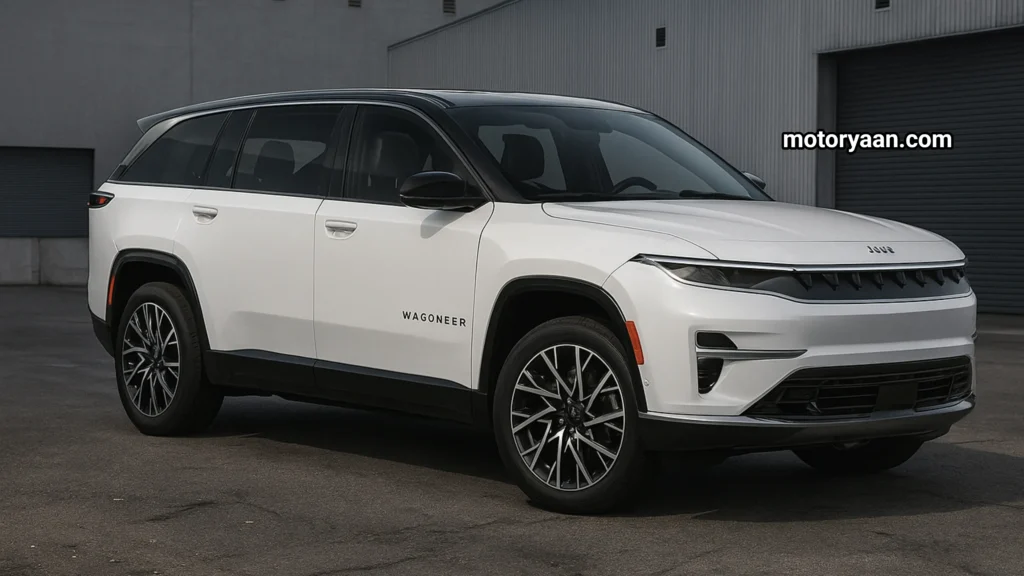
Jeep has done a very good job adapting their design language to meet EV aerodynamic needs. Since EVs do not need a traditional grille, the seven slot identity has been reinterpreted as a top lit design element at the front. At night, it creates a very distinct Jeep look.
Exterior Highlights
Slim full LED headlights
LED turn signals and LED fog lamps
Minimal cooling openings
Clean and modern nose design
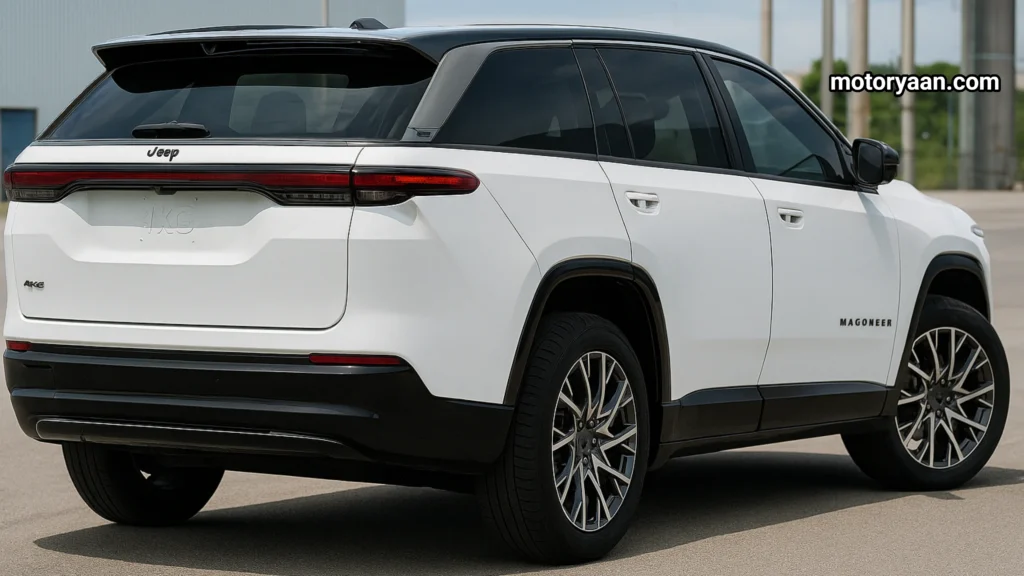
Aerodynamic rear with a very large roof spoiler and a secondary spoiler below it
Full LED tail lamps
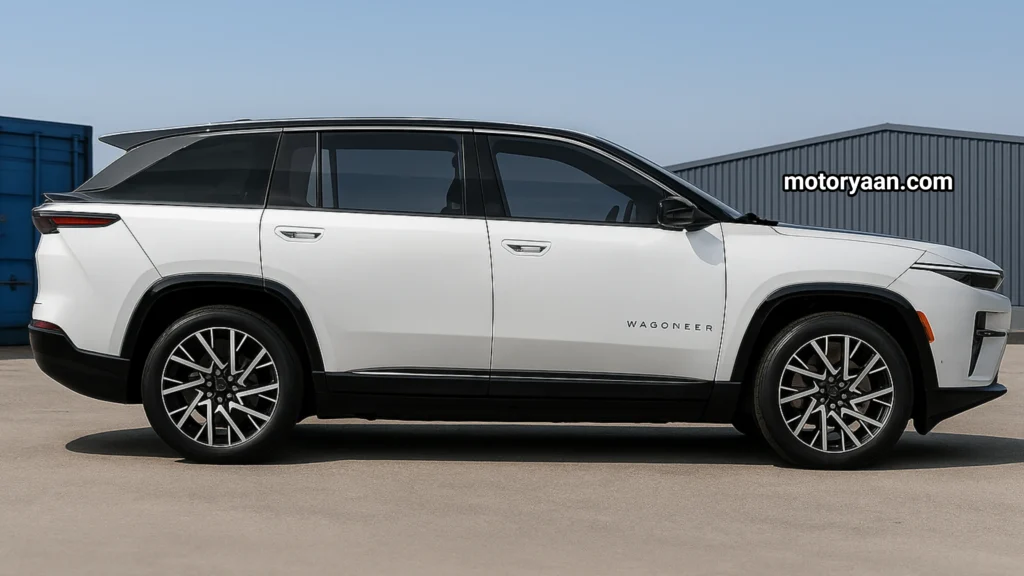
The design might suggest a Wagoneer size, but this vehicle is actually much closer to a Grand Cherokee.
Key Dimensions
Length: 192.4 inches (1 inch shorter than Grand Cherokee)
Wheelbase: 3.7 inches shorter than Grand Cherokee
Ground clearance: 6.44 inches
Curb weight: 5,667 pounds
This EV weighs 1,300 pounds more than a Grand Cherokee 4WD.
The roof drops sharply toward the rear, hidden behind the large spoiler, which improves aerodynamics but reduces the actual rear opening height.
Interior Quality and Technology
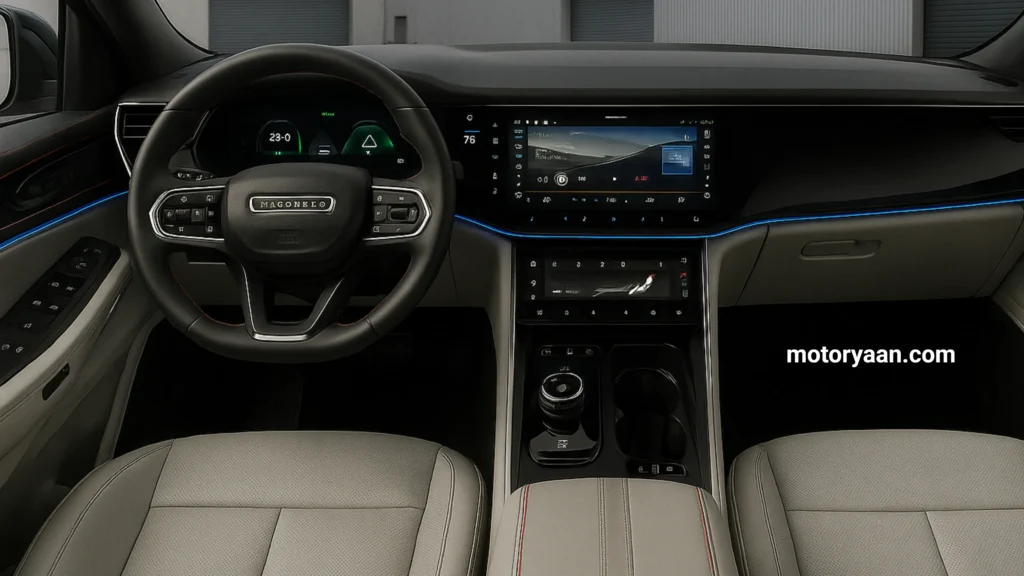
The interior is one of the strongest reasons to choose the Wagoneer S over rivals like the Mach-E or Blazer EV. Materials feel richer and more premium, with good fit and finish.
Interior Highlights
All LED interior lighting
Panoramic moonroof with powered shade
Height adjustable belts and four way headrests
Soft touch trim on most surfaces
Stitched imitation leather on doors and dashboard
Limited piano black use
Basket weave textured trim replaces glossy panels
Electronic door release plus mechanical emergency release
Infotainment and Screens
Three screen dashboard layout
Main Uconnect infotainment display with widget based pages
Passenger side screen (video capable but limited usefulness)
Digital instrument cluster with navigation view
Head up display available
Apple CarPlay and Android Auto but not full screen
Battery information is present but less detailed than some EV rivals
No battery health display
Regeneration control limited to two modes
Climate controls are touch based using an LCD panel
Useful 360 degree camera, lane keeping, autonomous parking controls
HDMI port for passenger screen
Wireless charging pad placed deep in the center console
Some functions require two steps, such as turning the vehicle off after putting it in park. The rotary shifter also makes quick three point turns slightly less convenient.
Seating, Space and Comfort
It took a little longer than usual to find a comfortable driving position. The seats themselves are supportive, but the lumbar support is only two way and positioned lower than expected. Many cheaper Jeep models offer four way lumbar adjustment, so this feels like a downgrade.
Front Seats
Heated and ventilated
Good overall comfort
Power memory steering column
Adequate adjustment range
Slightly less refined than Grand Cherokee seats
Rear Seats
Very roomy
About seven inches of legroom for a six foot tall driver
Slightly reduced headroom compared to Grand Cherokee
Center passenger hump present due to the multi purpose platform
Wide rear bench makes fitting child seats easier
Child seat belt from seatback, not the ceiling
Cargo Space and Front Trunk
Rear Cargo
30.6 cubic feet
Below Grand Cherokee but above smaller EVs
Opening height lower due to sloping roof
Hatch height is tall enough for most users
Button placed on side, easier for shorter users
Underfloor area resembles a spare tire well
Subwoofer box takes up the space where a full size spare could fit
Cargo cover uses a flip fold design that is not very user friendly
Front Trunk (Frunk)
Shallow and small
Foam divider limits usable space
Could hold larger bags if divider was removed
Electric release with no secondary latch
Driving Experience
This conclusion leads into the driving impressions. The high curb weight affects acceleration, handling, braking and ride quality. The Wagoneer S is heavy enough to outweigh a Dodge Durango with a 6.4 liter Hemi V8. At the same time, it rides on skinny tires that prioritize range. How this combination performs on the road becomes clear once you start driving.
Frequently Asked Questions – 2025 Jeep Wagoneer S
What is the 2025 Jeep Wagoneer S?
The 2025 Wagoneer S is Jeep’s first all-electric vehicle developed specifically for the North American market. It is built on a mixed-use STLA Large platform shared with other Stellantis models such as the electric Dodge Charger.
What is the EPA-rated driving range?
The EPA range for the 2025 Wagoneer S on all variants is 294 miles. Earlier versions showed 303 miles, but the drop was unexplained by Jeep.
How much does the Wagoneer S cost?
The MSRP starts at $67,195 for the Limited trim. The test vehicle, as equipped, was priced at $71,790. However, real-world transaction prices are often around $45,000–$50,000, thanks to strong dealer discounts.
What kind of battery and motor setup does the Wagoneer S use?
It uses a 100.5 kWh lithium-ion battery (about 97 kWh usable) and twin identical electric motors. In Limited trim, it produces 500 hp and 525 lb-ft of torque, or up to 600 hp and 617 lb-ft with an over-the-air software unlock.
How fast can the Wagoneer S charge?
It has an 11.5 kW onboard AC charger and supports DC fast charging up to 203 kW peak. On average, charging occurs at around 140 kW, allowing a 10–80% charge in about 28 minutes.
Why are the tires on the Wagoneer S so skinny?
Despite its heavy curb weight (5,667 lb), Jeep uses 235/50 R20 low-rolling-resistance tires to maximise highway range. The narrow tyre helps reduce energy loss, even though it compromises grip compared to wider tyres.
How is the ride quality and handling?
The ride is quite firm, especially on rough roads, due to the high curb weight and relatively low ground clearance (6.44 in). The steering feel is not very connected and you may notice body motion in corners. Braking from 60 mph takes around 138 ft, largely because of the tire choice.
How good is the interior and comfort?
The interior is well built, with soft-touch materials, stitched imitation leather, and a three-screen dashboard. Seats are heated and ventilated, though the lumbar support is only two-way and positioned low. Rear legroom is generous, but headroom is slightly compromised by the sloping roofline.
How is regenerative braking on the Wagoneer S?
There are two regen modes, but blending feels rough during braking transitions. In low-regen mode, braking can feel disconnected, similar to early hybrid systems like older Prius models. There are no steering-wheel paddles for regen, and adjusting it requires going into the touchscreen.
What are the strengths and weaknesses of the Wagoneer S?
Strengths: Bold Jeep design adapted to EV, very good performance, strong charging speed, symmetrical motors, premium interior.
Weaknesses: Lower ground clearance than expected for a Jeep, firm ride, limited regen control, software polish could be better.