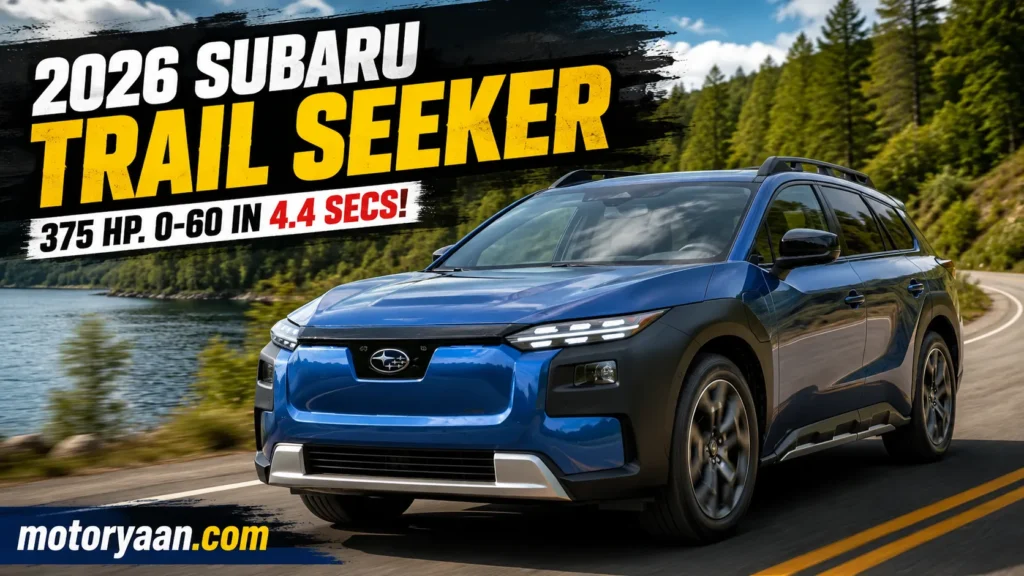
2026 Subaru Trail Seeker Review: Subaru's Fastest Production Car Yet Looks Like the Outback Many Buyers Wanted
Table of Contents
For more than three decades, the Subaru Outback has been one of the most popular lifted wagons in the market. It offered the practicality of a station wagon, standard all wheel drive, and enough ground clearance to handle rough roads without becoming a traditional SUV.
When Subaru revealed the sixth generation Outback, many longtime fans noticed a major design change. The new model adopted a more upright, SUV inspired look instead of the familiar wagon shape. While some buyers liked the new direction, others missed the classic Outback proportions.
Subaru seems to have noticed that gap. For 2026, the company has introduced an entirely new electric model called the Subaru Trail Seeker. It combines the familiar lifted wagon design with a fully electric powertrain, impressive performance, and everyday practicality.
The biggest surprise is not just its design. With 375 horsepower and a claimed 0 to 60 mph time of 4.4 seconds, the Trail Seeker is officially the most powerful production Subaru available today.
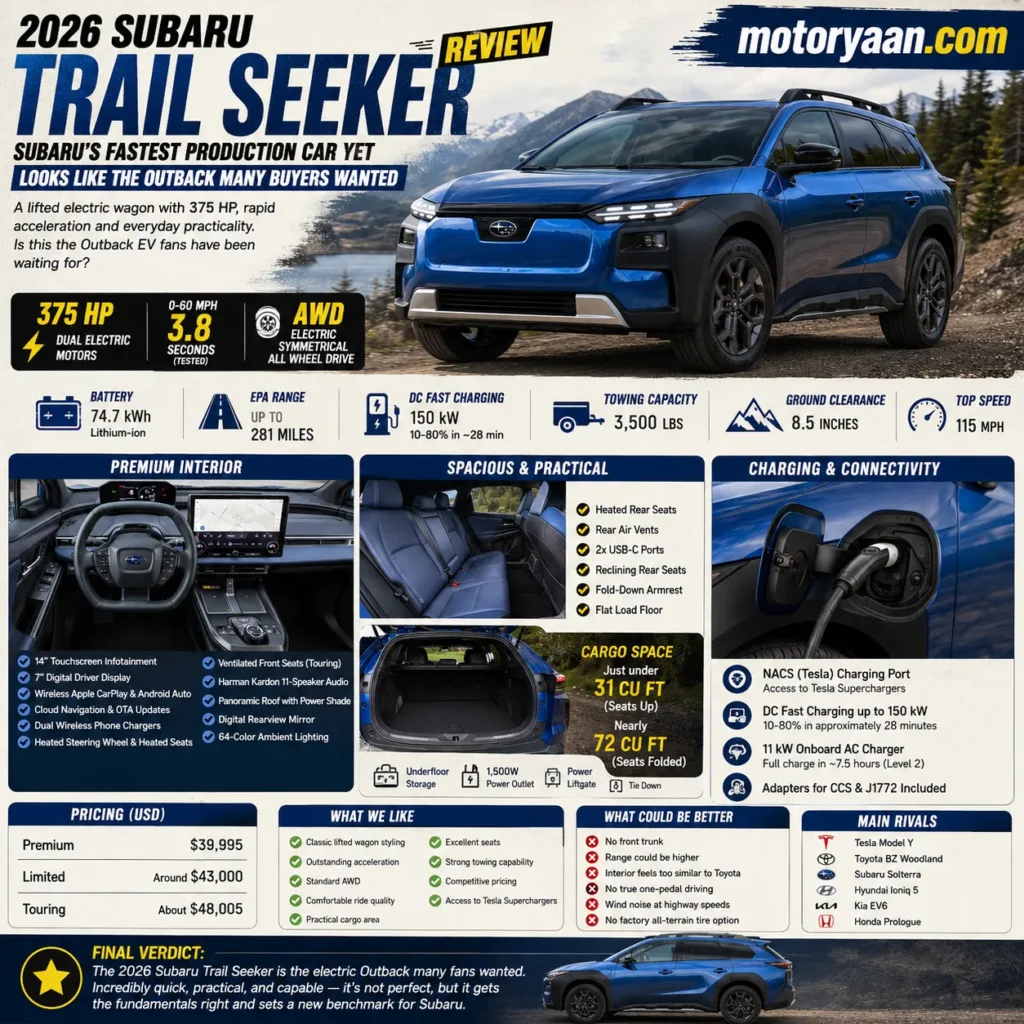
2026 Subaru Trail Seeker at a Glance
| Specification | Details |
|---|---|
| Powertrain | Dual electric motors |
| Drive System | Electric Symmetrical All Wheel Drive |
| Battery | 74.7 kWh lithium ion battery |
| Power | 375 hp |
| Torque | 396 lb ft |
| 0 to 60 mph | 4.4 seconds claimed |
| Tested 0 to 60 mph | Around 3.8 seconds |
| EPA Range | Up to 281 miles |
| Charging | NACS (Tesla style) |
| DC Fast Charging | Up to 150 kW |
| Towing Capacity | 3,500 lbs |
| Ground Clearance | 8.5 inches |
Subaru Trail Seeker Powertrain
Unlike the Outback, which still offers petrol engines, the Trail Seeker is available only as a battery electric vehicle.
Subaru has simplified the lineup by offering one battery size and one powertrain across the range. Every Trail Seeker receives:
- Dual electric motors
- Standard all wheel drive
- 74.7 kWh battery pack
- One speed reduction gear transmission
- 375 horsepower
- 396 lb ft of torque
Unlike Subaru’s traditional mechanical Symmetrical All Wheel Drive system, the Trail Seeker uses independent front and rear electric motors. There is no physical driveshaft connecting both axles, but the system continuously manages power delivery to maintain traction.
This setup makes the Trail Seeker significantly more powerful than the current Solterra while also becoming Subaru’s quickest production vehicle.
No Front Trunk Despite Being an EV
One feature many EV buyers expect today is a front trunk.
Unfortunately, the Trail Seeker does not include one.
Instead, opening the hood reveals the electric motors, cooling hardware, and electrical components. The layout is neat and well organized, but buyers looking for additional cargo storage under the hood may find this disappointing.
Considering several competitors now offer a front trunk, this feels like a missed opportunity.
Battery, Charging and Driving Range
The Trail Seeker uses a 74.7 kWh battery pack paired with Subaru’s latest electric platform.
Driving Range
Range depends on the wheel size.
| Wheel Size | Estimated Range |
|---|---|
| 18 inch wheels | Up to 281 miles |
| 20 inch wheels | Up to 274 miles |
While these numbers are competitive, many buyers now expect more than 300 miles from modern electric crossovers.
During real world driving, the vehicle delivered roughly 250 miles on a full charge in favorable weather conditions.
Charging Performance
The Trail Seeker adopts the North American Charging Standard (NACS) connector, allowing access to Tesla Superchargers without requiring major hardware changes.
Charging specifications include:
- DC fast charging up to 150 kW
- 10 to 80 percent charge in approximately 28 minutes
- 11 kW onboard AC charger
- Around 7.5 hours for a full Level 2 charge
Subaru also includes charging adapters for CCS and J1772 connectors, giving owners additional flexibility.
Performance That Changes Expectations
Performance is where the Trail Seeker becomes genuinely surprising.
Subaru officially claims a 0 to 60 mph time of 4.4 seconds, but independent testing produced consistent runs of approximately 3.8 seconds.
That makes it faster than every production Subaru sold today.
Acceleration is immediate thanks to instant electric torque. Even without engine noise, the Trail Seeker launches with remarkable force, pushing occupants firmly into their seats.
In everyday driving, the instant response makes highway merging and overtaking effortless.
The Trail Seeker also demonstrates excellent traction despite its lifted suspension. During repeated acceleration tests, wheel slip was minimal before the all wheel drive system quickly distributed power.
For buyers moving from a traditional Subaru boxer engine, the difference in acceleration will feel dramatic.
Exterior Design
The Trail Seeker introduces Subaru’s latest EV styling language while still retaining familiar wagon proportions.
At first glance, many people may mistake it for the updated Solterra because both models share several front end design elements.
Key exterior highlights include:
- Split LED headlight design
- Six point LED daytime running lights
- Illuminated Subaru logo
- Active grille shutters
- Full width LED rear light bar
- Integrated roof rails
- Black body cladding
- Silver lower bumper accents
- Standard LED lighting throughout
The front fascia does not feature a traditional grille because cooling requirements are much lower for an electric vehicle.
Although the design looks quite modern, the overall shape remains closer to a traditional Outback than the latest Outback itself.
Looks More Like the Outback Buyers Remember
From the side, the Trail Seeker clearly embraces the classic lifted wagon appearance that helped define Subaru for decades.
Compared with the current Outback:
| Dimension | Trail Seeker |
|---|---|
| Wheelbase | 112.2 inches |
| Length | 190.8 inches |
| Width | 73 inches |
| Ground Clearance | 8.5 inches |
The wheelbase is about four inches longer than the Outback, while the overall length is roughly one inch shorter.
The result is a vehicle that feels balanced and proportionate instead of tall and boxy.
For many Subaru enthusiasts, this design may actually represent the electric Outback they had hoped for.
Wheels and Off Road Capability
Limited and Touring trims receive 20 inch alloy wheels wrapped in 235/50 Bridgestone all season tyres.
Interestingly, Subaru uses removable aerodynamic wheel covers that can be detached to reveal the alloy wheel underneath. Some buyers may actually prefer the cleaner appearance without the covers.
Other capability highlights include:
- 8.5 inches of ground clearance
- Independent suspension
- X Mode terrain management
- Snow and Dirt mode
- Deep Snow and Mud mode
- Grip Control
- 3,500 pound towing capacity
Unlike Toyota’s BZ Woodland, however, the Trail Seeker cannot currently be ordered with factory fitted all terrain tyres.
Rear Design and Cargo Space
The rear styling follows current EV trends with a full width LED light bar and illuminated Subaru branding.
Practicality remains one of the Trail Seeker’s biggest strengths.
With all seats in place, cargo capacity stands at just under 31 cubic feet.
Fold the second row, and available cargo space expands to nearly 72 cubic feet.
Additional storage features include:
- Underfloor storage compartment
- 1,500 watt power outlet
- Tie down hooks
- Power liftgate
- Easy fold rear seats
- Trailer hitch preparation
Although cargo volume is slightly lower than the Outback, it remains considerably larger than the Subaru Solterra, making the Trail Seeker a much more practical family vehicle.
Interior and Cabin Experience
Step inside the 2026 Subaru Trail Seeker, and you’ll immediately notice something familiar. Much of the cabin shares its layout with Toyota’s latest EVs, which isn’t surprising since both brands jointly developed this platform.
While the overall design is modern and practical, it doesn’t feel as uniquely Subaru as some buyers might expect. Aside from the Subaru startup animation, steering wheel, and a few software touches, much of the cabin resembles Toyota’s infotainment and dashboard layout.
That said, build quality is solid, and the Trail Seeker offers plenty of technology and comfort features.
Interior Features
Depending on the trim level, buyers can expect:
- 14 inch touchscreen infotainment system
- 7 inch digital driver information display
- Wireless Apple CarPlay
- Wireless Android Auto
- Cloud based navigation
- Wireless software updates
- Dual wireless phone chargers
- Heated steering wheel
- Heated front seats
- Ventilated front seats on Touring trim
- 64 colour ambient lighting
- Harman Kardon 11 speaker premium audio system
- Panoramic glass roof with power sunshade
- Digital rearview mirror
- Power folding mirrors
The 14 inch touchscreen is responsive and easy to use. Physical climate control dials remain, making temperature adjustments simple while driving.
One drawback is the software itself. While functional, it feels more Toyota than Subaru. A unique Subaru interface would have helped give the Trail Seeker its own personality.
Comfortable Seats for Long Trips
The front seats deserve special praise.
The Touring model features Subaru’s StarTex upholstery as standard, while genuine leather is optional. The seats are supportive, well cushioned, and comfortable even during long highway drives.
Power adjustment is generous.
| Feature | Availability |
|---|---|
| 10 way power driver seat | Standard |
| Driver memory function | Yes |
| 8 way power passenger seat | Standard |
| Heated front seats | Standard on higher trims |
| Ventilated front seats | Touring |
Subaru also includes radiant knee warmers on the Touring model, helping reduce cabin heating demand during cold weather.
Rear Seat Space
Although official figures suggest the Trail Seeker has less rear legroom than the Outback, the cabin still feels spacious.
Rear passengers receive:
- Heated rear seats
- Rear air vents
- Two USB C charging ports
- Fold down centre armrest
- Reclining rear seats
- Nearly flat load floor when folded
The panoramic roof does not extend over the rear seats, but clever roof shaping still provides good headroom.
For most families, rear passenger comfort should not be a concern.
Cargo Practicality
Practicality remains one of the Trail Seeker’s strongest points.
Cargo space measures:
| Configuration | Cargo Capacity |
|---|---|
| Rear seats up | Just under 31 cubic feet |
| Rear seats folded | Nearly 72 cubic feet |
Additional storage includes:
- Underfloor storage compartment
- 1,500 watt household power outlet
- Tie down hooks
- Power liftgate
- Folding rear seats
- Charging cable storage
Although it offers slightly less cargo space than the Outback, it provides significantly more usable storage than the Subaru Solterra.
Driving Experience
The Trail Seeker may be designed as a practical family EV, but its acceleration tells a completely different story.
Subaru claims a 0 to 60 mph time of 4.4 seconds, yet repeated testing recorded runs close to 3.8 seconds.
That is remarkable for a lifted electric wagon weighing more than 4,500 pounds.
Instant electric torque makes the vehicle feel effortless during overtaking and highway merging. Press the accelerator, and power arrives immediately without waiting for gear changes or engine revs.
For anyone moving from a petrol powered Subaru, the difference feels dramatic.
Ride Quality and Handling
Despite its performance, the Trail Seeker remains comfortable.
The suspension focuses on ride quality rather than sporty handling.
Highlights include:
- Comfortable suspension tuning
- Minimal harshness over broken roads
- Light but accurate steering
- Good highway stability
- Excellent visibility
- Low centre of gravity thanks to the battery pack
Body roll is noticeable when driving quickly through corners, but that’s expected from a vehicle with 8.5 inches of ground clearance.
The steering offers decent weight, although it isn’t particularly sporty.
Regenerative Braking
Drivers can choose from four regenerative braking levels using steering wheel paddles.
The strongest setting provides noticeable deceleration but stops short of offering true one pedal driving.
The transition between regenerative braking and the traditional friction brakes occasionally feels inconsistent, especially during slower speeds.
A future software update could improve this behaviour.
Real World Range
Official EPA estimates are:
- Up to 281 miles with 18 inch wheels
- Up to 274 miles with 20 inch wheels
During mixed driving in warm weather, real world testing returned approximately 250 miles on a full charge.
That figure is respectable, though it falls short of the growing expectation of 300 plus miles in this segment.
Charging performance is acceptable rather than class leading.
Using a DC fast charger, the battery charges from 10 to 80 percent in about 28 minutes.
What We Like
- Classic lifted wagon styling
- Outstanding acceleration
- Standard all wheel drive
- Comfortable ride quality
- Practical cargo area
- Excellent seats
- Strong towing capability
- Competitive pricing
- Access to Tesla Superchargers through NACS
What Could Be Better
- No front trunk
- Range could be higher
- Interior feels too similar to Toyota
- No true one pedal driving
- Wind noise becomes noticeable at highway speeds
- No factory all terrain tyre option
2026 Subaru Trail Seeker Price
The Trail Seeker enters the market with competitive pricing considering its performance and equipment.
| Trim | Starting Price (USD) |
|---|---|
| Premium | $39,995 |
| Limited | Around $43,000 |
| Touring | About $48,005 |
The Touring model tested costs slightly less than a similarly equipped Outback XT Touring while delivering substantially more performance.
Main Rivals
The Trail Seeker competes with several electric crossovers, including:
- Tesla Model Y
- Toyota BZ Woodland
- Subaru Solterra
- Hyundai Ioniq 5
- Kia EV6
- Honda Prologue
Compared with many of these rivals, the Subaru stands out by combining lifted wagon styling, impressive performance, and competitive pricing.
Final Verdict
The 2026 Subaru Trail Seeker feels like the electric Subaru many buyers have been waiting for.
It keeps the familiar lifted wagon shape that made the Outback popular while adding a powerful dual motor electric powertrain capable of sports car levels of acceleration.
It isn’t perfect. The lack of a front trunk, average driving range, and Toyota influenced interior prevent it from being the complete package.
Even so, the Trail Seeker gets the fundamentals right. It rides comfortably, offers useful cargo space, delivers standard all wheel drive, and provides performance that no previous production Subaru has matched.
For buyers who wanted an electric Outback without giving up practicality, the Trail Seeker makes a very convincing case.
2026 Subaru Trail Seeker Specifications
| Specification | Details |
|---|---|
| Powertrain | Dual electric motors |
| Battery | 74.7 kWh |
| Power | 375 hp |
| Torque | 396 lb ft |
| Drive | Electric All Wheel Drive |
| Transmission | Single speed reduction gear |
| 0 to 60 mph | 4.4 seconds claimed, around 3.8 seconds tested |
| Top Speed | 115 mph |
| EPA Range | Up to 281 miles |
| Charging | NACS |
| DC Fast Charging | 150 kW |
| AC Charging | 11 kW |
| Ground Clearance | 8.5 inches |
| Towing Capacity | 3,500 lbs |
| Cargo Space | Up to nearly 72 cubic feet |
| Starting Price | $39,995 |
Sources & References
Official Sources
1. Subaru USA – 2026 Trailseeker EV
- Official product page with specifications, features, trims, pricing, charging, and photos.
- https://www.subaru.com/vehicles/trailseeker-ev
2. Subaru USA Newsroom
- Official press releases, media images, specifications, and launch information.
- https://media.subaru.com/
3. Subaru Global
- Global Subaru news and technology information.
- https://www.subaru.co.jp/en/
4. EPA (United States Environmental Protection Agency)
- Official EPA range, efficiency, and fuel economy ratings for EVs.
- https://www.fueleconomy.gov/
5. NHTSA (National Highway Traffic Safety Administration)
- Official safety recalls, crash ratings, and vehicle safety information.
- https://www.nhtsa.gov/
Trusted Automotive Publications
6. Car and Driver
- Independent reviews, performance testing, and comparison tests.
- https://www.caranddriver.com/
7. MotorTrend
- Road tests, first drives, specifications, and expert analysis.
- https://www.motortrend.com/
8. Edmunds
- Expert reviews, ownership costs, pricing, and real-world testing.
- https://www.edmunds.com/
9. Kelley Blue Book (KBB)
- Vehicle reviews, pricing, resale values, and buying advice.
- https://www.kbb.com/
10. Cars.com
- Reviews, comparisons, and owner-focused buying information.
- https://www.cars.com/
11. U.S. News & World Report – Cars
- Rankings, reviews, and competitor comparisons.
- https://cars.usnews.com/
12. InsideEVs
- Dedicated electric vehicle news, reviews, charging, and range testing.
- https://insideevs.com/
13. Green Car Reports
- EV news, charging updates, efficiency, and technology coverage.
- https://www.greencarreports.com/
14. Electrek
- EV news, charging infrastructure, and technology updates.
- https://electrek.co/
15. Autoblog
- Automotive news, reviews, and first-drive impressions.
- https://www.autoblog.com/
Charging & EV Resources
16. Tesla Supercharger
- Official information about the Supercharger network and NACS.
- https://www.tesla.com/supercharger
17. PlugShare
- Charging station locations and user reviews.
- https://www.plugshare.com/
Canadian Sources
18. Subaru Canada
- Official Canadian specifications, pricing, and trims.
- https://www.subaru.ca/
19. Driving.ca
- Canadian automotive reviews and road tests.
- https://driving.ca/
Australian Sources
20. Subaru Australia
- Official Australian Subaru information and local announcements.
- https://www.subaru.com.au/
21. Drive
- Australian automotive news and reviews.
- https://www.drive.com.au/
22. CarExpert
- Australian vehicle reviews, comparisons, and news.
- https://www.carexpert.com.au/