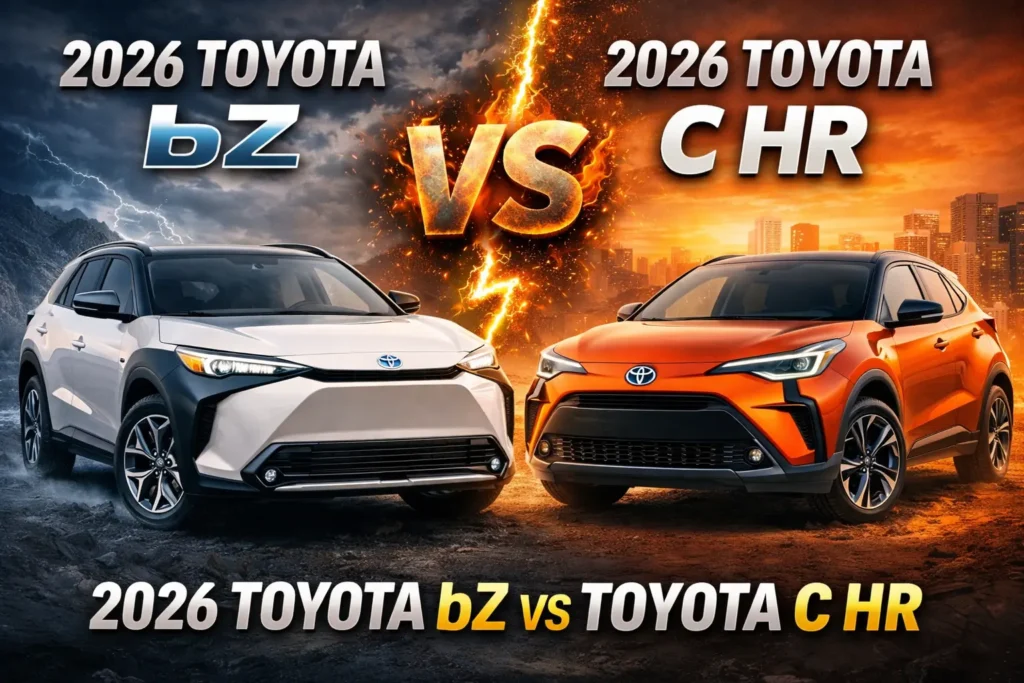
2026 Toyota bZ vs C HR Electric
Table of Contents
Toyota said for years that EVs were not the only answer. Hybrids made sense. Hydrogen had potential. And yet, here we are in California, where Toyota just pulled the wraps off three new electric vehicles at once.
The lineup includes the Toyota C-HR, the updated Toyota bZ which replaces the old bZ4X name, and the off road focused Toyota bZ Woodland Edition. A three row electric Toyota Highlander is also on the way.
Toyota is late to the EV party. That is not an opinion. It is a timeline fact. So the real question is simple: are these serious EVs, or is Toyota still catching up?
2026 Toyota C HR Electric: Compact, Quick, City Focused
The new C HR is no longer petrol powered. It is now fully electric and sits on the same platform as the bZ.
Toyota says this is the more compact, city friendly option. The coupe style roofline and hidden rear door handles are carried over from the older C HR, which originally stood for Coupe High Rider.
Key Specs
Dual motor all wheel drive only
338 horsepower
167 kW front motor
87 kW rear motor
0 to 60 mph in under 5 seconds
75 kWh battery pack
287 miles range with 18 inch wheels
273 miles range with 20 inch wheels
10 to 80 percent charge in around 30 minutes
North American Charging Standard port
Toyota confirmed the switch to NACS, which means access to the Tesla Supercharger network in North America. That is a major improvement over the earlier CCS setup.
Why Less Than 300 Miles?
Toyota says it is a price and usability balance. According to US Department of Transportation data, the average American drives about 37 miles per day. So 270 to 290 miles is more than enough for most people.
Still, in 2026, some buyers will expect that 300 mile figure psychologically. Hyundai, Ford and Tesla have already normalized it in this segment.
Driving Impressions
The C HR feels quick. The torque is strong enough to throw your phone off the seat if you are not careful. Handling is nimble thanks to the shorter 108 inch wheelbase compared to the bZ’s 112 inches.
Regenerative braking feels weaker than Tesla’s one pedal setup. There is also a slight delay when you press the accelerator. It is noticeable. Not terrible, but noticeable.
Suspension is sport tuned but not harsh. Road noise is well controlled.
Interior and Space
Front space is generous. Rear space depends on your height. At 6 foot 3, legroom is acceptable but headroom gets tight, especially with the panoramic glass roof.
Cargo capacity:
25.3 cubic feet behind second row
No spare tire
Large sub trunk storage
120 volt outlet in the rear
The cabin layout mirrors the bZ. You get:
14 inch central screen
Apple CarPlay and Android Auto
Wireless charging
USB C ports
Manual steering adjustment
No glove box
SoftTex trim and textile cloth seats feel better than expected for a Toyota entry trim.
2026 Toyota bZ: Bigger, More Practical, More Range
Toyota dropped the bZ4X name. It is now simply bZ, which stands for Beyond Zero.
This is the more traditional crossover of the two.
Key Specs
Dual motor AWD version: 338 horsepower
Up to 314 miles of range in AWD
Front wheel drive version also available
0 to 60 mph around 5 seconds
NACS charging port
25 percent range improvement over previous model
Interior and Space
The bZ feels more family oriented.
Rear seat space is clearly better than the C HR. Headroom and legroom are noticeably improved.
Cargo capacity is larger as well. Toyota positions it as the more practical option for families.
You still get:
Dual wireless chargers
Heated seats
Toyota Safety Sense 3.0 standard
Blind spot monitor
Rear cross traffic alert
Lane centering and adaptive cruise
The layout is almost identical to the C HR, including the high mounted digital gauge cluster. Toyota says the higher placement improves forward focus, especially for older drivers.
On the Road
It drives almost the same as the C HR. That makes sense because both share the same architecture.
The difference is subtle:
Slightly more stable feel due to longer wheelbase
Less sporty, more planted
Strong acceleration remains
The sense of solidity stands out. EV weight helps here. Combined with Toyota’s long standing reliability reputation, it feels built to last.
2026 Toyota bZ Woodland Edition: Off Road EV Twist
This one surprised me.
Toyota took the bZ and gave it a Woodland Edition treatment similar to the RAV4 Woodland.
What Changes?
1 inch higher ride height
All terrain tires
375 horsepower
0 to 60 mph in 4.4 seconds
281 miles standard range
260 miles with all terrain tires
3500 lb towing capacity
X Mode with snow, dirt and mud settings
Cargo space is impressive:
33.8 cubic feet standard
74.9 cubic feet with seats folded
It includes:
120 volt outlet
JBL audio
Digital rearview mirror
Panoramic view monitor
Heated rear seats
The cabin still uses hard plastics in places, but it does not feel cheap. It feels durable.
Tech: Toyota’s Weak Spot
This is where Toyota still trails Tesla, Hyundai and Ford.
Yes, you get Apple Maps EV routing when connected via CarPlay. Yes, you can schedule charging and precondition the battery.
But the native system feels laggy. Route planning lacks detailed charging stop intelligence compared to Tesla’s integrated system.
The hold function resetting every time you restart the car is also frustrating. Many EV drivers prefer non creeping behavior by default.
Toyota says they are studying improvements. That is honest. But in 2026, studying may not be enough.
Pricing: Where Things Get Interesting
Base pricing:
C HR starts at around 39,000 dollars
bZ starts at 39,900 dollars
bZ Woodland Edition around 49,000 dollars
Fully optioned C HR can cross 43,000 dollars.
Surprisingly, in some configurations, the larger bZ is cheaper than a loaded C HR.
Price will decide the winner here. Toyota understands that. Their engineers openly admit range and cost must balance.
So, Is Toyota Serious About EVs?
Here is the honest answer.
Toyota does not rush. The company tests. Waits. Studies. Then scales.
While other brands are pulling back EV plans due to slowing demand, Toyota is launching three new EVs at once.
The C HR fits urban buyers.
The bZ fits families.
The Woodland fits adventurous drivers.
And the electric Highlander could become a major player if priced right.
Toyota still needs to fix its infotainment and EV routing intelligence. That is the Achilles heel.
But when it comes to build quality, comfort, safety and long term durability, Toyota is doing what it always does.
Quietly building cars people can trust.
And yes, the T in Toyota really might stand for trust. My mother still drives a 1999 Toyota. That says more than any press release ever will.
Now the real question is yours.
What matters more to you in an EV?
Price and reliability?
Or cutting edge tech and flashy features?
Because Toyota just made its position very clear.
Sources and reference
- Toyota USA Press Release (Official)
https://pressroom.toyota.com/toyotas-all-electric-lineup-gains-rugged-powerful-new-bz-woodland-suv/ - Toyota Global Newsroom
https://global.toyota/en/newsroom/toyota/42757175.html - Official Toyota Product Page
https://www.toyota.com/upcoming-vehicles/bzwoodland/ - Car and Driver – bZ Woodland overview
https://www.caranddriver.com/toyota/bz-woodland/ - Car and Driver – First drive
https://www.caranddriver.com/reviews/a70345585/2026-toyota-bz-woodland-drive/ - InsideEVs – bZ Woodland coverage
https://insideevs.com/news/759617/2026-toyota-bz-woodland-offroad-ev/ - EV.com – spec summary
https://ev.com/news/toyota-2026-bz-woodland-suv-260-miles-range-nacs-port Toyota C-HR Official Model Page
https://www.toyota.com/upcoming-vehicles/c-hr/Toyota Press Release — 2026 C-HR BEV Debut
https://pressroom.toyota.com/toyota-debuts-stylish-powerful-2026-c-hr-battery-electric-vehicle/Toyota EV Warranty Overview
https://www.toyota.com/electrified-vehicles/warranty/Toyota North America Press Room Homepage
https://pressroom.toyota.com/CarsDirect 2026 Toyota C-HR Preview
https://www.carsdirect.com/toyota/c-hr/2026The Verge — Toyota C-HR EV Details
https://www.theverge.com/transportation/880395/toyota-chr-ev-price-range-specsToyota Press Release — 2026 Toyota C-HR Overview
https://pressroom.toyota.com/2026-toyota-c-hr-puts-sporty-stylish-spin-on-the-compact-electric-suv/