Waymo Recall 2026: Nearly 4,000 Robotaxis Recalled Over Freeway Construction Zone Issue
Table of Contents
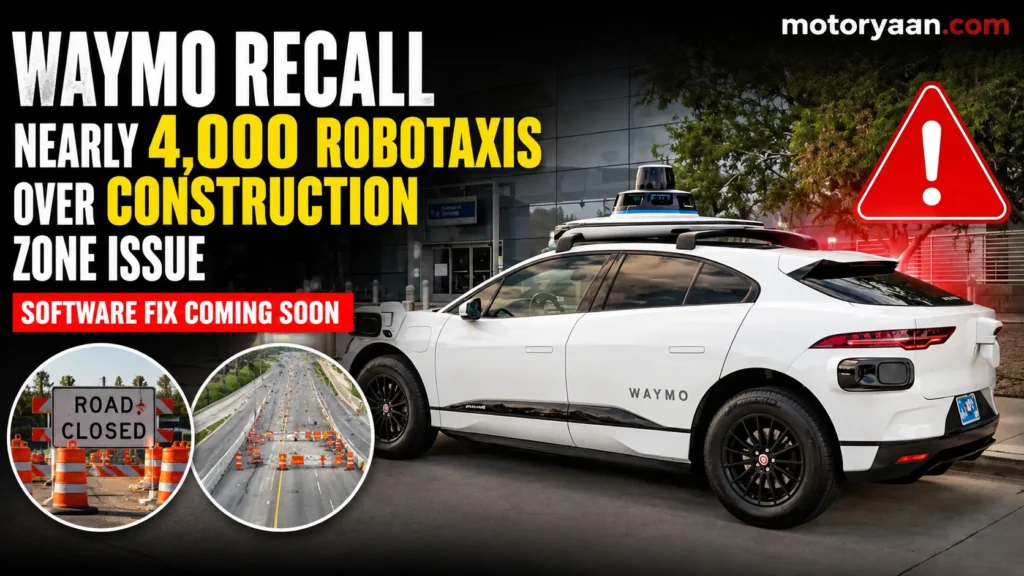
Autonomous driving technology continues to improve, but it is still far from perfect. Waymo has now issued a voluntary recall affecting nearly 4,000 autonomous vehicles in the United States after discovering that its robotaxis could enter closed freeway construction zones.
The issue is linked to software rather than hardware, and the company is already working on a fix. Until the update is ready, Waymo has temporarily restricted freeway operations for the affected vehicles.
Why Is Waymo Recalling Its Robotaxis?
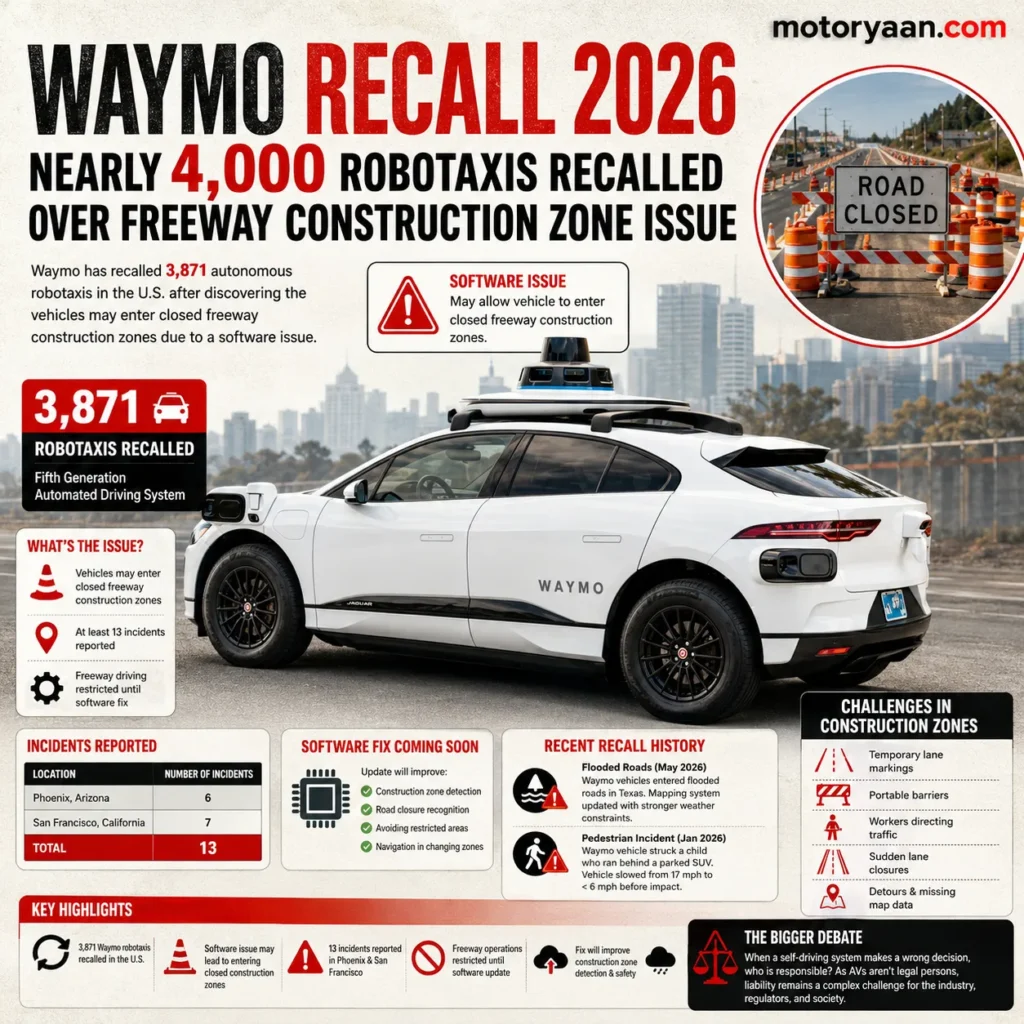
Waymo has recalled 3,871 fifth generation autonomous vehicles after identifying that the software may allow the cars to drive into freeway construction areas that have been closed to traffic.
The company voluntarily filed the recall with the National Highway Traffic Safety Administration (NHTSA) after recognizing the issue and informing regulators.
According to Waymo, engineers identified an area where the automated driving system could perform better around changing construction environments.
The upcoming software update will allow the vehicles to:
- Detect freeway construction zones more accurately
- Recognize road closures
- Avoid entering restricted highway sections
- Improve navigation around temporary traffic changes
Until then, freeway driving has been restricted for the affected robotaxis.
Waymo Construction Zone Incidents
Government recall documents mention that at least 13 incidents have already occurred where Waymo robotaxis entered closed highway construction areas.
| Location | Number of Incidents |
|---|---|
| Phoenix, Arizona | 6 |
| San Francisco, California | 7 |
| Total | 13 |
Fortunately, no major injuries related to these incidents have been reported.
Software Fix Is Under Development
Waymo says the problem is software based, meaning owners do not need any physical repairs.
Instead, the company plans to roll out an update for its fifth generation Automated Driving System that will improve how the vehicle identifies construction zones and temporary road restrictions.
Software updates have become one of the biggest advantages of modern autonomous vehicles. Instead of replacing components, companies can often improve safety through updated algorithms and mapping data.
This Is Not Waymo's First Software Recall
This latest recall comes only weeks after another software related issue involving flooded roads.
Earlier this year, a Waymo vehicle entered a flooded roadway in Texas and became stuck. Although the robotaxi reduced its speed before entering the flooded area and no passengers were inside, the incident highlighted another challenge autonomous vehicles face when dealing with changing weather conditions.
Following that event, Waymo updated its mapping system to include stronger weather related driving restrictions.
Previous Safety Concerns
Waymo has also faced public attention after an incident involving a child crossing the road from behind a double parked SUV.
According to the company, the autonomous vehicle detected the child and reduced its speed from approximately 17 mph to below 6 mph before contact occurred.
The case remains under investigation, but Waymo stated that the vehicle significantly reduced the severity of the impact compared with what could have happened without emergency braking.
Challenges Facing Autonomous Vehicles
Construction zones remain one of the most difficult environments for autonomous driving systems.
Unlike permanent roads, construction areas change frequently and may include:
- Temporary lane markings
- Portable barriers
- Workers directing traffic
- Sudden lane closures
- Detours and missing map data
Human drivers often rely on visual judgment and instructions from construction workers, while autonomous systems must combine cameras, sensors, artificial intelligence, and digital maps to make decisions.
This makes construction zones one of the toughest real world tests for self driving technology.
The Bigger Debate Around Self Driving Cars
Autonomous vehicles continue to generate discussion about safety and responsibility.
If a human driver causes an accident, legal responsibility is generally clear. However, when a self driving system makes an incorrect decision, questions arise about who should be held accountable.
Manufacturers, software developers, operators, regulators, and insurance companies all play important roles, making liability far more complex than in conventional vehicles.
As self driving technology becomes more common, governments around the world will likely continue updating regulations to address these challenges.
Key Highlights
- Waymo has recalled 3,871 autonomous robotaxis in the United States.
- The vehicles may enter closed freeway construction zones because of a software issue.
- At least 13 incidents have been reported in Phoenix and San Francisco.
- Freeway operations have been restricted until a software update is available.
- The fix will improve construction zone detection and road closure recognition.
- The recall follows another recent software update involving flooded roads.
Final Thoughts
Waymo’s latest recall shows that autonomous driving technology is evolving but still faces real world challenges. Construction zones, changing road layouts, and unexpected traffic situations remain difficult even for advanced artificial intelligence systems.
The positive aspect is that the issue appears to be software related, allowing Waymo to improve vehicle behavior through updates instead of mechanical repairs. As autonomous technology continues to mature, situations like these will likely play an important role in making future self driving vehicles safer and more reliable.
Sources & References
1. Waymo Official Website
https://waymo.com/
Official website of Waymo, providing information about its autonomous driving technology, robotaxi service, safety reports, and company updates.
2. National Highway Traffic Safety Administration (NHTSA) Recall Report
https://static.nhtsa.gov/odi/rcl/2026/RCLRPT-26E035-7637.pdf
Official U.S. government recall document explaining the software issue, affected vehicles, and recall details.
3. NHTSA Safety Recall Notice
https://static.nhtsa.gov/odi/rcl/2026/RCAK-26E035-6843.pdf
Official recall campaign summary including the defect description, safety risks, and planned remedy.
4. Reuters Automotive News
https://www.reuters.com/legal/litigation/waymo-recall-over-3800-robotaxis-over-risk-entering-closed-construction-zones-2026-06-18/
Trusted international news coverage explaining the recall and its impact on Waymo’s robotaxi operations.
Technology news report covering the software recall and freeway driving restrictions.
6. Waymo Safety Information
https://waymo.com/safety/
Official Waymo safety page describing the company’s testing process, safety approach, and autonomous driving research.
7. Waymo Safety Methodologies Research Paper
https://arxiv.org/abs/2011.00054
Technical paper explaining how Waymo evaluates and validates the safety of its autonomous driving system.
8. Waymo Safety Case Research
https://arxiv.org/abs/2306.01917
Research publication detailing Waymo’s framework for determining autonomous vehicle safety readiness.
9. Business Insider
https://www.businessinsider.com/waymo-recall-robotaxis-entered-freeway-construction-zones-2026-6
News report summarizing the recall, reported incidents, and planned software update.
Editorial coverage discussing the recall and the broader challenges facing autonomous vehicle technology.