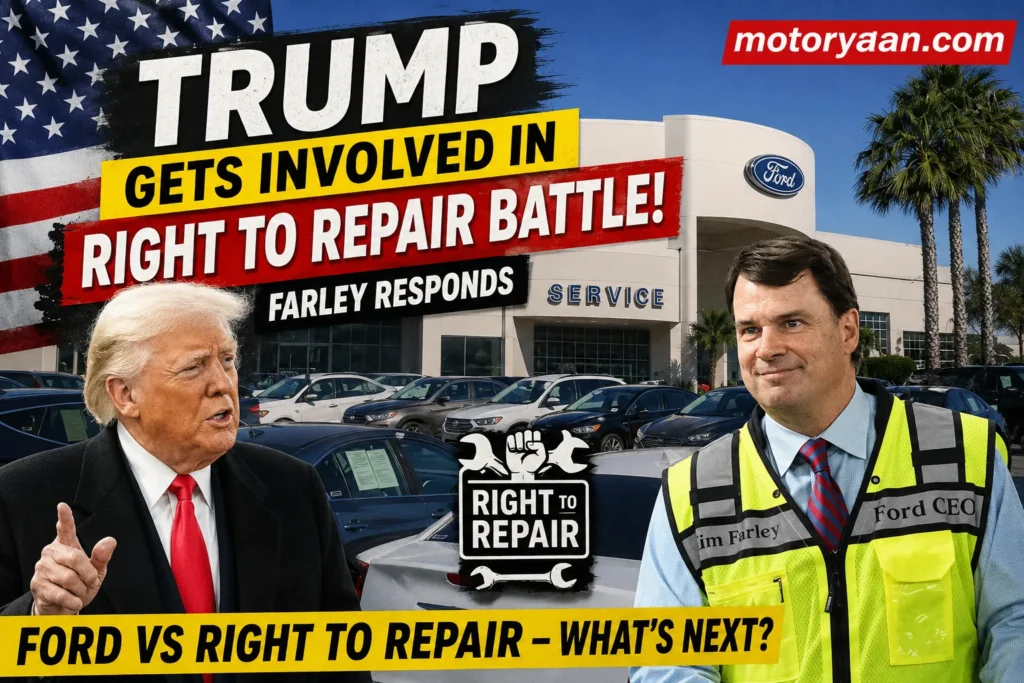
Trump Weighs In on Right to Repair Debate as Ford CEO Jim Farley Defends Automaker Position
Table of Contents
Trump Says Federal Government Could Step Into Right to Repair Fight
The long running Right to Repair debate has once again grabbed attention after President Donald Trump revealed that executives from Ford and General Motors discussed the issue with him during a recent meeting.
Speaking during an Oval Office event focused on energy infrastructure, Trump described the dispute as “strange” and suggested that automakers do not want owners repairing their own vehicles. He also indicated that the federal government could take action to help vehicle owners, although he did not mention any specific legislation or policy proposal.
Trump recalled knowing mechanics from his younger days who could repair engines with remarkable skill, using the example to question why modern vehicle owners face increasing restrictions when trying to service their own cars.
What Is the Right to Repair Movement?
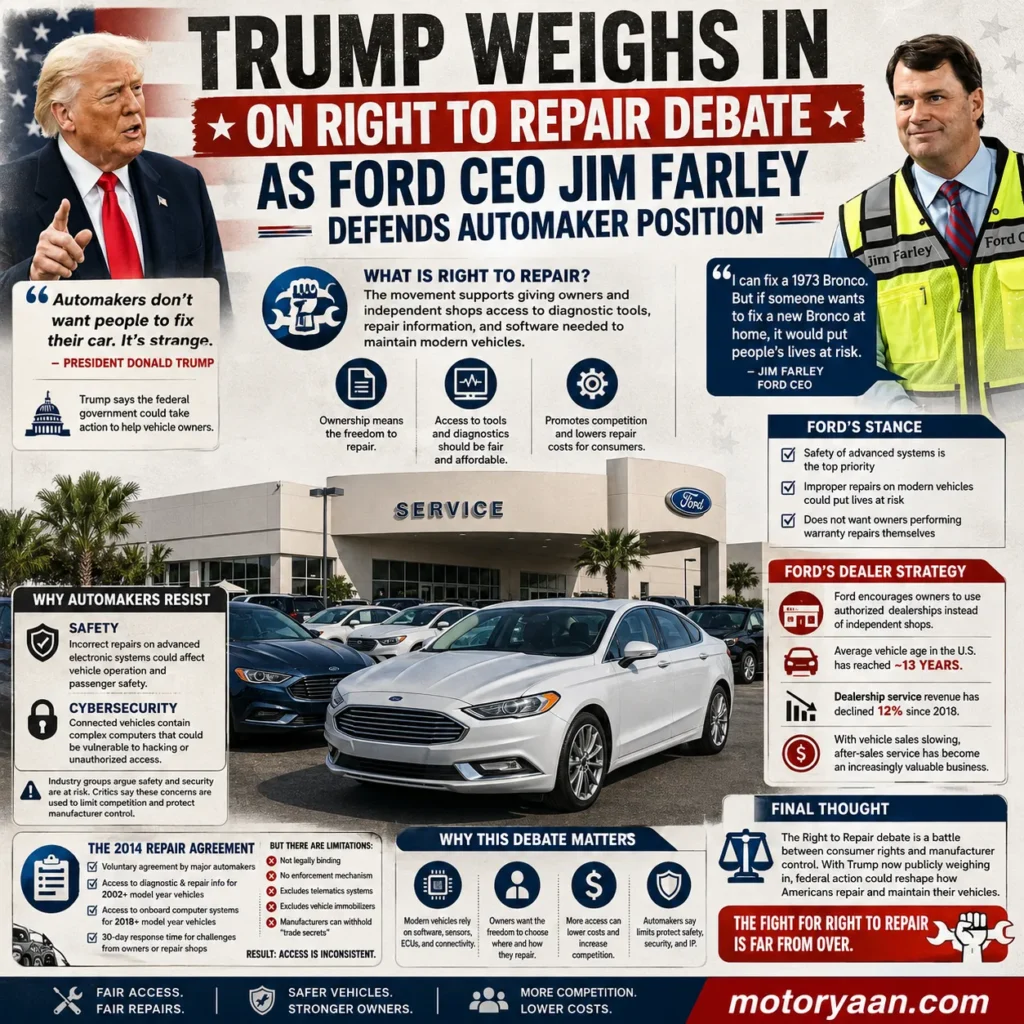
The Right to Repair movement supports giving vehicle owners and independent repair shops access to the diagnostic tools, repair information, and software needed to maintain modern vehicles.
Supporters argue that once someone buys a vehicle, they should have the freedom to repair it without depending entirely on an authorised dealership.
Many consumers also believe manufacturers should provide affordable access to repair manuals and diagnostic systems instead of keeping them behind proprietary barriers.
Jim Farley Explains Ford's Position
Ford CEO Jim Farley responded to Trump’s remarks by defending the company’s position on repair restrictions.
According to Farley, repairing older vehicles is very different from working on today’s highly connected and technology heavy models. He explained that he could comfortably repair a 1973 Ford Bronco himself, but attempting similar repairs on a modern Bronco at home could create serious safety risks.
Farley argued that improper repairs on advanced vehicle systems could put lives at risk, making professional servicing an important safety measure.
He also stated that Ford does not want owners performing warranty repairs themselves, although warranty work is only one part of the broader Right to Repair discussion.
Why Automakers Continue to Resist Expanded Repair Access
Automakers have consistently raised two major concerns.
| Concern | Explanation |
|---|---|
| Safety | Incorrect repairs on advanced electronic systems could affect vehicle operation and passenger safety. |
| Cybersecurity | Connected vehicles contain complex computer systems that could become vulnerable if unrestricted access is provided. |
Industry groups have argued that expanding access to vehicle software may increase the risk of hacking or unauthorised control of connected systems.
While these concerns have some technical basis, many consumer advocates believe manufacturers are using them to justify limiting competition in the repair market.
Consumers Say Diagnostic Information Should Be Accessible
Owners and independent repair businesses argue that manufacturers increasingly restrict access to diagnostic information, forcing customers to visit dealerships even for relatively simple repairs.
Many believe diagnostic data should be available to anyone who legally owns the vehicle, while manufacturers continue to classify much of this information as proprietary intellectual property.
This disagreement remains one of the biggest obstacles in the Right to Repair debate.
Ford's Dealer Service Strategy Comes Under Attention
Ford has recently encouraged owners to use its authorised dealerships instead of independent repair shops for servicing and maintenance.
This strategy comes at a time when Americans are keeping their vehicles longer than ever. The average vehicle age in the United States has reached approximately 13 years.
At the same time, dealership service revenue has reportedly declined by around 12 percent since 2018, creating financial pressure for both manufacturers and dealer networks.
With vehicle sales slowing and owners delaying replacements, aftersales service has become an increasingly valuable business for automakers.
The 2014 Repair Agreement Explained
Back in 2014, major automakers signed a voluntary memorandum agreeing to provide owners and independent repair facilities with diagnostic and repair information for vehicles built from the 2002 model year onward.
The agreement also included access to onboard computer systems for vehicles from the 2018 model year.
The memorandum included a process allowing owners or repair facilities to challenge manufacturers if access was denied, giving companies 30 days to respond.
However, several important limitations remain:
- The agreement is voluntary and not legally binding.
- It contains no formal enforcement mechanism.
- Telematics systems are excluded.
- Vehicle immobiliser systems are excluded.
- Manufacturers are not required to disclose trade secrets, creating a potentially significant loophole.
As a result, access to repair information has not been provided consistently across the industry.
Why the Right to Repair Debate Matters
Modern vehicles rely heavily on software, sensors, electronic control units, and internet connectivity. As automotive technology becomes more advanced, the ability to diagnose and repair these systems increasingly depends on manufacturer controlled tools and software.
Supporters of Right to Repair argue that owners should have the freedom to choose where and how their vehicles are repaired, potentially reducing maintenance costs and increasing competition.
Automakers, meanwhile, maintain that limiting access helps protect vehicle safety, cybersecurity, and proprietary technology.
With President Trump now publicly acknowledging the issue and signalling possible federal involvement, the debate could receive renewed political attention in the coming months.
Final Thoughts
The Right to Repair discussion highlights the growing tension between consumer ownership rights and manufacturer control over increasingly complex vehicles.
While Ford and other automakers continue to emphasise safety and security concerns, many owners believe access to repair information should be part of owning a vehicle.
Whether future legislation changes the balance remains uncertain, but the issue is becoming increasingly important as software driven vehicles dominate today’s automotive market.
Sources and References
- Federal Trade Commission (FTC)
- https://www.ftc.gov
- Official US consumer protection agency that provides information on repair restrictions, competition, and consumer rights.
- FTC Report “Nixing the Fix”
- https://www.ftc.gov/reports/nixing-fix-ftc-report-congress-repair-restrictions
- Official FTC report examining manufacturer repair restrictions and their impact on consumers.
- National Highway Traffic Safety Administration (NHTSA)
- https://www.nhtsa.gov
- Official US government agency responsible for vehicle safety regulations and cybersecurity guidance.
- Alliance for Automotive Innovation
- https://www.autosinnovate.org
- Official trade association representing major automakers and their position on vehicle repair and cybersecurity.
- Massachusetts Right to Repair Information
- https://www.mass.gov
- Official Massachusetts government portal covering Right to Repair laws and implementation.
- Auto Care Association
- https://www.autocare.org
- Leading US aftermarket industry association advocating for independent repair access and consumer choice.
- MEMA Aftermarket Suppliers
- https://www.mema.org
- Industry organization providing updates on automotive Right to Repair legislation and policy developments.
- Cox Automotive
- https://www.coxautoinc.com
- Trusted automotive market research company known for vehicle age and industry trend reports.
- Car and Driver
- https://www.caranddriver.com/news/a71562651/trump-ford-gm-right-to-repair-battle/
- Trusted automotive publication covering President Trump’s comments and Jim Farley’s response on the Right to Repair debate.
- National Conference of State Legislatures (NCSL)
- https://www.ncsl.org/technology-and-communication/right-to-repair-2023-legislation
- Provides legislative tracking and summaries of Right to Repair laws across US states.
- Motor Vehicle Owners’ Right to Repair Act Overview
- https://en.wikipedia.org/wiki/Motor_Vehicle_Owners%27_Right_to_Repair_Act
- Useful background explaining the history of federal and state automotive Right to Repair legislation and the 2014 nationwide memorandum.
- Right to Repair Overview
- https://en.wikipedia.org/wiki/Right_to_repair
- Provides historical context and explains how the movement expanded from automotive repair into broader consumer rights discussions.