I Drove a Porsche 911 at Laguna Seca. And Yes, the Corkscrew Really Is That Wild
Table of Contents
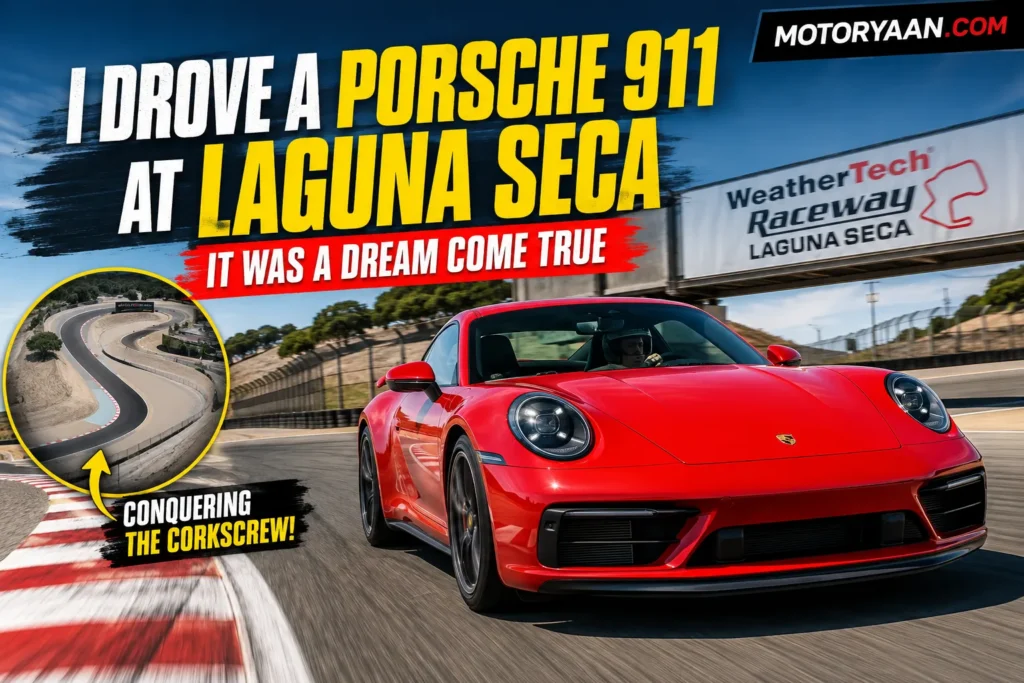
For a lot of car enthusiasts, driving a Porsche 911 Carrera S at WeatherTech Raceway Laguna Seca sits somewhere near the top of the bucket list. The track has history, elevation changes, fast corners, and of course, the famous Corkscrew that has scared and excited drivers for decades.
That dream became real during Porsche’s Track Experience program in California. And honestly, it sounds exactly how most enthusiasts imagine it in their heads. Fast, intimidating, loud, and unforgettable.
What Is Porsche Track Experience?
Porsche runs its Porsche Track Experience driving school at Laguna Seca and several other locations around the world. The program originally started in 1974 under the Porsche Sport Driving School banner. Today, it operates across the U.S. and Europe with professional racing drivers working as instructors.
The California program takes place at Laguna Seca near Monterey. Drivers get classroom sessions, instructor guidance, and multiple lead follow laps around the circuit.
Pricing depends on the program level:
| Program Type | Estimated Cost |
|---|---|
| One day beginner course | Around $3,500 |
| Multi day programs | Around $6,500 to $20,000 |
Higher level courses include more advanced cars and race focused setups.
The Car: Porsche 911 Carrera S
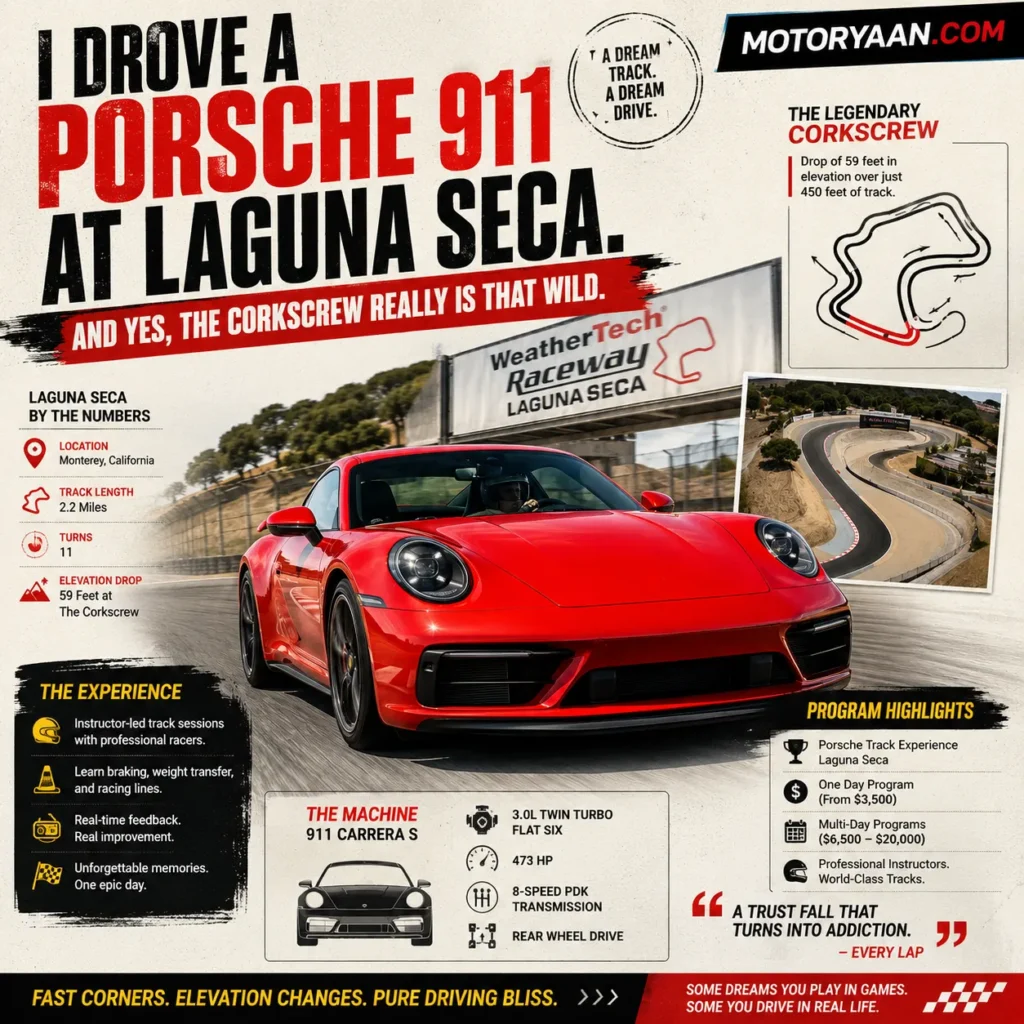
The car used during the session was the rear wheel drive Porsche 911 Carrera S, powered by a 3.0 litre twin turbo flat six engine producing 473 horsepower. It comes paired with Porsche’s eight speed PDK transmission.
That combination matters on a track like Laguna Seca because the circuit rewards stability, quick direction changes, and strong braking confidence. The Carrera S delivers all three without trying to behave like a full race car.
Key specs:
| Specification | Porsche 911 Carrera S |
|---|---|
| Engine | 3.0 litre twin turbo flat six |
| Power | 473 hp |
| Transmission | 8 speed PDK |
| Drive Layout | Rear wheel drive |
Interestingly, Porsche kept every student in the same car throughout the day instead of switching between models like the GT3. The logic was simple. Drivers improve faster when they stay familiar with one setup. Makes sense honestly.
Laguna Seca Still Feels Like a Video Game Track in Real Life
Anyone who grew up playing racing games probably remembers Laguna Seca. The track first opened in 1957 and today runs as a 2.2 mile circuit with 11 turns.
Some of its most famous sections include:
- Andretti Hairpin
- Rahal Straight
- Rainey Curve
- The Corkscrew
The Corkscrew remains the track’s signature moment because drivers enter blind before dropping 59 feet in elevation over just 450 feet of track. On paper it sounds dramatic. In real life it apparently feels even crazier.
Why The Corkscrew Is So Famous
The Corkscrew became legendary after Alex Zanardi’s famous overtake during the 1996 IndyCar race at Laguna Seca. Fans still refer to it simply as “The Pass.”
Even experienced drivers describe the section as intimidating because you cannot fully see the exit while entering the corner. Drivers rely on braking points, curbs, and visual markers before committing downhill.
During the track sessions, instructors guided drivers corner by corner through radio communication. One useful technique involved imagining a string connecting the steering wheel to the pedals. More steering angle means less pedal pressure. It sounds simple, but on track, simple advice usually works best.
What Driving a 911 at Laguna Seca Actually Feels Like
The article describes the sensations in a way most track day drivers will instantly understand.
At over 120 mph on the front straight, the car gets light approaching Turn 1 before compressing back into the Andretti Hairpin. Later laps helped turn those reactions into muscle memory, especially through Laguna Seca’s elevation changes.
And then came the Corkscrew.
Approaching uphill at full throttle, the driver positioned the 911 toward the left curb before heavy braking into Turn 8. Once committed, the car drops sharply downhill into the right hand section almost blindly.
The experience was compared to a trust fall. Terrifying at first, then addictive once confidence builds.
Why Experiences Like This Matter
Modern performance cars have become unbelievably capable, but most owners never experience what these cars can really do.
Programs like Porsche Track Experience give drivers a controlled environment to understand braking, weight transfer, steering balance, and cornering techniques properly. And honestly, learning those skills on one of the world’s most iconic circuits in a 911 sounds like a pretty solid way to spend a day.
Also, let’s be honest. Every Gran Turismo kid probably imagined themselves attacking the Corkscrew at least once. Few actually get to do it for real.
Sources and References
- Porsche Track Experience Laguna Seca
Official Porsche Track Experience page for Laguna Seca with course details, pricing, and booking information. - WeatherTech Raceway Laguna Seca Official Website
Official website of Laguna Seca Raceway featuring track history, events, and visitor information. - Porsche Newsroom USA PTX Laguna Seca Launch
Official Porsche press release about the opening of Porsche Track Experience at Laguna Seca. - Porsche Track Experience Course Booking
Direct booking page for Porsche driving programs in the United States. - Laguna Seca Track Information
Official track information page covering the Corkscrew, layout, and circuit history. - Motor1 Porsche Track Experience Laguna Seca Coverage
Automotive news coverage explaining Porsche’s expansion to Laguna Seca and program details. - Road & Track PTX Laguna Seca Article
Road & Track’s breakdown of Porsche Track Experience pricing and track programs. - INDYCAR Laguna Seca Circuit Overview
Official IndyCar overview of Laguna Seca including Corkscrew details and circuit specifications. - See Monterey Laguna Seca Guide
Travel and visitor guide for Laguna Seca and Monterey motorsport attractions. - Porsche Track Experience Global Overview
Official Porsche global overview explaining the Track Experience program structure and training levels.
Frequently Asked Questions
What is Porsche Track Experience at Laguna Seca?
Porsche Track Experience is Porsche’s driving school program. At Laguna Seca, it gives drivers classroom time, instructor guidance, and lead follow laps on the circuit.
The program started in 1974 under the Porsche Sport Driving School name and now runs in the U.S. and Europe.
Which car was used for the Laguna Seca track session?
The car was a rear wheel drive Porsche 911 Carrera S.
It used a 3.0 litre twin turbo flat six engine with 473 horsepower and an eight speed PDK transmission.
Why is the Corkscrew at Laguna Seca so famous?
The Corkscrew is famous because drivers enter it blind and then drop 59 feet in elevation over just 450 feet of track.
It became legendary after Alex Zanardi’s overtake in the 1996 IndyCar race at Laguna Seca, a moment fans still call “The Pass.”
How much does Porsche Track Experience cost?
The pricing depends on the program level. A one day beginner course costs around $3,500.
Multi day programs can range from about $6,500 to $20,000, depending on the setup and the cars used.
How long is Laguna Seca and how many turns does it have?
Laguna Seca is a 2.2 mile circuit with 11 turns.
Some of its best known sections include the Andretti Hairpin, the Rahal Straight, the Rainey Curve, and the Corkscrew.
What makes Laguna Seca feel so challenging to drive?
The track combines fast straights, hard braking zones, and major elevation changes.
That mix makes the car feel light in some sections and loaded up in others, so drivers need good timing with steering, braking, and throttle.
Why did Porsche keep students in the same car all day?
Porsche kept everyone in the same car so drivers could stay familiar with one setup throughout the day.
That makes it easier to judge progress and understand how the car reacts lap after lap.
What can drivers learn from this kind of track experience?
Drivers can learn braking control, weight transfer, steering balance, and cornering technique in a controlled environment.
It is the kind of training that makes a performance car feel more understandable, not just faster.