The Mercedes M156 V8 Problem Owners Eventually Solved Without Mercedes’ Help
Table of Contents
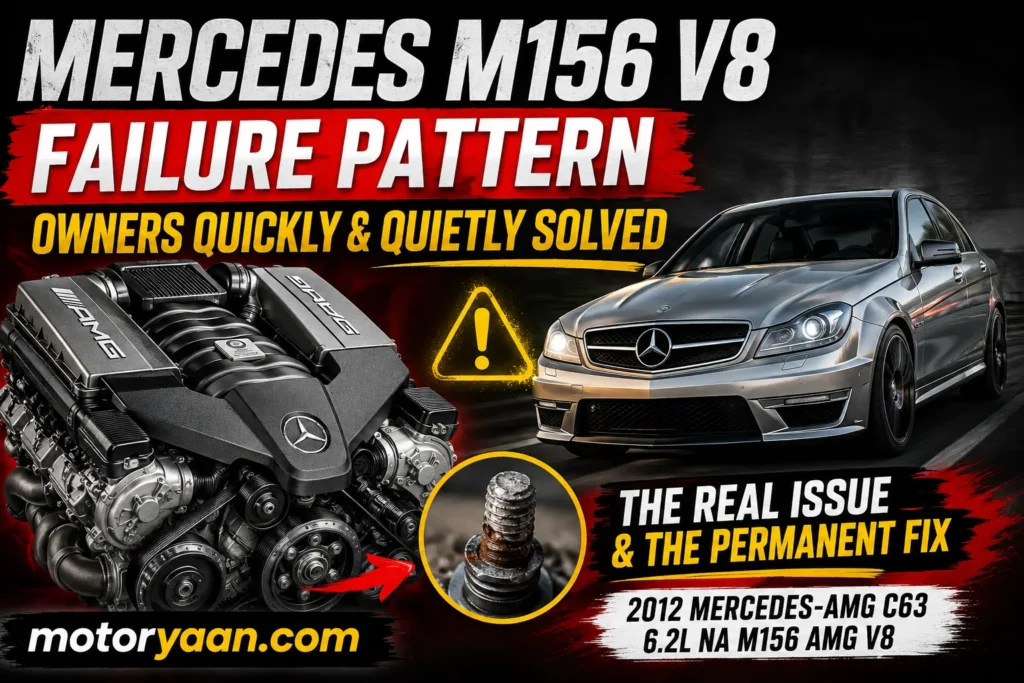
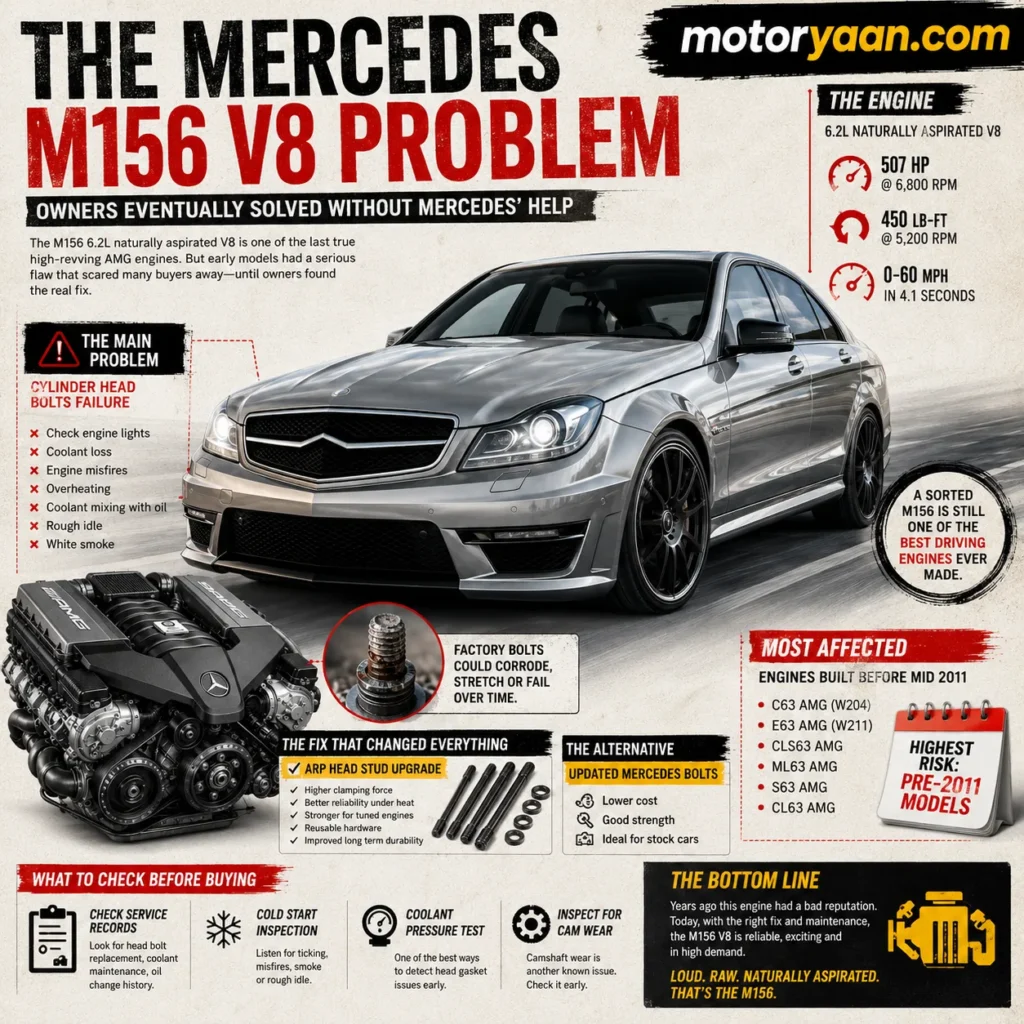
The Mercedes AMG M156 V8 is one of those engines people still talk about years later. Loud cold starts, instant throttle response, and a naturally aspirated character that modern turbo engines still struggle to copy. This 6.2 liter V8 powered several AMG models including the C63 AMG, E63 AMG, CLS63 AMG, S63 AMG, ML63 AMG, and more.
Today, demand for M156 powered cars continues to rise because enthusiasts know this era of AMG is basically gone for good. But there was one major problem that damaged the reputation of this engine for years.
The issue involved cylinder head bolts failing inside the engine. In worst cases, owners faced expensive repairs or even complete engine failure. Over time though, the AMG community found proper fixes that turned the M156 into a far more dependable performance engine.
Why The Mercedes M156 AMG V8 Became So Popular
AMG built the M156 as a hand assembled naturally aspirated V8 with over 500 horsepower in some applications. The engine quickly gained attention because it felt raw and mechanical compared to many modern performance engines.
Some reasons enthusiasts still love the M156:
- Massive naturally aspirated V8 sound
- Fast throttle response
- Strong aftermarket support
- High tuning potential
- Used in several AMG models
- One of the last old school AMG engines
The engine even won multiple awards during its production years. But as mileage increased on older cars, more owners started reporting serious issues.
The Main M156 Engine Problem
The biggest issue on early M156 engines involved the cylinder head bolts.
These bolts clamp the cylinder heads to the engine block. Inside any high performance V8, temperatures and combustion pressure stay extremely high. If the head bolts weaken or stretch, the seal between the cylinder head and block starts failing.
That is exactly what happened on many early M156 engines.
Owners started noticing problems like:
- Check engine lights
- Coolant loss
- Engine misfires
- Rough idle
- Overheating
- Coolant mixing with oil
- White smoke in some cases
In severe situations, the damaged head gasket could lead to catastrophic engine failure.
Why The Head Bolts Failed
According to owner reports and technical discussions, the original factory bolts on many pre 2011 M156 engines could corrode, weaken, or stretch over time.
Mercedes later released a Technical Service Bulletin related to the issue. The bulletin helped technicians diagnose failed cylinder head bolts and associated head gasket failures. However, this was not a recall. Owners outside warranty often had to pay huge repair bills themselves.
The repair process was not simple either.
Fixing the issue often involved:
| Repair Item | Why It Matters |
|---|---|
| Replacing head bolts | Restores proper clamping force |
| Head gasket replacement | Stops coolant and oil leaks |
| Valve replacement | Prevents internal damage |
| Coolant flush | Removes contamination |
| Oil changes | Clears coolant contaminated oil |
| Internal inspection | Checks for piston or bearing damage |
Labor costs alone could become painful because technicians had to partially disassemble the hand built AMG engine.
Which M156 Engines Were Most Affected?
Most enthusiasts agree the highest risk exists on engines built before mid 2011.
Mercedes reportedly updated the head bolt design around that period. Later engines generally showed fewer failures compared to earlier versions.
Common affected models include:
- W204 C63 AMG
- W211 E63 AMG
- CLS63 AMG
- ML63 AMG
- S63 AMG
- CL63 AMG
That said, not every early engine fails. Some owners crossed 120,000 miles without major problems. Maintenance history plays a huge role here.
The ARP Head Stud Fix Changed Everything
Once the problem became widely known, AMG specialists and performance shops started looking for stronger solutions.
That solution came from ARP.
Automotive Racing Products developed upgraded head studs for the M156 engine. Unlike the original factory torque to yield bolts, ARP studs use far stronger materials and do not rely on stretching during installation.
This became the gold standard fix in the AMG world.
Benefits of ARP head studs include:
- Higher clamping force
- Better reliability under heat
- Stronger for tuned engines
- Reusable hardware
- Improved long term durability
The upgrade became especially popular among owners running superchargers, twin turbo kits, or high horsepower builds where cylinder pressure increases significantly.
The Cheaper Alternative Many Owners Use
Not everyone installs ARP studs.
Some owners choose the updated Mercedes factory bolts instead because the job is cheaper and less invasive.
Unlike ARP studs, technicians can replace upgraded Mercedes bolts individually while maintaining clamping force from the remaining bolts. That reduces labor costs substantially.
In simple terms:
| Option | Cost | Strength | Best For |
|---|---|---|---|
| Updated Mercedes bolts | Lower | Good | Stock cars |
| ARP head studs | Higher | Excellent | Tuned or long term ownership |
For many stock daily driven AMG models, the updated Mercedes hardware works fine. But owners planning heavy tuning usually go straight for ARP.
What To Check Before Buying A Used M156 AMG
Buying a used M156 powered AMG can still be a fantastic decision if you inspect the car properly.
Before purchasing:
Check Service Records
Look for proof of:
- Head bolt replacement
- Coolant maintenance
- Oil change history
- Camshaft inspections
- Injector replacement
Start The Engine Cold
Never inspect the car after it has been warmed up.
A cold start helps reveal:
- Valvetrain ticking
- Misfires
- Smoke
- Rough idle
- Coolant related issues
Perform A Coolant Pressure Test
This is one of the smartest checks you can do on an M156 AMG. A pressure test may reveal head gasket problems before they become obvious.
Inspect For Camshaft Wear
Apart from head bolts, camshaft wear is another known issue on some M156 engines. Early detection matters because replacement costs rise quickly once damage spreads.
Is The M156 AMG V8 Reliable Today?
Surprisingly, yes. Many enthusiasts now consider the M156 reasonably reliable if owners address known weak points early.
That is the interesting part about this engine. Years ago, many buyers avoided it completely. Today, properly maintained examples with updated hardware are becoming more desirable because modern AMG engines simply feel different.
The sound, the aggression, and the naturally aspirated experience keep pulling enthusiasts back toward cars like the C63 AMG Black Series and E63 AMG.
A sorted M156 still delivers one of the best AMG driving experiences ever made.
Sources and References
Official Mercedes-Benz Sources
- Mercedes-Benz USA AMG C63 Page
Official Mercedes AMG performance sedan page with specs, AMG details, and engine information. - Mercedes-Benz Global AMG Page
Official global Mercedes-Benz and AMG brand website with company history and AMG performance details. - Mercedes-AMG C-Class Sedan Official Page
Official AMG performance C-Class information and technical highlights.
Technical And Repair References
- FCP Euro M156 Head Bolt Kit
Trusted US based European car parts supplier showing M156 head bolt replacement kit details. - Vivid Racing ARP Head Studs For M156
Performance upgrade reference for ARP head studs used in M156 reliability builds.
AMG Community And Owner Discussions
- MBWorld M156 Head Bolt Discussion
One of the best known AMG forum discussions explaining the M156 head bolt failure issue. - MBWorld Head Bolt VIN Guide
Useful VIN and production year discussion for affected M156 engines. - MBWorld DIY Head Bolt Replacement Guide
Detailed owner DIY guide for replacing M156 head bolts. - MBWorld M156 Reliability Article
Good technical overview of the M156 engine, common failures, and long term ownership.
Reddit And Owner Experience Sources
- Reddit AMG M156 Head Bolt Discussion
Real owner experiences discussing how common the head bolt problem actually is. - Reddit M156 Issues And Buying Advice
Helpful owner discussion covering which M156 years buyers should watch for.
Video And DIY References
- M156 Head Bolt DIY Replacement Video
Detailed walkthrough showing M156 head bolt replacement methods. - M156 Head Bolt Issue Explained
Simple explanation of the common M156 coolant and head bolt failure problem. - M156 One At A Time Head Bolt Method
Shows the cheaper one at a time replacement approach many owners use.
Mercedes M156 V8 FAQ
What is the Mercedes M156 V8?
The M156 is AMG’s 6.2 liter naturally aspirated V8. It powered several models, including the C63 AMG, E63 AMG, CLS63 AMG, S63 AMG, ML63 AMG, and CL63 AMG. People still like it because of the sound, throttle response, and old school AMG feel.
What is the main problem with the M156 engine?
The biggest known issue is failure of the cylinder head bolts on early engines. When those bolts stretch, corrode, or weaken, the head gasket can lose its seal. That can lead to coolant loss, misfires, rough idle, overheating, and in bad cases, engine failure.
Which M156 models are most affected?
The highest risk is usually linked to engines built before mid 2011. Common affected models include the W204 C63 AMG, W211 E63 AMG, CLS63 AMG, ML63 AMG, S63 AMG, and CL63 AMG. Not every early engine fails, but the risk is higher on older cars.
Is the head bolt problem a recall?
No. Mercedes issued a Technical Service Bulletin, which helped technicians diagnose the problem, but it was not a recall. That means warranty coverage depended on the car’s status at the time, and many owners outside warranty had to pay for repairs themselves.
What is the best fix for the M156 head bolt issue?
The strongest long term fix is the ARP head stud upgrade. ARP studs use stronger materials and do not rely on the same stretch based design as the original factory bolts. Many owners with tuned cars prefer this because it offers better clamping force and long term durability.
Are the updated Mercedes factory bolts a good option?
Yes, for many stock cars they can be a sensible lower cost option. They are less expensive and less invasive than the ARP route. For a stock daily driven AMG, the updated Mercedes hardware may be enough. For heavy tuning, ARP is usually the better choice.
What should I check before buying a used M156 AMG?
Check service records first. Look for proof of head bolt work, coolant maintenance, oil changes, camshaft inspections, and injector replacement. Then do a cold start, listen for ticking or clatter, and check for smoke, misfires, or rough idle.
- Cold start from a truly cold engine
- Coolant pressure test for head gasket leaks
- Camshaft wear inspection
- Full service history if available
Is the M156 reliable today?
Yes, many owners now see it as a reliable engine if the weak points are handled early. A sorted M156 with updated hardware and proper maintenance can still be a strong choice, and some high mileage cars have already crossed 120,000 miles without major trouble.