
Mazda Sports Car Patent Reveals Butterfly Doors, Rear Wheel Drive Layout and Four Cylinder Engine
Table of Contents
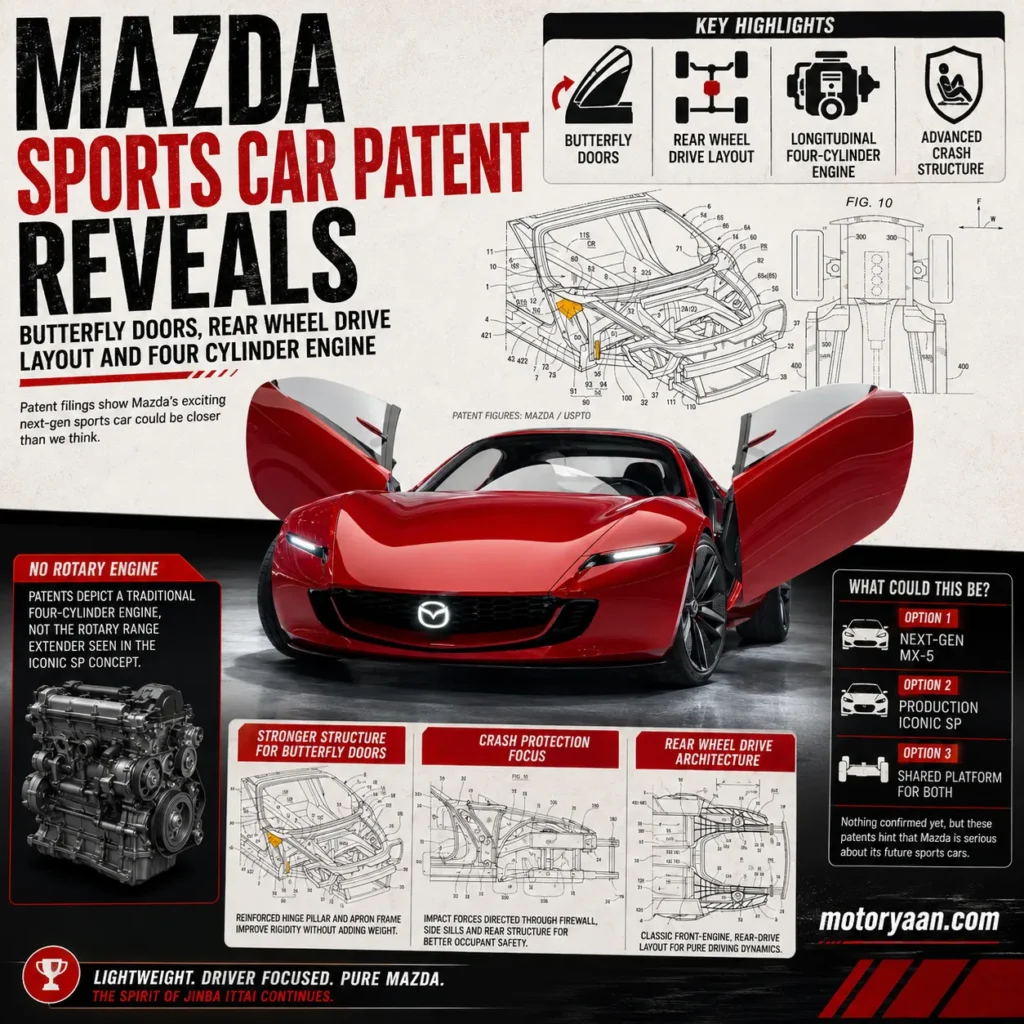
Mazda may be preparing something exciting for sports car fans. Newly discovered patent filings reveal a compact rear wheel drive convertible with butterfly doors and a longitudinal four cylinder engine. Interestingly, the documents do not mention the name of the vehicle, leaving room for speculation about whether this could be the next generation Mazda MX 5, the production version of the Iconic SP, or a platform that could support both.
The patents were recently uncovered by CarBuzz and filed through the United States Patent and Trademark Office (USPTO).
Mazda Files Patents for a New Sports Car
Mazda has submitted two separate patent applications. Both focus on engineering solutions rather than confirming a future production model.
The patent drawings show:
- Front engine layout
- Rear wheel drive configuration
- Convertible body style
- Butterfly style doors
- Longitudinally mounted four cylinder engine
- Traditional transmission tunnel
While the patents never identify the vehicle, the design immediately raises questions about Mazda’s future sports car plans.
Butterfly Doors Could Finally Reach a Mazda Production Car
One of the biggest highlights is the butterfly door design.
Mazda has never offered butterfly doors on a production model before. The patent describes a flip up side door where the rear portion swings outward and upward, similar to butterfly or scissor style doors.
The engineering document explains how Mazda could make this possible while maintaining structural strength in a convertible body.
To achieve this, Mazda proposes:
- Moving the A pillars closer to the front suspension towers
- Reinforcing the hinge pillar
- Adding structural bracing to transfer suspension loads
- Using an apron frame to improve chassis stiffness without adding much weight
These solutions are designed to keep the body rigid even after removing the fixed roof.
Crash Structure Also Gets Attention
The second patent focuses on occupant protection.
According to the filing, crash forces would be directed through several reinforced areas, including:
| Component | Purpose |
|---|---|
| Firewall | Helps absorb frontal impact loads |
| Side sills | Improves side impact strength |
| Rear structure | Distributes crash energy more effectively |
This approach is intended to improve passenger protection while maintaining the lightweight character expected from a Mazda sports car.
Patent Shows a Four Cylinder Engine Instead of a Rotary Setup
Perhaps the biggest surprise comes from the powertrain shown in the patent illustrations.
The drawings clearly depict:
- A longitudinal four cylinder engine
- Conventional transmission tunnel
- Front engine layout
That differs significantly from the Mazda Iconic SP Concept, which debuted with a rotary range extender as part of its electrified powertrain.
The patent does not mention a rotary engine anywhere, suggesting Mazda could be evaluating a different setup for a future production model.
Could This Be the Next Mazda MX 5?
Mazda has already confirmed that a new generation MX 5 is under development. The company has also stated that it wants to bring the Iconic SP Concept into production.
That creates several possibilities.
Option 1: Next Generation MX 5
The patents could belong to the next MX 5. However, the butterfly doors make this less likely.
The MX 5 has always focused on:
- Lightweight engineering
- Affordable pricing
- Simple mechanical design
- Driver engagement
Adding complex butterfly doors could increase both weight and production costs.
Option 2: Production Mazda Iconic SP
Many enthusiasts believe these patents are more likely connected to the Iconic SP.
The dramatic styling of the concept already featured butterfly doors, making the patent a natural fit.
However, the four cylinder engine shown in the filings suggests Mazda may be considering a different production powertrain than the concept originally showcased.
Option 3: Shared Sports Car Platform
Another possibility is that Mazda is developing one flexible rear wheel drive platform.
This architecture could eventually support:
- Next generation Mazda MX 5
- Production Mazda Iconic SP
If true, the patents may represent the underlying engineering rather than one specific vehicle.
What This Means for Mazda Fans
Mazda continues to invest in driver focused sports cars despite the industry’s shift toward electrification.
These patent filings suggest the company is exploring new engineering ideas while still prioritising lightweight construction, structural rigidity and engaging driving dynamics.
Nothing has been officially confirmed, and patent filings do not guarantee production. Still, they provide an interesting look at what Mazda engineers are working on behind the scenes.
Final Thoughts
Mazda’s latest patents reveal a sports car with butterfly doors, rear wheel drive and a longitudinal four cylinder engine. While the company has not confirmed which model these filings relate to, they point toward an exciting future for Mazda’s performance lineup.
Whether this becomes the next Mazda MX 5, the production Iconic SP, or a new platform shared by both, the patents show that Mazda remains committed to building engaging sports cars with innovative engineering.
Sources & References
Official Sources
- Mazda USA Newsroom
https://news.mazdausa.com/vehicles-iconic-sp-concept
Official Mazda press release and specifications for the Iconic SP concept. - Mazda Global Newsroom (Japan)
https://newsroom.mazda.com/ja/publicity/release/2023/202310/231025a.html
Official global announcement of the Mazda Iconic SP concept unveiled at the Japan Mobility Show. - United States Patent and Trademark Office (USPTO)
https://www.uspto.gov/
Official U.S. patent database where Mazda’s patent filings can be searched and verified.
Reputable Automotive References
- CarBuzz
https://carbuzz.com/
Automotive news outlet that first highlighted the newly discovered Mazda patent filings. - Road & Track
https://www.roadandtrack.com/
Trusted U.S. publication covering Mazda’s future sports car plans and Iconic SP developments. - Motor1
https://www.motor1.com/
Covers patent filings, concept cars, and future Mazda performance models. - Car and Driver
https://www.caranddriver.com/
Respected U.S. automotive publication with coverage of the Mazda Iconic SP and future sports cars. - Top Gear
https://www.topgear.com/car-news
International automotive publication with analysis of Mazda’s sports car concepts and patents. - Auto Express
https://www.autoexpress.co.uk/
UK-based publication frequently reporting on Mazda’s future sports car strategy and executive interviews.
What do Mazda's latest sports car patents reveal?
The newly discovered patents show a compact front engine, rear wheel drive convertible featuring butterfly style doors, a longitudinally mounted four cylinder engine and a traditional transmission tunnel. The documents focus on engineering solutions rather than confirming a future production vehicle.
Has Mazda confirmed this sports car for production?
No. Mazda has not announced a production model based on these patents. Patent applications protect engineering ideas and do not guarantee that the vehicle shown will eventually reach dealerships.
Could this be the next generation Mazda MX 5?
It is one possibility. Mazda has already confirmed that a new MX 5 is under development. However, the butterfly doors shown in the patents would represent a major departure from the lightweight and affordable philosophy that has always defined the MX 5.
Could the patents belong to the production Mazda Iconic SP?
Many enthusiasts believe so because the Iconic SP Concept featured dramatic butterfly doors. However, the patent drawings show a longitudinal four cylinder engine instead of the rotary range extender that powered the concept car.
Does the patent include a rotary engine?
No. The patent illustrations clearly show a longitudinal four cylinder engine with a conventional transmission layout. There is no mention of a rotary engine in the patent documents.
Why are the butterfly doors significant?
This would be Mazda's first production vehicle with butterfly style doors if the design reaches production. The patents explain how reinforced A pillars, hinge pillars, structural bracing and an apron frame could maintain body rigidity even without a fixed roof.
What safety features are described in the patents?
The second patent focuses on occupant protection by directing crash forces through reinforced areas such as the firewall, side sills and rear body structure. This helps improve passenger safety while preserving lightweight construction.
Could Mazda build both the MX 5 and Iconic SP on one platform?
Yes, that is another possibility. The patents may describe a flexible rear wheel drive platform that could eventually support both the next generation MX 5 and a production version of the Iconic SP.
Where were the Mazda patents discovered?
The patent filings were first reported by CarBuzz after being submitted through the United States Patent and Trademark Office. The filings provide an early look at engineering concepts Mazda may be exploring for future sports cars.
What do these patents mean for Mazda's future?
They suggest Mazda remains committed to developing engaging sports cars despite the industry's shift toward electrification. Although nothing has been officially confirmed, the filings indicate continued investment in lightweight engineering, rear wheel drive layouts and innovative chassis design.