Toyota Ends Four Year Le Mans Drought With Hard Fought 2026 Victory
Table of Contents
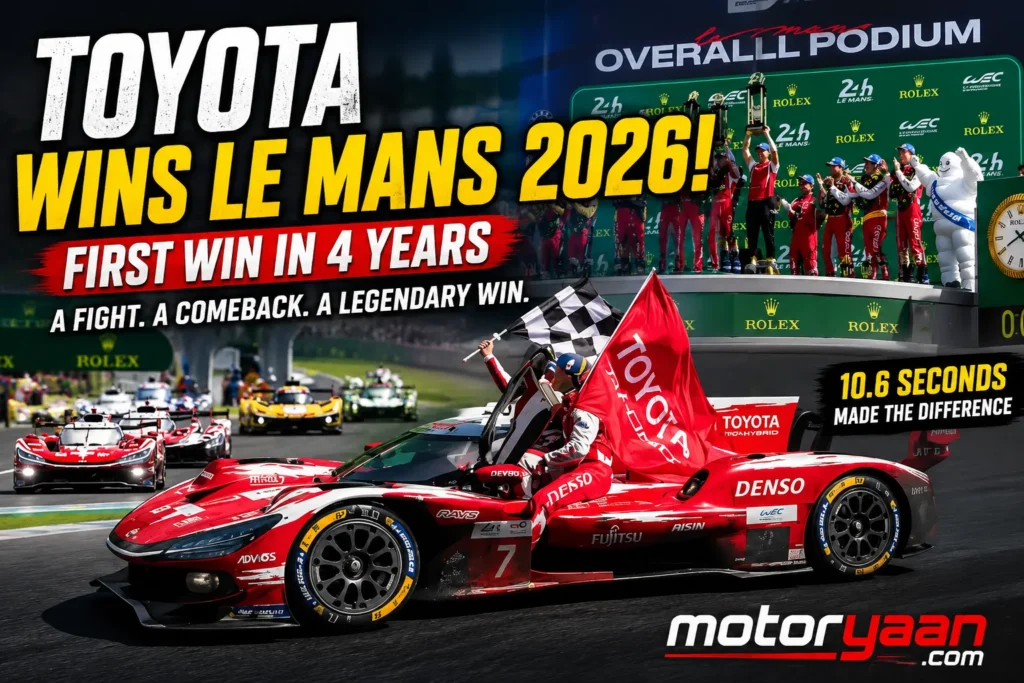
Toyota is back on top at the 24 Hours of Le Mans. After four years without an overall victory, the Japanese manufacturer fought through mechanical issues, tire problems, bad timing with safety cars, and a relentless race to claim one of its most memorable wins in recent history.
The No. 7 Toyota driven by Kamui Kobayashi, Mike Conway, and Nyck de Vries crossed the finish line just 10.6 seconds ahead of the No. 20 BMW M Hybrid V8 after 24 hours of racing. It was the fourth closest finish in the history of the legendary endurance event, proving once again that Le Mans is a race where every second matters.
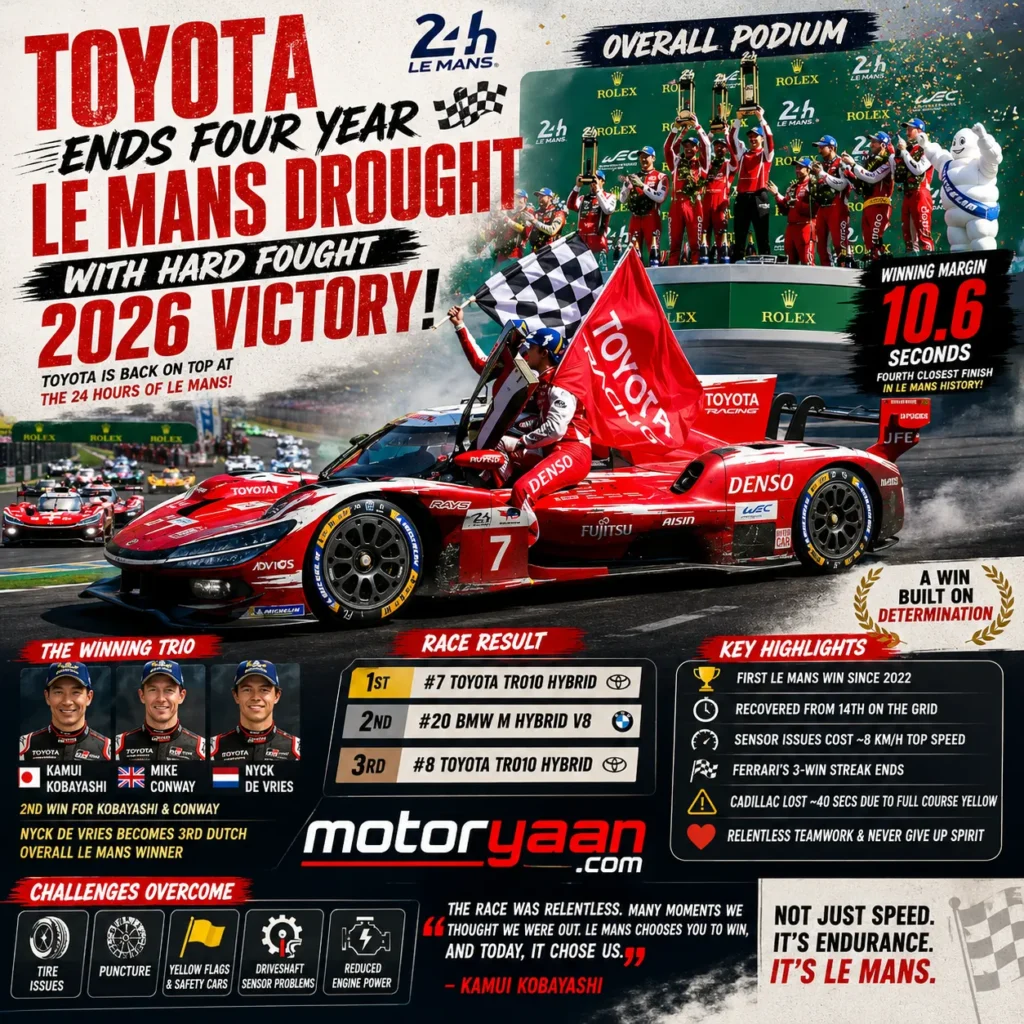
A Victory Built on Determination
Toyota last won Le Mans in 2022, ending what had been a dominant five year period at Circuit de la Sarthe. Since then, Ferrari had claimed three consecutive victories and entered the 2026 event as one of the strongest contenders.
Despite that, Toyota managed to return to the top step of the podium through consistency, strategy, and determination rather than outright pace.
For Kamui Kobayashi and Mike Conway, it was their second overall Le Mans victory, while Nyck de Vries became only the third Dutch driver to win the race overall.
Race Result
| Position | Car |
|---|---|
| 1st | No. 7 Toyota TR010 Hybrid |
| 2nd | No. 20 BMW M Hybrid V8 |
| 3rd | No. 8 Toyota TR010 Hybrid |
The winning margin of just 10.6 seconds highlighted how competitive this year’s race remained until the final lap.
Toyota Had Problems From the Very Beginning
The final result does not tell the full story.
Toyota’s No. 7 entry started the race in 14th position and was not expected to be the stronger of the two factory cars. Many believed the No. 8 Toyota had a better chance of victory.
Instead, the winning crew spent much of the race overcoming setbacks, including:
- Tire related issues
- A puncture during the race
- Poorly timed yellow flags
- Safety car interruptions
- Driveshaft sensor problems
- Reduced engine power caused by electronic issues
Each challenge could have ended their hopes, but the team continued to recover every time.
Sensor Failure Reduced Performance
Toyota Technical Director David Floury explained after the race that the car suffered from an intermittent sensor issue that repeatedly forced the system into a protective safe mode.
According to the team, the faulty sensor produced unstable readings that interfered with FIA measurements, forcing engineers to reduce power output.
The issue caused the No. 7 Toyota to lose nearly 8 km/h in top speed compared with its sister car.
At Le Mans, where long straights reward maximum speed, losing that much performance over every lap creates a significant disadvantage.
Driver Reactions Show the Pressure
Kamui Kobayashi admitted the week had been extremely difficult.
The team dealt with a puncture, power loss, and multiple unexpected problems, making every hour of the race a fight for survival.
Nyck de Vries revealed that the final stages were almost unbearable, joking that he spent the closing minutes walking around the drivers’ room and making countless trips to the restroom because of the tension.
Kobayashi also reflected on the emotional side of endurance racing, saying there were several moments when the team believed its race was over. Somehow, they kept finding a way back into contention.
That fighting spirit eventually delivered victory.
Ferrari Could Not Repeat Its Winning Form
Ferrari entered Le Mans after winning the previous three editions but struggled to match its earlier performances.
Ferrari endurance chief designer Mauro Barbieri stated that the team felt the competitive balance was not in its favour from the test sessions onward.
Although teams are not allowed to directly discuss Balance of Performance regulations, Barbieri suggested the field did not appear evenly matched and admitted Ferrari was not among the fastest cars throughout the event.
It marked the first significant struggle for Ferrari’s Hypercar programme since its return to endurance racing in 2023.
Cadillac's Strong Pace Was Not Enough
Cadillac also looked capable of fighting for victory during several stages of the race.
The No. 12 car driven by Will Stevens, Louis Deletraz, and Norman Nato showed impressive speed and remained in contention.
However, an unfortunate full course yellow late in the race forced an emergency pit stop at exactly the wrong moment.
When the race returned to green flag conditions, Cadillac had lost approximately 40 seconds, destroying its strategic advantage.
Without another caution period, recovering that lost time became almost impossible.
Why Toyota's Win Matters
Toyota’s victory was not simply about having the fastest car.
It represented years of persistence after painful defeats and missed opportunities.
Building a successful Le Mans programme requires enormous investment, technical development, and constant improvement over many seasons. Teams rarely succeed overnight.
Toyota continued refining its package despite setbacks and eventually earned another place at the top.
That journey reflects the true nature of endurance racing.
Key Highlights
- Toyota secured its first Le Mans victory since 2022.
- Kamui Kobayashi and Mike Conway earned their second overall wins.
- Nyck de Vries became only the third Dutch overall Le Mans winner.
- The winning margin was just 10.6 seconds.
- The No. 7 Toyota recovered from 14th on the grid.
- Sensor issues reduced the car’s top speed by around 8 km/h.
- Ferrari’s three race winning streak came to an end.
- Cadillac lost valuable time due to an unfortunate full course yellow.
Final Thoughts
The 2026 24 Hours of Le Mans reminded fans why endurance racing remains one of motorsport’s greatest challenges. Speed alone is never enough. Reliability, strategy, teamwork, and the ability to recover from setbacks often decide the winner.
Toyota’s No. 7 crew overcame technical failures, race incidents, and constant pressure to deliver a victory that many thought was out of reach.
After four years away from the top step, Toyota proved that persistence and resilience remain some of the most valuable qualities in endurance racing.
Sources and References
- Toyota Racing (Official)
Toyota Racing WEC
Official Toyota Racing website covering the TR010 Hybrid, team news, driver lineup, and FIA WEC participation. - 24 Hours of Le Mans (Official)
24 Hours of Le Mans Official Website
The official website of the legendary endurance race featuring news, history, schedules, results, and race information. - FIA World Endurance Championship (Official)
FIA WEC Official Website
Official source for championship standings, race results, calendars, teams, and technical regulations. - Toyota Racing Official Homepage
Toyota Racing Official
Toyota’s global motorsport portal with race previews, Le Mans history, and WEC updates. - Motorsport.com Endurance Racing
Motorsport.com Endurance Racing
One of the world’s most respected motorsport news websites, offering detailed race analysis and interviews. - Reuters Sports
Reuters Sports Motorsport
Trusted international news agency providing factual coverage of major motorsport events and results. - Toyota Global Motorsport
Toyota Gazoo Racing Global
Official global motorsport platform featuring Toyota’s racing programs, technologies, and endurance racing heritage. - IMSA Official
IMSA Official Website
Official source for North American endurance racing, useful for readers interested in Hypercar and sports car competition. - Automobile Club de l’Ouest (ACO)
ACO Official Website
Official organization behind the 24 Hours of Le Mans with historical archives and event information. - Racer Magazine
Racer Magazine
Well known North American motorsport publication covering endurance racing, IndyCar, IMSA, and Formula racing.
Toyota Ends Four Year Le Mans Drought FAQ
Who won the 2026 24 Hours of Le Mans?
The No. 7 Toyota TR010 Hybrid driven by Kamui Kobayashi, Mike Conway, and Nyck de Vries won the 2026 24 Hours of Le Mans after a dramatic race that lasted the full 24 hours.
How long had Toyota waited for another Le Mans victory?
Toyota secured its first overall Le Mans victory since 2022, ending a four year wait and returning to the top step of the podium after several difficult seasons.
What was the winning margin at Le Mans 2026?
The No. 7 Toyota crossed the finish line just 10.6 seconds ahead of the No. 20 BMW M Hybrid V8, making it one of the closest finishes in Le Mans history.
Which drivers won the race for Toyota?
Kamui Kobayashi, Mike Conway, and Nyck de Vries shared driving duties in the No. 7 Toyota TR010 Hybrid and claimed the overall victory.
Where did the winning Toyota start the race?
The winning No. 7 Toyota started from 14th on the grid and fought its way through the field despite several technical and strategic challenges.
What problems did Toyota face during the race?
The team dealt with tire issues, a puncture, poorly timed yellow flags, safety car interruptions, driveshaft sensor problems, and reduced engine power before securing victory.
Why did the Toyota lose top speed during the race?
An intermittent driveshaft sensor issue forced the car into a protective mode, reducing power output and costing nearly 8 km/h in top speed on Le Mans' long straights.
Who finished second and third at Le Mans 2026?
The No. 20 BMW M Hybrid V8 finished second, while the No. 8 Toyota TR010 Hybrid completed the podium in third place.
Why did Ferrari struggle at Le Mans 2026?
Ferrari could not match its previous pace and suggested the competitive balance was not in its favour, ending its streak of three consecutive Le Mans victories.
Why is Toyota's 2026 Le Mans victory significant?
The victory highlights Toyota's persistence and resilience after years of setbacks. The team overcame multiple race issues and proved that endurance racing rewards consistency, teamwork, and determination as much as outright speed.