Jeep and Ram Set to Lead Stellantis’s Big Global Push Through 2030
Table of Contents
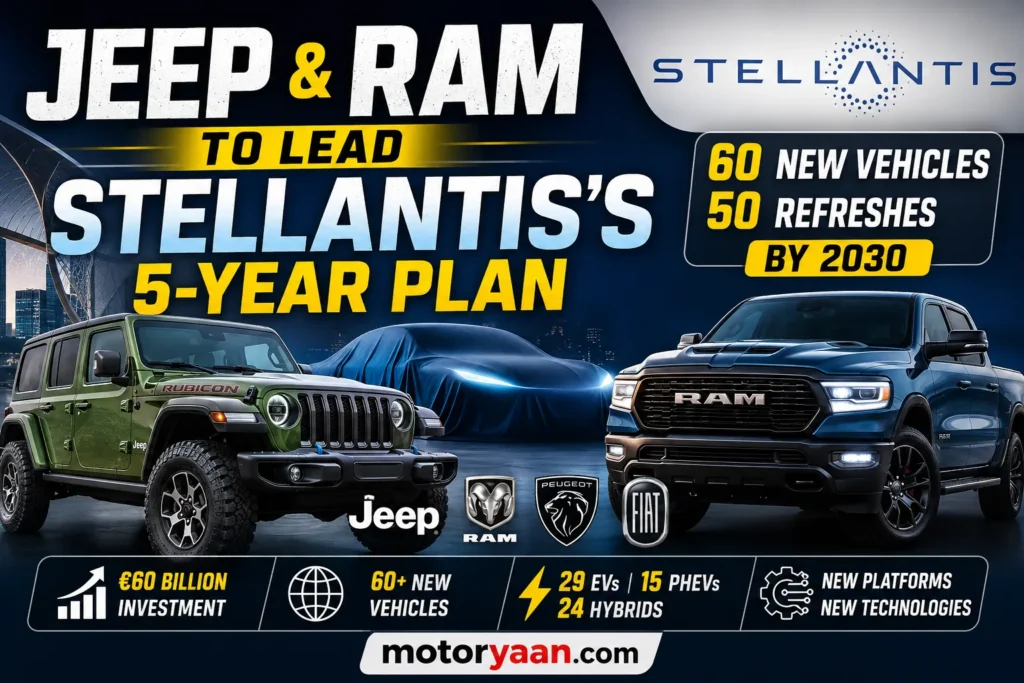
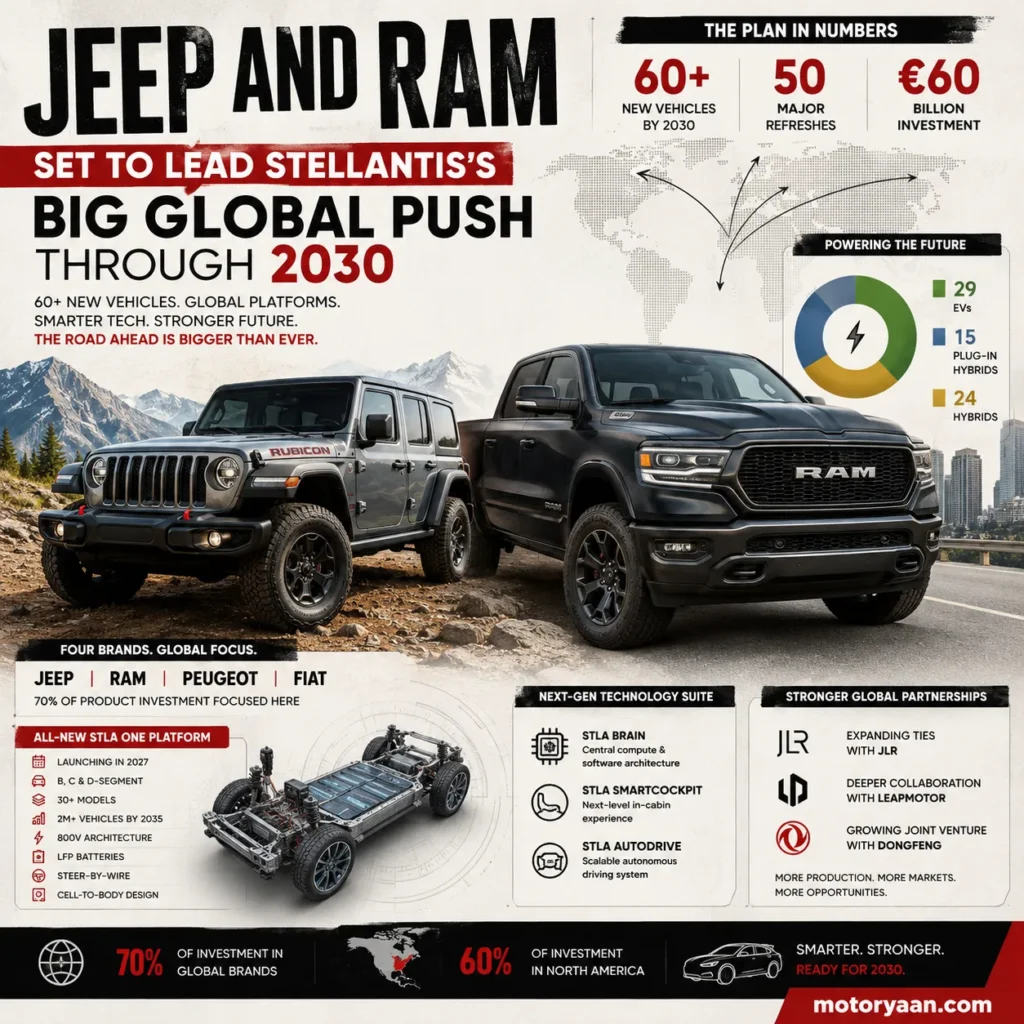
Stellantis has revealed its new five year roadmap, and the company is going all in on new vehicles, EV technology, hybrid systems, and platform sharing. The plan, officially called FaSTLAne 2030, includes over 60 billion Euros in investment and more than 60 new vehicle launches worldwide by 2030.
The biggest focus will be on four brands:
- Jeep
- Ram
- Peugeot
- Fiat
According to Stellantis, these brands have the strongest global presence and the best growth potential moving forward.
Stellantis Plans More Than 60 New Vehicles By 2030
The company confirmed that more than 60 all new vehicles and around 50 major refreshes will arrive globally over the next few years.
That includes:
| Powertrain Type | Number of Vehicles |
|---|---|
| EVs | 29 |
| Plug in Hybrids | 15 |
| Traditional Hybrids | 24 |
This clearly shows Stellantis is not abandoning gasoline and hybrid vehicles overnight. Instead, the company is spreading its bets across EVs, hybrids, and plug in hybrid technology depending on market demand.
A large part of the investment will also go toward North America, which remains one of Stellantis’s most important regions.
Jeep And Ram Will Receive Major Attention
Stellantis says 70 percent of its product related investments will go toward Jeep, Ram, Peugeot, and Fiat.
For Jeep, this likely means more electrified SUVs, new global platforms, and continued expansion in both premium and mainstream segments.
Ram is also expected to play a major role as Stellantis continues pushing into electrified trucks and next generation pickups.
Brands like Chrysler, Dodge, Citroën, Opel, and Alfa Romeo will focus more on regional markets while using shared Stellantis platforms and technologies.
Meanwhile, Lancia and DS Automobiles will operate as specialty brands focused mainly on Italy and France.
Maserati Will Get Two New Flagship Models
Maserati was also part of the announcement.
Stellantis confirmed that Maserati will receive two new E segment vehicles. Early teaser silhouettes suggest one could be a luxury SUV while the other appears to be a sedan.
The company says a detailed Maserati roadmap will arrive later this year.
New STLA One Platform Will Arrive In 2027
One of the biggest parts of the announcement was the new STLA One platform.
This modular architecture is designed for B segment, C segment, and D segment vehicles and will support more than 30 models globally. Stellantis expects the platform to underpin over 2 million vehicles annually by 2035.
The company says the platform is designed to reduce manufacturing complexity and improve cost efficiency by around 20 percent.
Key features include:
- 800 volt electrical architecture
- LFP battery technology for lower costs
- Steer by wire system
- Cell to body battery integration
The platform will also support several upcoming Stellantis software systems.
New Software And Autonomous Technology Incoming
Stellantis announced three new technology systems that will roll out by 2027:
STLA Brain
A scalable central computing and software architecture designed to support future connected vehicle systems.
STLA SmartCockpit
A new driver interface and infotainment experience focused on digital interaction inside the vehicle.
STLA AutoDrive
A scalable autonomous driving system that will expand Stellantis’s advanced driver assistance capabilities.
By 2030, Stellantis expects 35 percent of its global vehicle sales to include at least one of these technologies. That figure could rise to 70 percent by 2035.
Stellantis Expands Partnerships With JLR, Leapmotor, And Dongfeng
Stellantis also confirmed deeper cooperation with several automotive partners.
The company recently announced a collaboration with Jaguar Land Rover, commonly known as JLR.
At the same time, Stellantis plans to expand its relationship with Chinese EV company Leapmotor, where it already owns a 51 percent stake.
Both companies plan to share production capacity at two factories in Spain.
Stellantis is also increasing cooperation with Dongfeng Motor Corporation. The partnership includes plans to assemble two Peugeot models and two Jeep models in China for both domestic sales and export markets.
A new European joint venture between Stellantis and Dongfeng is also under development and will focus on increasing production in France.
What This Means For Stellantis
The company’s latest roadmap makes one thing clear. Stellantis wants fewer overlapping products, more shared technology, and stronger global platforms.
Instead of chasing only EVs, the company is keeping hybrids, plug in hybrids, and gasoline powered vehicles in the mix. That approach could help Stellantis stay flexible in markets where EV adoption remains slow.
Jeep and Ram now sit at the center of that strategy, and both brands are expected to see major product activity over the next few years.
Sources and References
- Stellantis Official Investor Day 2026 Page
Official Stellantis Investor Day page covering the FaSTLAne 2030 strategy announcement. - Stellantis Official FaSTLAne 2030 Press Release
Official company press release detailing the €60 billion investment plan and future roadmap. - Stellantis Investor Relations
Official investor relations portal with company financial reports, strategy updates, and presentations. - Car and Driver Coverage
Detailed automotive industry breakdown of Stellantis’s five year strategy and upcoming products. - Reuters Report on Stellantis 2030 Plan
Trusted global news coverage focused on investments, EV strategy, and North American plans. - Autoweek Analysis
Automotive analysis covering Stellantis brand restructuring and manufacturing strategy. - The Drive Report
Easy to understand breakdown of the new products, platforms, and technology plans. - Barron’s Automotive Business Coverage
Financial and market focused analysis of Stellantis’s long term business strategy. - Yahoo Finance Stellantis Strategy Report
Short financial overview of Stellantis’s Investor Day presentation and future goals. - Reuters Strategy Pivot Coverage
Coverage focused on Stellantis partnerships, technology expansion, and future growth plans.