Mazda CX 50 Turbo vs Volkswagen Tiguan Turbo
Two powerful compact family SUVs with very different personalities
If you are shopping for a family SUV but do not want something dull, these two sit right at the top of the mainstream compact SUV pile. Mazda has played the premium alternative card for years, starting with the CX 5. Volkswagen, on the other hand, is clearly trying to get back to its old “budget Audi” reputation with the latest Tiguan.
This comparison puts the Mazda CX 50 Turbo next to the Volkswagen Tiguan Turbo, both driven for a full week, both priced right around the forty five thousand dollar mark. Same segment, similar performance, very different execution.
Where these two SUVs sit in the market
Mazda positions the CX 50 as a sportier and more rugged companion to the CX 5. It rides on an updated Mazda 3 based platform, with a wider stance and a more aggressive look.
The Tiguan is all new for 2026. Volkswagen has clearly pushed hard on interior tech, comfort, and perceived quality. This is the most powerful Tiguan ever sold with a petrol engine.
If you want a traditional petrol SUV with strong acceleration and no electrification, these two are among the quickest options you can buy today, excluding plug in hybrids like the RAV 4 Prime.
Engines and performance numbers
Mazda CX 50 Turbo powertrain
Under the hood is a 2.5 litre turbocharged petrol engine.
Key specs
• 256 horsepower on premium fuel
• 227 horsepower on regular fuel
• 320 pound feet of torque
• Six speed automatic gearbox
• All wheel drive standard
Fuel economy is rated at 23 city, 29 highway, 25 combined. Mazda claims a theoretical range of about 395 miles.
Mazda does not publish official zero to sixty numbers, but real world testing lands around 6.7 seconds.
Volkswagen Tiguan Turbo powertrain
Volkswagen goes with a smaller but newer engine.
Key specs
• 2.0 litre turbo petrol engine
• 268 horsepower on regular fuel
• 258 pound feet of torque
• Eight speed automatic gearbox
• FourMotion all wheel drive standard
Fuel economy matches the Mazda on paper at 25 combined, with a real world range closer to 360 miles.
Real world testing shows zero to sixty in about 6.5 seconds, making it one of the quickest petrol compact SUVs you can buy.
Exterior design and road presence
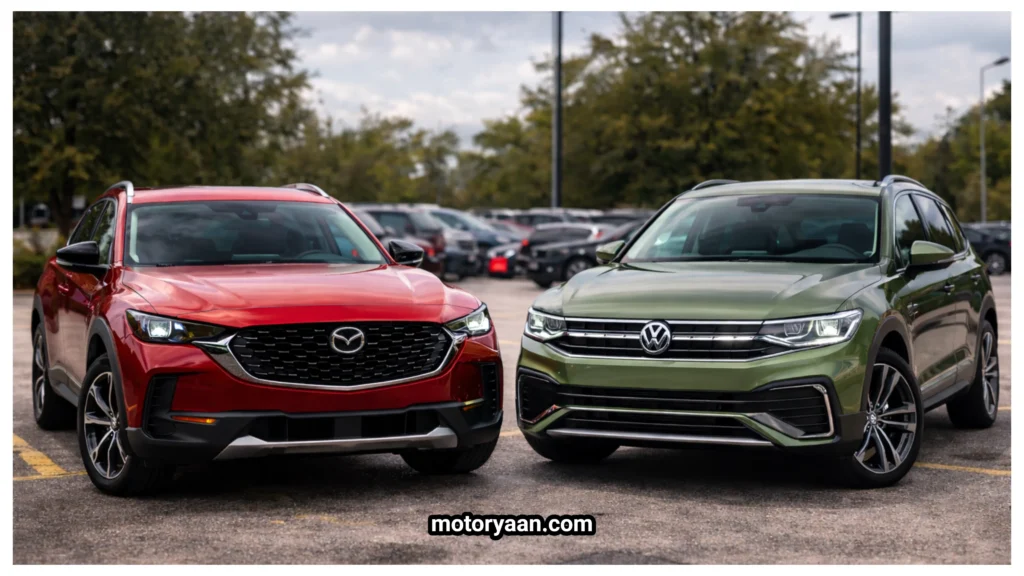
Mazda CX 50 Turbo
The CX 50 has been around since 2023, and the design has aged well.
Key exterior highlights
• Slim full LED headlights with a distinctive DRL signature
• Large five point Mazda grille with functional openings
• Heavy body cladding for a more rugged look
• 20 inch alloy wheels with a double five spoke design
• Ground clearance of around 8.6 inches
In Soul Red Crystal, the CX 50 stands out even in low light. The paint has real depth and metallic richness that is still rare in this segment.
The rear looks aggressive, with full LED tail lamps, subtle turbo badging, and exposed dual chrome exhaust tips. It feels sporty in a very Mazda way.
Volkswagen Tiguan Turbo
The Tiguan looks more modern and more tech driven.
What stands out visually
• IQ Light adaptive LED headlights
• Full width LED light bar and illuminated VW logo
• Gloss black grille with visible intercooler and radiator
• 20 inch alloy wheels with a geometric design
• Ground clearance of about 7.2 inches
From the rear, the Tiguan looks better than it does from the front. The full width LED tail lamps and illuminated badge give it a premium vibe, especially at night. The downside is the fake vent treatment on the bumper and hidden exhaust outlets.
Size, stance, and practicality
On paper, these two are closer than they look.
Mazda CX 50 dimensions
• Length 185.8 inches
• Width 75.6 inches
• Wheelbase 110.8 inches
Volkswagen Tiguan dimensions
• Length 184.8 inches
• Width 73.5 inches
• Wheelbase 109.9 inches
The Mazda is wider and slightly longer. The Volkswagen is taller, which helps with interior space and visibility.
Cargo space comparison
Cargo is where the Tiguan quietly pulls ahead.
Mazda CX 50 cargo figures
• 31 cubic feet behind rear seats
• Up to 56 cubic feet with seats folded
Volkswagen Tiguan cargo figures
• 34 cubic feet behind rear seats
• Up to 69 cubic feet with seats folded
Both offer underfloor storage and a temporary spare. Both allow you to drop the rear seats from the cargo area. In real use, the Tiguan simply feels easier to load, especially for family duty.
Interior quality and technology
Mazda CX 50 interior
Mazda has always done interiors well, but the CX 50 shows its age.
What works
• Soft touch materials on dash and doors
• Heated and ventilated front seats
• Physical climate control buttons
• Solid build quality and door feel
Where it falls behind
• Seats feel firm and uncomfortable on long drives
• Part digital instrument cluster looks dated
• 10.25 inch infotainment screen feels small and far away
• Software is slow and laggy
Rear seat space is tight despite decent numbers on paper. The seatbacks eat into knee room, and the smaller door openings make child seat installation more work than it should be.
Volkswagen Tiguan interior
This is where the Tiguan changes the game.
Highlights that matter
• Premium leather with quilting and contrast stitching
• Heated, ventilated, and massaging front seats
• 15 inch central touchscreen
• Fully digital 10.25 inch instrument display
• Head up display
• Thirty color ambient lighting
The Tiguan is the only mainstream compact SUV offering a massage function on both front seats. It sounds gimmicky until you use it on a long drive.
Rear seat space is excellent. You can stretch out, cross your legs, and still have room to spare. Heated rear seats and three zone climate control add to the family friendly feel.
Driving experience on real roads
Behind the wheel of the Tiguan
The Tiguan feels refined and balanced.
• Smooth power delivery
• Comfortable ride quality
• Strong acceleration with minimal drama
• Excellent visibility
• Quiet cabin at highway speeds
The eight speed automatic fades into the background, which is exactly what you want. In a straight line, it is quick. In corners, it feels confident without being harsh.
Behind the wheel of the CX 50
The Mazda feels more alive.
• Quicker steering response
• Better feedback through the wheel
• Less body roll
• More engine character
The downside is ride quality. The torsion beam rear suspension makes itself known over bumps. Road noise is higher, and the stiff seats do not help on longer drives.
Fuel efficiency in the real world
After a full week of mixed driving
• Tiguan averaged around 26 miles per gallon
• CX 50 averaged around 21 miles per gallon
The Volkswagen goes further on a tank and asks for regular fuel. The Mazda wants premium to deliver its full power.
Pricing and value
Base prices
• Mazda CX 50 starts around 29,000 dollars
• Volkswagen Tiguan starts just under 31,000 dollars
Turbo versions
• CX 50 Turbo starts around 38,000 dollars
• Tiguan Turbo starts around 43,000 dollars
Fully loaded models
• CX 50 Turbo about 45,600 dollars
• Tiguan Turbo about 45,400 dollars
At the top end, the prices are nearly identical. That puts the spotlight firmly on features and comfort.
Which one makes more sense?
If handling feel and driving engagement matter most, the Mazda CX 50 Turbo still delivers. It feels sporty, sounds better, and has that classic Mazda character.
If comfort, space, and technology matter more, the Volkswagen Tiguan Turbo is hard to ignore. It feels like a luxury car without the luxury badge, especially inside.
For the same money, the Tiguan simply gives you more seat comfort, more tech, more space, and better efficiency. Mazda still has its charm, but the Tiguan shows how far Volkswagen has pushed the segment forward.
There is no wrong choice here. But if you are spending around forty five thousand dollars on a family SUV, the Tiguan currently sets the benchmark.
Frequently Asked Questions
Which SUV is more powerful, the Mazda CX 50 Turbo or the Volkswagen Tiguan Turbo?
Both are among the most powerful petrol powered compact SUVs in the mainstream segment. The Volkswagen Tiguan Turbo produces 268 horsepower, while the Mazda CX 50 Turbo makes 256 horsepower on premium fuel. However, the Mazda delivers significantly more torque at 320 lb ft compared to the Tiguan’s 258 lb ft, which you can feel during hard acceleration.
Which SUV is quicker from 0 to 60 mph?
In real world testing, both SUVs are nearly identical. The Volkswagen Tiguan Turbo recorded a 0 to 60 mph time of about 6.5 seconds, while the Mazda CX 50 Turbo followed closely at roughly 6.51 seconds. In everyday driving, the difference is practically unnoticeable.
Which one offers better fuel efficiency?
The Volkswagen Tiguan Turbo is more fuel efficient in real world use. It averaged around 26 mpg during mixed driving, compared to about 21 mpg in the Mazda CX 50 Turbo. The Tiguan also runs at full power on regular fuel, while the Mazda needs premium fuel to deliver its maximum output.
Which SUV has the better interior?
The Volkswagen Tiguan Turbo clearly leads in interior design, technology, and comfort. It offers a larger touchscreen, fully digital displays, ambient lighting, massaging front seats, and more rear seat space. The Mazda CX 50 Turbo still feels solid and premium but its infotainment system and seat comfort feel dated in comparison.
Which SUV is more comfortable for long drives?
The Tiguan Turbo is the more comfortable long distance vehicle. Its independent rear suspension, softer ride, quieter cabin, and massaging seats make it easier to live with on extended trips. The Mazda CX 50 Turbo rides stiffer and has firmer seats, which can become tiring over time.
Which one handles better?
The Mazda CX 50 Turbo is the more engaging SUV to drive. It has sharper steering, less body roll, and a more connected feel on twisty roads. The Tiguan still handles well but prioritizes comfort and balance over outright sportiness.
Which SUV offers more cargo space?
The Volkswagen Tiguan Turbo provides more usable cargo space. It offers about 34 cubic feet behind the rear seats and up to 69 cubic feet with the seats folded. The Mazda CX 50 Turbo has around 31 cubic feet behind the rear seats and expands to roughly 56 cubic feet.
Which one is better for families?
For family use, the Tiguan Turbo makes more sense. It has more rear seat legroom, wider door openings for child seats, better visibility, and additional comfort features like heated rear seats and three zone climate control.
How do prices compare between the two?
The Mazda CX 50 starts cheaper at around 29,000 dollars, while the Tiguan starts just under 31,000 dollars. Fully loaded turbo models for both SUVs land close to 45,000 dollars, making them directly comparable at the top end.
Which SUV is the better buy at around 45,000 dollars?
At this price point, the Volkswagen Tiguan Turbo offers more comfort, technology, space, and everyday usability for the money. The Mazda CX 50 Turbo still appeals to drivers who value handling and a sportier feel, but overall value favors the Tiguan.