2026 Audi RS3 Review: A Small Sedan With a Big Personality
Table of Contents
The 2026 Audi RS3 is one of those cars that feels special for a reason that goes beyond its numbers. Under its compact sedan body sits a 2.5-liter turbocharged five-cylinder engine, a configuration that has become increasingly rare.
For buyers in America, the RS3 is particularly unusual because it remains the only new vehicle available there with a five-cylinder engine.
The result is a car that combines everyday usability with genuinely serious performance. It is quick enough to challenge much more powerful cars, turns sharply and delivers a character that is difficult to reproduce with a conventional four-cylinder or six-cylinder engine.
But the RS3 is not perfect. Its ride can be firm, the rear seat is tight, the trunk is small and the interior does not always feel as luxurious as its price suggests.
The biggest question, then, is whether the RS3’s distinctive character makes up for those compromises.
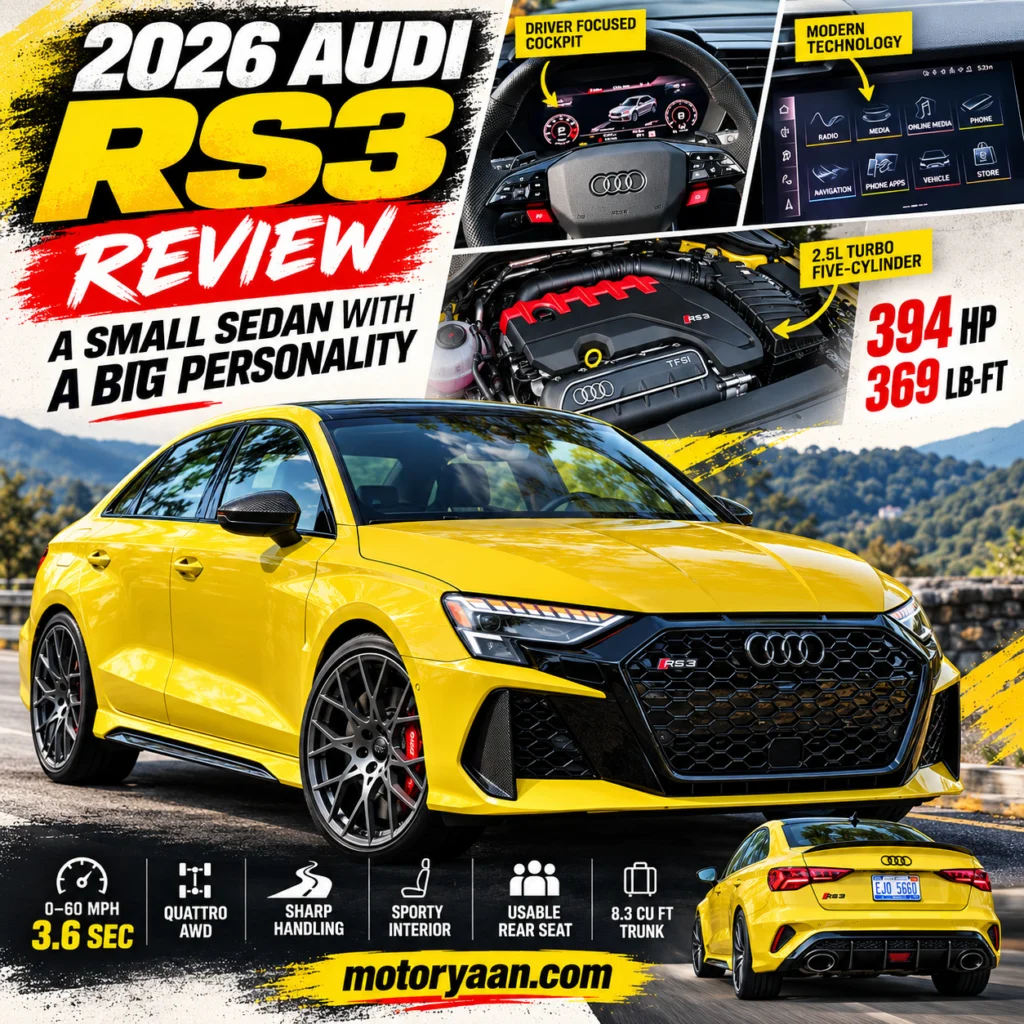
First Impressions
The RS3 is Audi’s smallest sedan, but it does not look like an ordinary A3 with a larger engine.
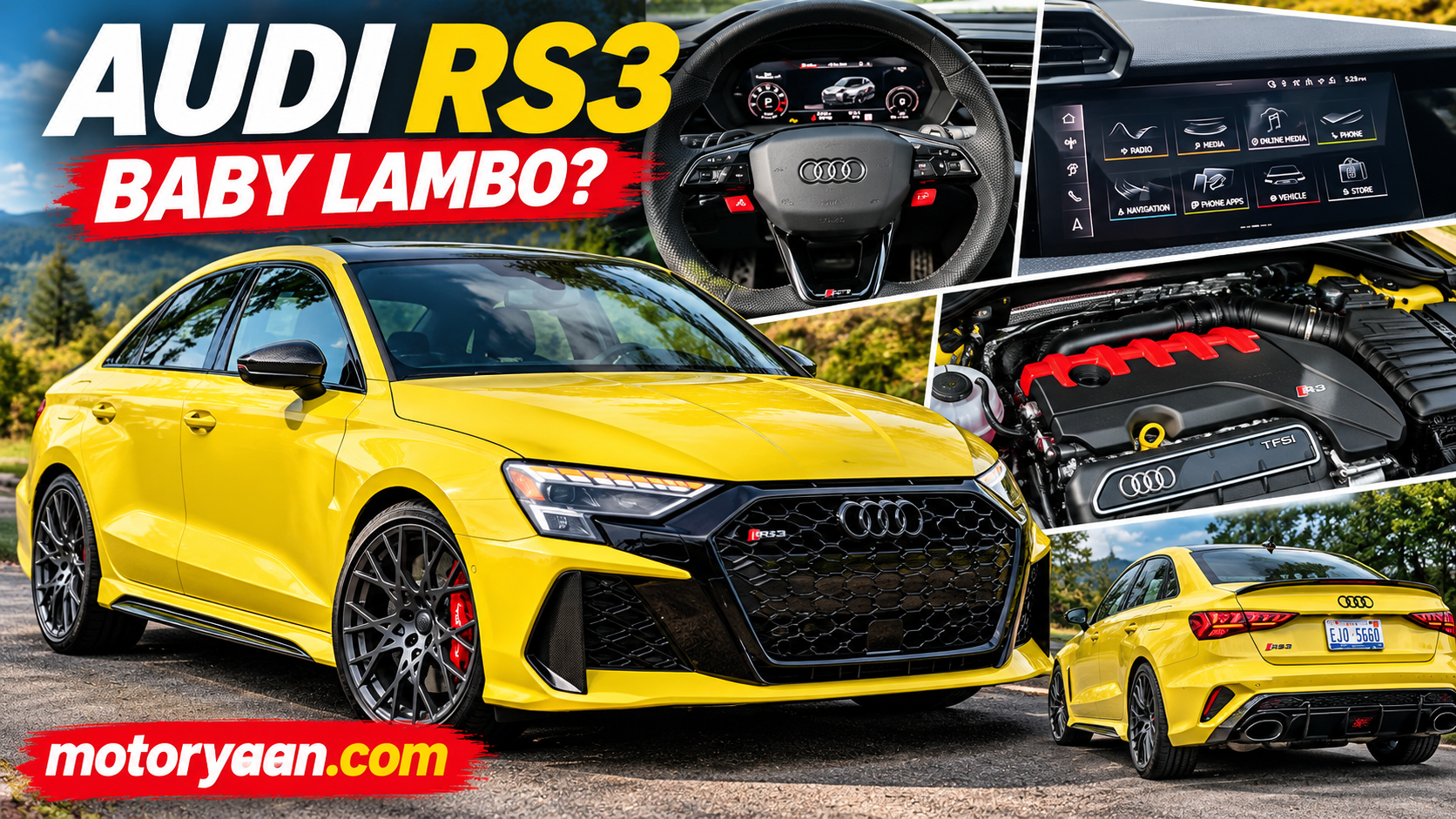
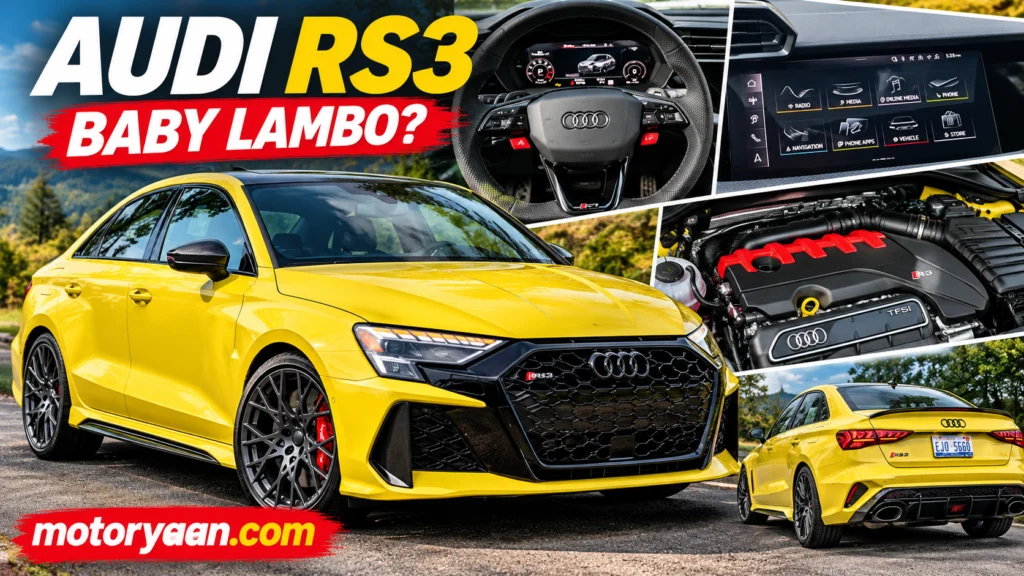
The body is around 1.5 inches wider than the regular A3 and S3, giving the RS3 a noticeably more aggressive stance. The wider fenders, 19-inch wheels, large brakes and more aggressive front and rear styling make its performance intentions obvious.
The test car’s Python Yellow metallic paint adds even more personality. The $600 color option gives the RS3 a particularly dramatic appearance, especially when combined with the black grille and carbon fiber exterior elements.
The carbon fiber package adds a functional front splitter, carbon fiber mirror caps and other exterior details. At the back, the carbon fiber spoiler and aggressive diffuser suit the car particularly well.
The large oval exhaust outlets are another reminder that this is not simply a sporty-looking compact sedan. Behind them sits the hardware responsible for much of the RS3’s personality.
And then there is the engine sound.
The five-cylinder produces a distinctive note that immediately separates the RS3 from most other cars in this class. It does not sound like a Lamborghini V10, despite the familiar enthusiast comparison, but it has enough character of its own to make the RS3 memorable.
Driving Experience
This is where the 2026 Audi RS3 makes the strongest case for itself.
The 2.5-liter turbocharged five-cylinder produces 394 horsepower and 369 lb-ft of torque. Power is sent through a seven-speed dual-clutch transmission to Audi’s quattro all-wheel-drive system with a rear torque splitter.
On paper, Audi quotes a 0 to 60 mph time of 3.6 seconds.
In testing, however, the RS3 managed 3.38 seconds using launch control. Another run produced 3.49 seconds, with the slower result affected by an uphill section. Without launch control, the car still managed around 4.2 seconds to 60 mph.
That makes the RS3 considerably quicker than its compact dimensions might suggest. The consistency of the launch control system is particularly impressive. It allows the car to produce repeatable acceleration rather than requiring the driver to perfect every launch manually.
The acceleration itself is only part of the experience.
The five-cylinder engine provides a strong sense of occasion. There is noticeable vibration and mechanical character coming through the car, particularly when driving hard. That gives the RS3 a visceral quality that is increasingly difficult to find in modern performance cars.
The engine also has a distinctive sound. It is sharp and unusual rather than simply loud, and it is one of the main reasons the RS3 feels different from its rivals.
Handling and Steering
The RS3 uses the same basic MQB architecture found underneath less exotic Volkswagen Group products, but Audi’s RS engineers have transformed how it behaves.
The car feels nimble and responsive rather than cumbersome.
The front end reacts quickly to steering inputs, while the steering itself has a fast ratio and noticeable feedback. The front tires are wider than the rear tires, with 265-section rubber at the front and 245-section tires at the rear.
That unusual staggered setup helps give the front axle plenty of grip and reduces the understeer traditionally associated with front-drive-based performance cars.
The quattro system with its rear torque splitter also allows the RS3 to distribute more drive toward the rear and between the rear wheels. This gives the car a more playful character when driven aggressively.
It does not simply feel like a car that is trying to maximize traction. It can feel lively and entertaining when the driver wants to push it.
The result is a compact sedan that can change direction quickly while maintaining a strong sense of stability.
Braking Performance
The RS3 test car’s carbon ceramic front brakes provide enormous stopping power.
They are also extremely aggressive.
The initial brake pedal bite is so strong that smooth braking can take some adjustment. A light application of the pedal can produce a surprisingly sharp response.
For enthusiastic driving, that strength is an advantage. For everyday driving, however, the brakes can feel more aggressive than necessary.
The Dynamic Plus package includes 15-inch carbon ceramic front rotors with six-piston red calipers, while the rear uses conventional iron rotors.
Ride Quality and Comfort
The RS3’s ride is one of its compromises.
In its more relaxed settings, the adaptive suspension does a reasonably good job of absorbing ordinary bumps. With the dampers in Comfort, the car can be surprisingly manageable as a daily driver.
Sharper bumps are a different story.
The 19-inch wheels and very low-profile tires leave less sidewall to absorb impacts, so rougher roads make themselves known inside the cabin.
Switch the car into its most aggressive setting and the difference becomes obvious. The suspension gets stiffer, the steering becomes heavier and sharper, and the engine becomes louder.
That setting makes the RS3 feel much more like a dedicated sports car, but it is not the mode you would want to use all day on poor roads.
For daily driving, the more relaxed settings make much more sense.
The RS3 therefore manages to remain usable, but its ride is definitely on the firm side. Buyers who prioritize comfort above all else may find it too stiff.
Engine and Transmission
The 2.5-liter five-cylinder is the heart of the RS3.
It uses a single turbocharger and produces 394 horsepower and 369 lb-ft of torque. The engine is paired with a seven-speed dual-clutch transmission.
In Sport mode, the transmission shifts quickly and aggressively, matching the character of the engine.
In normal driving, however, it becomes much less noticeable. The transmission can fade into the background and behave much like a conventional automatic.
There can occasionally be a slight stutter when pulling away or moving through heavy traffic, but it is relatively minor.
That dual personality suits the RS3 well. The same car can be aggressive when the driver wants it and reasonably relaxed when the situation demands it.
The manual mode also gives the driver genuine control. If a gear is selected manually, the transmission can hold that gear until the rev limiter rather than automatically shifting up.
Fuel Economy and Range
Despite its performance, the RS3 can return respectable fuel economy when driven sensibly.
The official ratings are 20 mpg city and 29 mpg highway.
Real-world driving produced around 26 mpg in mixed conditions. At around 65 mph on the highway, fuel economy reached approximately 31 mpg. Increasing highway speeds to around 75 to 80 mph reduced the figure to roughly 28 mpg.
That makes the RS3 more efficient than its performance suggests, provided the driver is willing to keep highway speeds reasonable.
The car also managed around 350 miles of range during testing, despite using premium gasoline.
Interior and Everyday Usability
The 2026 RS3’s cabin is a mixture of good touches and areas that remind you of its A3 roots.
The front seats are comfortable and supportive, with 12-way adjustment, memory functionality and an adjustable thigh extension. The quilted Nappa leather looks appropriate for a performance-oriented Audi.
However, the seats are not ventilated.
That is a notable omission at this price point, particularly because ventilated seats are available in considerably less expensive vehicles.
The front seats also do not hold the driver quite as securely as expected during very aggressive driving. The bolstering is supportive, but there can still be some movement.
The steering wheel is one of the cabin’s highlights. It has a chunky flat-bottom and flat-top design with perforated leather and metal-finished paddle shifters. Dedicated RS controls also make it easy to access the car’s more aggressive drive modes.
The steering wheel itself feels good in the hands, although the absence of a heated function is another surprising omission.
Audi’s 12.3-inch Virtual Cockpit remains one of the better elements of the cabin. Its graphics are customizable and the display can show navigation and other information directly in front of the driver.
The center screen measures 10.1 inches and supports wireless Apple CarPlay and Android Auto.
There are also physical climate controls, which make everyday adjustments easier than relying entirely on a touchscreen.
The wireless charging pad works reliably, although it lacks features such as ventilation and MagSafe integration.
The Sonos audio system is now standard and is one of the cabin’s stronger points. It delivers a powerful, bass-heavy sound while remaining clear when the volume is turned up.
Interior Quality
This is where the RS3 falls short of what you might expect from an expensive Audi.
There are premium touches. The real carbon fiber trim looks good, the steering wheel feels special and some of the switchgear has the quality expected from Audi.
But there is also a considerable amount of hard plastic.
The lower sections of the door panels, in particular, do not feel especially luxurious. The cabin could also use more stitching, leather and softer materials to create a warmer atmosphere.
The piano-black trim is another weak point because it quickly collects fingerprints and smudges.
Overall, the interior feels premium enough, but it does not consistently feel luxurious enough for the price of the car.
That is an important distinction.
The RS3 may have the performance of a serious premium sports sedan, but parts of its cabin still remind you that the car shares its basic architecture with much more affordable models.
Rear Seat Experience
The rear seats are usable, but this is not a spacious sedan.
There is around 35 inches of rear legroom, and a shorter adult can fit reasonably well behind a properly positioned front seat.
There is enough foot space, and the rear passengers get useful features including air vents, two USB-C ports, storage areas, adjustable headrests and a fold-down armrest with cupholders.
The problem is headroom.
The sunroof takes up some of the available space, and rear headroom is limited. The center floor hump also makes the middle seating position less attractive for an adult.
The rear doors also use harder materials than the front doors.
For children and smaller adults, the back seat adds useful practicality. For taller passengers or long-distance journeys with four adults, the RS3’s compact dimensions become much more obvious.
Practicality
The RS3 is a sedan first and a practical family car second.
The trunk provides only 8.3 cubic feet of cargo capacity, which is small compared with some rivals.
The rear seats split 40/20/40, allowing the center section to fold down when carrying longer items. There is also some underfloor storage, although there is no spare wheel.
For everyday shopping or a couple of bags, the trunk should be sufficient. But if cargo capacity is a priority, the RS3 is not the strongest choice.
Other markets receive an RS3 hatchback, but the American model remains a sedan.
That limits its practicality compared with some alternatives.
Technology and Controls
The 2026 RS3 uses Audi’s older interior technology before a significantly redesigned cabin arrives for the 2027 model year.
The existing setup has a more traditional appearance, which may actually appeal to buyers who prefer physical controls and a conventional dashboard layout.
The 10.1-inch touchscreen supports wireless smartphone connectivity, while built-in navigation is also standard.
The 360-degree camera is useful, although its image quality is not class-leading.
The volume control is another area that could be improved. The rotary control can feel somewhat laggy and finicky compared with a conventional knob.
On the positive side, the cabin still provides physical climate controls and several straightforward controls for the driving modes.
What Works Well
The five-cylinder engine gives the RS3 genuine character.
Acceleration is seriously quick, with a tested 3.38-second 0 to 60 mph run.
Launch control is consistent and easy to use.
Quattro all-wheel drive provides strong traction and playful handling characteristics.
The steering feels quick and communicative.
Front-end grip is excellent.
The seven-speed dual-clutch transmission works well in both aggressive and relaxed driving.
The car remains relatively easy to drive every day.
Fuel economy can be surprisingly good on the highway.
The front seats are comfortable and supportive.
The 12.3-inch digital instrument display remains attractive and useful.
The Sonos audio system delivers strong sound quality.
The RS3 has a distinctive character that is difficult to find elsewhere.
What Could Be Better
The ride is firm, particularly on 19-inch wheels and low-profile tires.
Sport and Dynamic modes can be too harsh for everyday roads.
Carbon ceramic brakes have an extremely aggressive initial bite.
The front seats are not ventilated.
The steering wheel is not heated.
Rear-seat space is limited, particularly for taller passengers.
Rear door materials are noticeably cheaper than those at the front.
The trunk is small.
The interior does not feel as luxurious as its price suggests.
Piano-black trim attracts fingerprints and smudges.
Some controls and the volume interface can feel unnecessarily finicky.
Higher option levels push the price close to $80,000.
2026 Audi RS3 Price and Value
The RS3’s price has risen considerably since this generation was introduced.
The base price is around $66,000, compared with roughly $40,000 for an A3 and around $52,000 for an S3.
That makes the jump from an S3 to an RS3 significant.
The situation becomes more difficult when expensive options are added. The test car, equipped with Python Yellow, the Dynamic Plus package, carbon fiber package and other equipment, reached around $77,000 including destination.
At that price, the RS3 starts to become difficult to justify purely on value.
Keeping the options under control changes the equation. A car priced around $67,000 to $68,000 makes considerably more sense, particularly when its performance and unique five-cylinder engine are taken into account.
The RS3 also occupies an interesting position against cars such as the BMW M2, Mercedes-AMG CLA45 and Acura Integra Type S.
Each offers something different. The Integra is less expensive and offers a manual transmission, while the M2 provides substantially more power. The RS3’s advantage is the combination of compact dimensions, all-wheel drive, five-cylinder character and everyday usability.
Verdict
The 2026 Audi RS3 is not the most comfortable, spacious or luxurious car in its class.
It does not have the biggest trunk, the most accommodating rear seat or the richest interior for the money.
But that is not why you buy an RS3.
You buy it because the five-cylinder engine gives the car a personality that is increasingly difficult to find. You buy it because the engine sounds different, the car launches brutally hard and the steering and front end make it feel alive when you start pushing.
The RS3 also manages something important for a performance car: it can still be used every day.
Put it in a relaxed drive mode and the transmission becomes smooth, the suspension becomes more tolerable and the car is easy to live with. Switch to its aggressive settings and the character changes dramatically.
That dual personality is one of its biggest strengths.
The ride is the main compromise. The 19-inch wheels and firm suspension can make rough roads uncomfortable, while the aggressive brake pedal requires some adjustment. The interior also leaves you wanting more luxury for the money.
Then there is the price.
Around $67,000 to $68,000 with sensible options, the RS3 makes a strong case for itself. Near $80,000, the value proposition becomes much harder to defend.
Still, the RS3 has something many of its rivals cannot offer: genuine uniqueness.
It is a compact performance sedan with nearly 400 horsepower, all-wheel drive and a five-cylinder engine that gives it a sound and character all its own.
For someone who wants a fast daily driver that feels more special than an ordinary performance compact, the 2026 Audi RS3 remains an unusually compelling choice.
It may not be a baby Lamborghini in the literal sense, but it certainly has enough personality to understand why enthusiasts make the comparison.
Sources & References
Official sources
Audi USA 2026 RS 3 Official Page — Official US specifications, pricing, performance, features and equipment for the 2026 RS 3.
Audi Canada 2026 RS 3 Official Page — Canadian-market specifications, performance information, design and technology details.
Audi USA Sedan Models — Useful official reference for the RS 3’s position within Audi’s US sedan lineup and its key performance figures. Audi
Unofficial automotive sources
Car and Driver 2026 Audi RS3 Review — Detailed US review covering performance, pricing, fuel economy, interior space and driving impressions.
MotorTrend 2026 Audi RS3 First Test — Excellent source for independent acceleration, handling, braking and real-world driving impressions.
MotorTrend 2026 Audi RS3 Expert Review — Useful overview of performance, practicality, standard equipment, competitors and ownership considerations.
Edmunds 2026 Audi RS 3 Consumer Reviews — Useful for real-owner perspectives on driving experience, comfort, handling, acceleration and daily usability.
Car and Driver Audi RS3 Lightning Lap 2026 — Useful additional performance reference showing how the RS3 performs in demanding track conditions.
2026 Audi RS3 FAQs
Here are some of the most common questions about the 2026 Audi RS3, including its performance, driving experience, comfort, interior, practicality and value.
How fast is the 2026 Audi RS3 from 0 to 60 mph?
Audi quotes a 0 to 60 mph time of 3.6 seconds for the 2026 RS3. In testing, the car reached 60 mph in 3.38 seconds using launch control, while another run took 3.49 seconds. Without launch control, it still managed around 4.2 seconds to 60 mph.
What engine does the 2026 Audi RS3 have?
The 2026 Audi RS3 uses a 2.5-liter turbocharged five-cylinder engine. It produces 394 horsepower and 369 lb-ft of torque. The five-cylinder layout also gives the RS3 a distinctive engine note and a mechanical character that separates it from many four-cylinder performance cars.
Does the 2026 Audi RS3 have all-wheel drive?
Yes. The 2026 Audi RS3 comes with quattro all-wheel drive and a rear torque splitter. The system can send more drive toward the rear and between the rear wheels, helping the car remain stable while also giving it a more playful character when driven aggressively.
How does the 2026 Audi RS3 handle?
The RS3 feels nimble, responsive and stable. Its steering has a quick ratio and noticeable feedback, while the wider 265-section front tires provide strong front-end grip. The quattro system with the rear torque splitter also helps reduce the understeer traditionally associated with front-drive-based performance cars.
Is the 2026 Audi RS3 comfortable for daily driving?
The RS3 can work well as a daily driver when its more relaxed drive settings are used. The adaptive suspension does a reasonable job of absorbing ordinary bumps in Comfort mode. However, the ride remains firm, especially over sharper bumps because of the 19-inch wheels and low-profile tires.
Is the Audi RS3 ride too stiff?
The ride is on the firm side. Comfort mode makes the RS3 considerably easier to live with, but rougher roads can still be felt inside the cabin. The more aggressive settings make the suspension stiffer and the steering sharper, which is better suited to enthusiastic driving than everyday use on poor roads.
How is the dual-clutch transmission in the 2026 Audi RS3?
The RS3 uses a seven-speed dual-clutch transmission. In Sport mode, it shifts quickly and aggressively to match the engine's character. During normal driving, it becomes much less noticeable and behaves much like a conventional automatic. There can occasionally be a slight stutter when pulling away or moving through heavy traffic.
What fuel economy does the 2026 Audi RS3 get?
The official fuel economy figures are 20 mpg city and 29 mpg highway. Real-world driving produced around 26 mpg in mixed conditions. At approximately 65 mph, highway economy reached about 31 mpg, while driving around 75 to 80 mph reduced it to roughly 28 mpg.
How much highway range does the 2026 Audi RS3 have?
The RS3 managed around 350 miles of range during testing while using premium gasoline. Actual range will depend on driving style, road conditions and speed, but the car can be surprisingly efficient when driven sensibly.
Is the 2026 Audi RS3 interior luxurious?
The RS3 interior has several premium touches, including real carbon fiber trim, a quality steering wheel and a 12.3-inch digital instrument display. However, there is also a noticeable amount of hard plastic, particularly in the lower sections of the doors. The cabin feels premium overall, but it does not always feel as luxurious as its price suggests.
Does the 2026 Audi RS3 have Apple CarPlay and Android Auto?
Yes. The 2026 Audi RS3 has a 10.1-inch center touchscreen with wireless Apple CarPlay and Android Auto. Built-in navigation is also available, while the cabin retains physical climate controls for easier everyday adjustments.
Are the front seats of the 2026 Audi RS3 comfortable?
The front seats are comfortable and supportive, with 12-way adjustment, memory functionality and an adjustable thigh extension. However, they are not ventilated and do not hold the driver as securely as expected during very aggressive driving.
Is the 2026 Audi RS3 good for rear-seat passengers?
The rear seats are usable but relatively tight. There is around 35 inches of rear legroom, and shorter adults can fit reasonably well. Rear passengers also get air vents, two USB-C ports, storage areas, adjustable headrests and a fold-down armrest with cupholders. Headroom is more limited, especially with the sunroof, and the center floor hump makes the middle position less comfortable for adults.
How much cargo space does the 2026 Audi RS3 have?
The 2026 Audi RS3 sedan has 8.3 cubic feet of trunk space. The rear seats have a 40/20/40 split, which adds some flexibility for carrying longer items. There is also underfloor storage, but the car does not have a spare wheel.
How much does the 2026 Audi RS3 cost?
The base price of the 2026 Audi RS3 is around $66,000 based on the pricing discussed in the review. With sensible options, a price around $67,000 to $68,000 makes the car easier to justify. A heavily equipped example with Python Yellow paint, the Dynamic Plus package, carbon fiber package and other equipment reached around $77,000 including destination.
Is the 2026 Audi RS3 worth the money?
The RS3 makes a stronger value case when its options are kept under control. Around $67,000 to $68,000, it combines nearly 400 horsepower, all-wheel drive, a five-cylinder engine and everyday usability in a compact sedan. Once the price approaches $80,000, the value becomes much harder to defend because the car still has a firm ride, limited rear space, a small trunk and an interior that does not always feel as luxurious as the price suggests.
What are the main advantages of the 2026 Audi RS3?
The biggest strengths are the distinctive five-cylinder engine, very quick acceleration, consistent launch control, strong quattro traction, sharp steering, excellent front-end grip and the ability to remain usable as a daily driver. Its combination of compact dimensions, performance and engine character also gives it a personality that is difficult to find elsewhere.
What are the main disadvantages of the 2026 Audi RS3?
The main compromises are the firm ride, aggressive carbon ceramic brake pedal response, limited rear-seat space, small trunk, lack of ventilated front seats, lack of a heated steering wheel and an interior that does not feel consistently luxurious for the price. Higher option levels can also push the RS3 close to $80,000.
What makes the 2026 Audi RS3 different from its rivals?
The RS3 stands out through its combination of a five-cylinder engine, quattro all-wheel drive, compact dimensions and everyday usability. Cars such as the BMW M2, Mercedes AMG CLA45 and Acura Integra Type S offer different strengths, but the RS3's particular mix of engine character, traction and performance gives it a distinctive position in the segment.