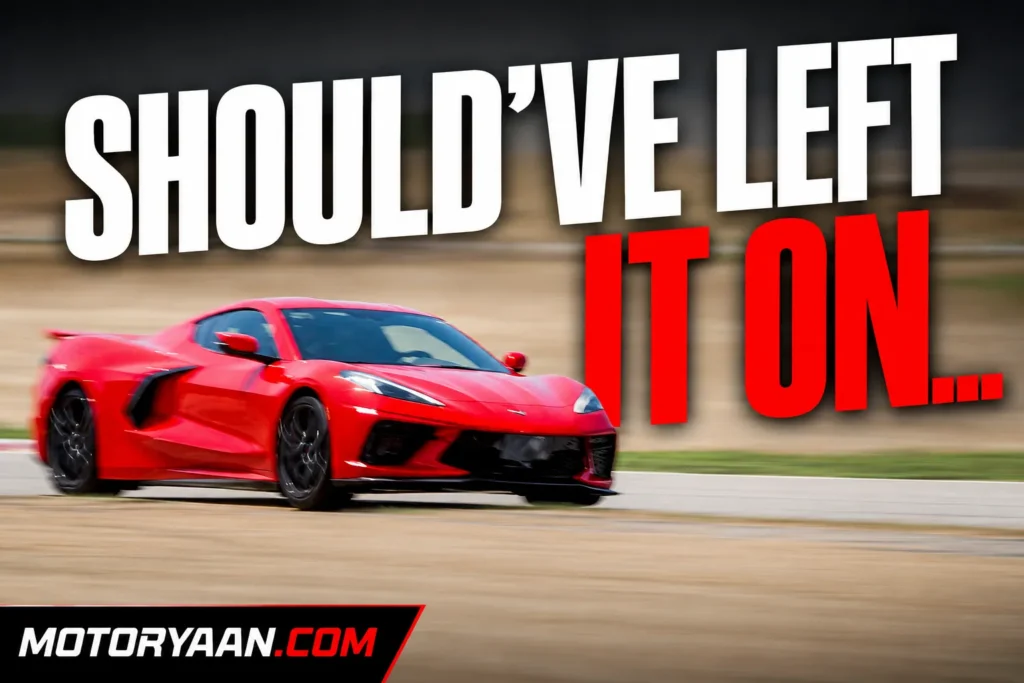
Want Faster Lap Times? Leaving Traction Control On Might Actually Make You Quicker
Table of Contents
For years, performance driving culture has followed a simple ritual. Start the car, buckle up, and switch the traction control system off before heading onto the track. Many enthusiasts believe disabling electronic assistance unlocks the car’s full potential.
Modern performance cars, however, are changing that idea.
Recent testing with the 2026 Chevrolet Corvette C8 shows that keeping the traction control system active can actually produce faster and smoother lap times, even for experienced drivers.
Modern Traction Control Is Very Different From Older Systems
Older traction control systems worked in a simple way. When wheel slip was detected through the ABS sensors, the system reduced engine power to regain grip. While effective for safety, these early systems often interrupted acceleration and limited performance.
Today’s technology is significantly more advanced.
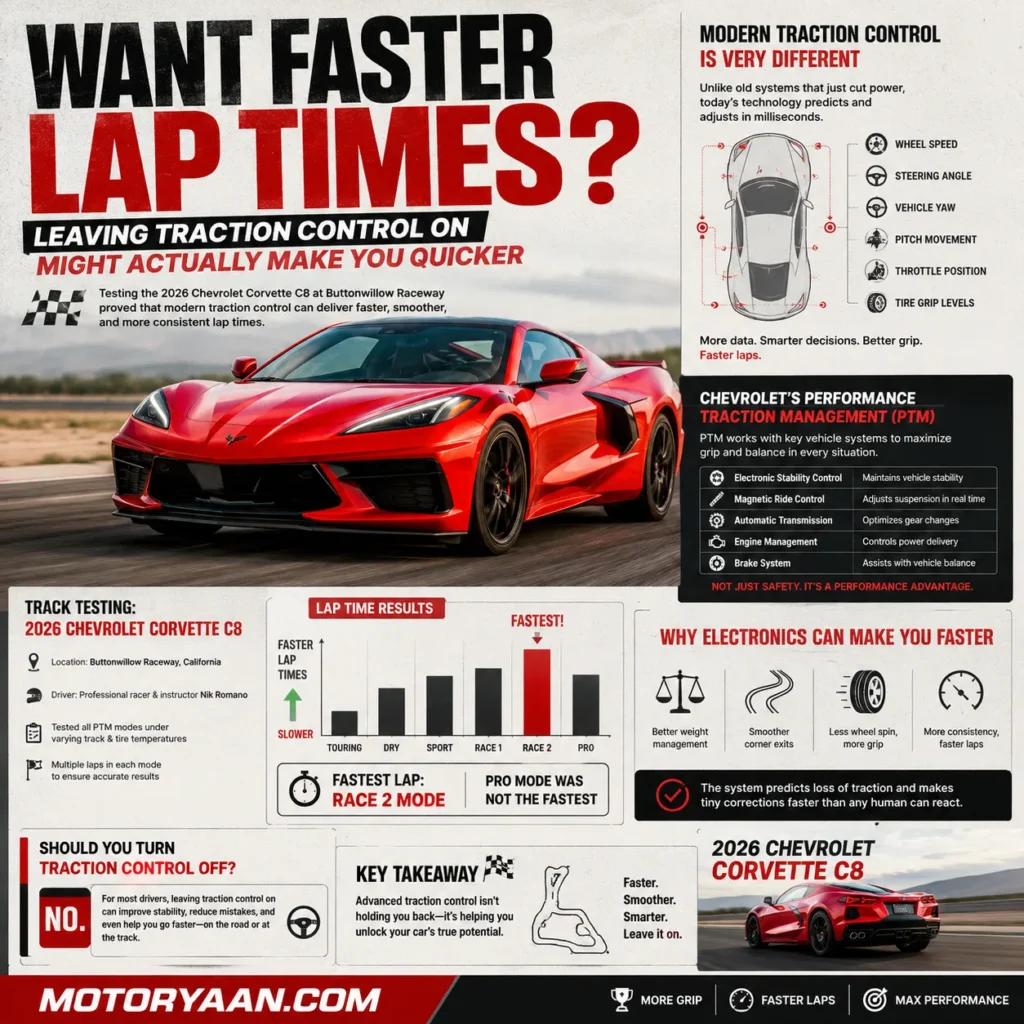
Modern traction management systems constantly monitor multiple vehicle parameters, including:
- Wheel speed
- Steering angle
- Vehicle yaw
- Pitch movement
- Throttle position
- Tire grip levels
Instead of simply cutting power, these systems predict how the car will behave and make tiny adjustments before the driver even notices a loss of control.
That allows the vehicle to stay balanced while maintaining maximum possible acceleration.
Chevrolet's Performance Traction Management Explained
General Motors uses an advanced system called Performance Traction Management (PTM) on its high performance Chevrolet and Cadillac models.
PTM works alongside several vehicle systems, including:
| System | Function |
|---|---|
| Electronic Stability Control | Maintains vehicle stability |
| Magnetic Ride Control | Adjusts suspension in real time |
| Automatic Transmission | Optimizes gear changes |
| Engine Management | Controls power delivery |
| Brake System | Assists with vehicle balance |
Rather than acting as a simple safety feature, PTM becomes a performance tool that helps drivers maximize grip under different track conditions.
Track Testing With the 2026 Chevrolet Corvette C8
Professional racing driver and high performance driving instructor Nik Romano tested the 2026 Chevrolet Corvette C8 at California’s Buttonwillow Raceway.
The goal was straightforward.
Test every available PTM mode under varying track and tire temperatures while recording lap times to determine whether electronic assistance helps or hurts overall performance.
The Corvette was driven in multiple settings:
- Touring
- Dry
- Sport
- Race modes
- Pro mode, where most electronic intervention is removed
Several laps were completed in each mode to reduce inconsistencies caused by changing conditions.
The Fastest Lap Was Not With Traction Control Off
Many drivers assume that Pro mode, with minimal electronic assistance, would deliver the quickest lap time.
The testing showed the opposite.
The fastest lap came in Race 2 mode, not Pro mode.
Touring mode was the slowest, which is expected since it prioritizes comfort and stability. However, completely removing electronic assistance did not produce the best result.
Data analysis also revealed another important finding.
The driver was smoother and more consistent while PTM remained active.
Smooth inputs help maintain tire grip, improve corner exits, and reduce unnecessary wheel spin, all of which contribute to faster lap times.
Why Electronics Can Make You Faster
On a race track, managing weight transfer is critical.
Every braking zone, steering input, and throttle application shifts the vehicle’s balance. Modern traction management systems constantly monitor these changes through sensors that measure pitch and yaw.
Instead of waiting for the car to lose traction, the system predicts instability and makes extremely small corrections.
For most drivers, those corrections happen faster than any human reaction.
The result is improved confidence, better corner exits, and more consistent lap times.
High Horsepower Cars Depend on These Systems
Performance cars have become dramatically more powerful over the past two decades.
General Motors now offers several rear wheel drive performance models producing well over 400 horsepower. Advanced traction management systems have played a major role in making these vehicles easier to drive on both roads and race tracks.
Without sophisticated electronics, controlling that level of power would require far greater driver skill.
These systems allow enthusiasts to enjoy high performance while maintaining stability when conditions become challenging.
Should You Turn Traction Control Off?
For most drivers, the answer is probably no.
Modern traction control systems are designed to enhance performance rather than restrict it. On both public roads and race circuits, they can improve stability, reduce mistakes, and even help deliver quicker lap times.
Experienced professional drivers may still prefer complete control in certain situations, but testing suggests that even skilled racers can benefit from advanced performance traction management systems.
If your goal is simply to drive faster and more consistently, leaving traction control on could be the smarter choice.
Final Thoughts
The belief that switching traction control off automatically makes a car faster is becoming outdated. Advances in vehicle electronics have transformed traction management from a safety feature into a genuine performance advantage.
Real world testing with the 2026 Chevrolet Corvette C8 demonstrated that an optimized performance mode delivered quicker and smoother laps than driving with electronic assistance disabled.
The next time you head onto a race track, it may be worth leaving the system on and letting modern engineering work alongside your driving skills.
Sources & References
The original report covering track testing of the 2026 Chevrolet Corvette C8 and explaining why leaving Performance Traction Management enabled resulted in quicker and smoother lap times.
2. Chevrolet 2025 Corvette Track Preparation Guide (Official)
Official Chevrolet track guide explaining Driver Modes, Performance Traction Management (PTM), Competitive Driving Mode, and recommended settings for track use.
3. Chevrolet Corvette Performance Reference Guide (Official GM PDF)
Official owner reference detailing PTM modes, traction control operation, ESC functions, launch control, and Corvette performance features.
4. Road & Track – Performance Traction Management: How It Works
Independent performance test explaining how GM’s PTM system can help even professional drivers achieve faster lap times than driving with all electronic aids disabled.
5. GM Authority – 2026 Corvette PTM Pro Mode
Covers the new PTM Pro mode for the 2026 Corvette and explains how it differs from Race modes by disabling traction and stability control while retaining ABS.
6. Corvette Forum (Community Technical Discussion)
Corvette owners and experienced track drivers discuss PTM behavior, corner exit strategy, and real world use of the system on track.
7. Taylor Chevrolet – Understanding Traction Control Systems
Beginner friendly guide explaining how modern traction control systems work, when they activate, and how they improve vehicle stability and safety.