Tesla FSD Can Reportedly Be Fooled by a Doll Head, Raising Fresh Questions About Driver Monitoring
Table of Contents
Tesla’s Full Self Driving technology has always been one of the most talked about driver assistance systems in the automotive industry. While the company continues to expand its self driving ambitions and robotaxi services, the system still requires an attentive human behind the wheel.
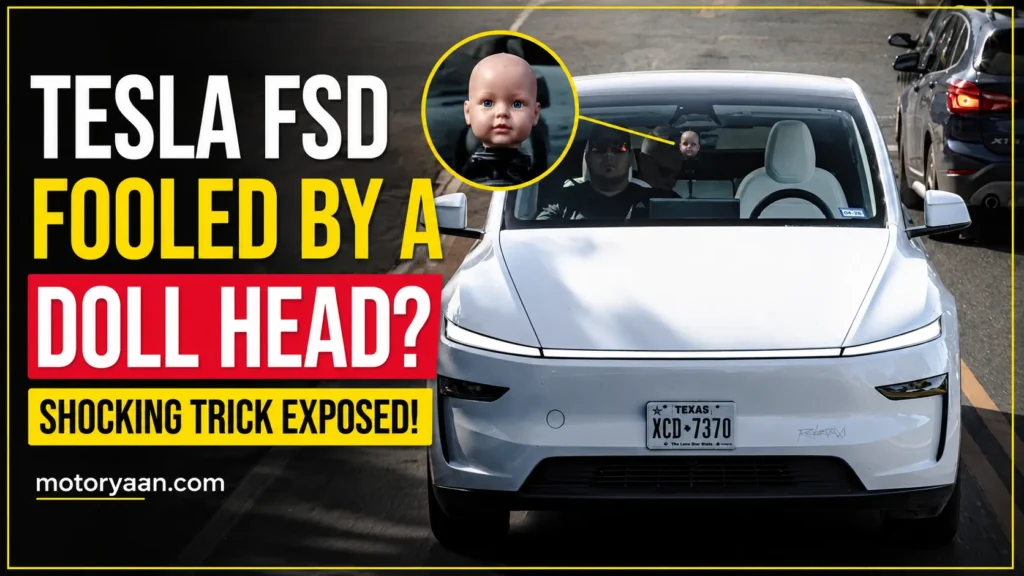
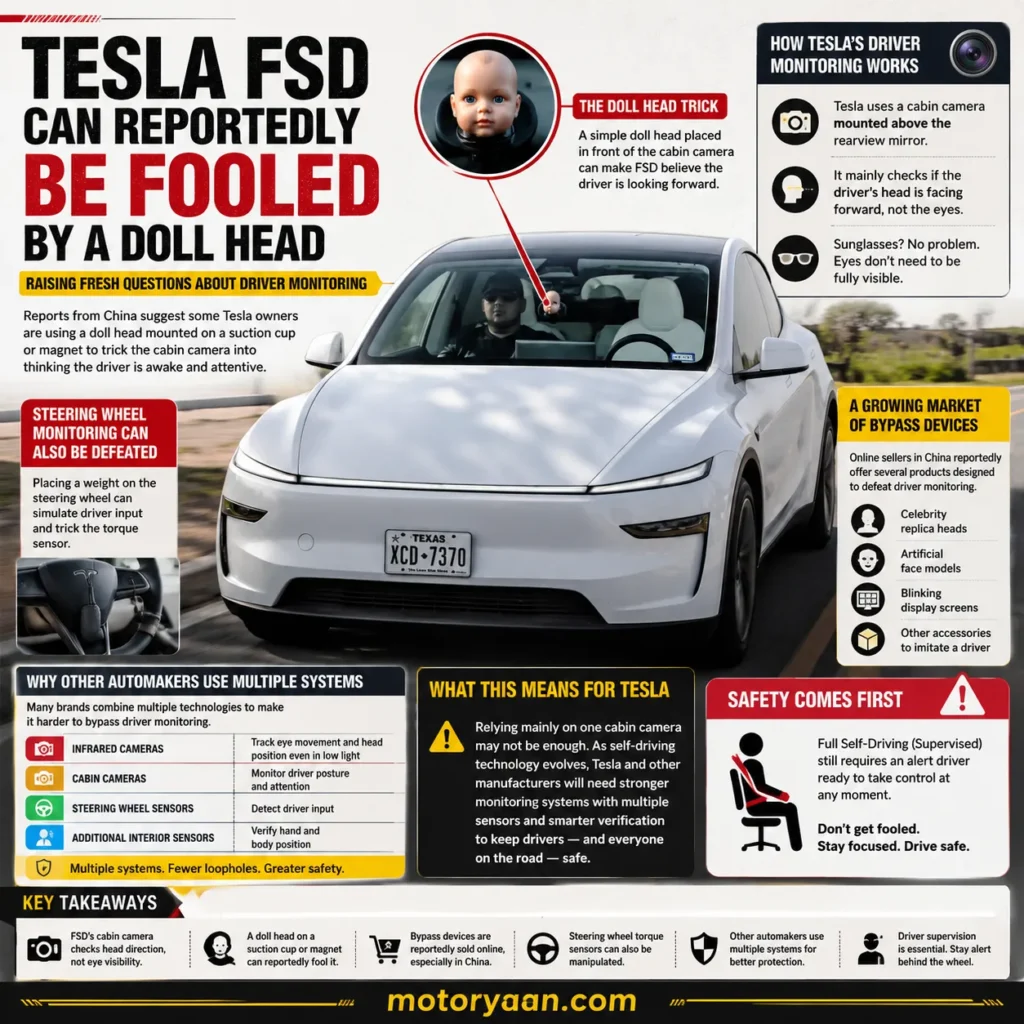
However, reports from China suggest that some Tesla owners have found a surprisingly simple way to trick the driver monitoring system. By using a doll head attached to a suction cup or magnet, they can reportedly make the vehicle believe the driver is looking at the road even when they are not.
How Tesla's Driver Monitoring System Works
Tesla’s Full Self Driving (Supervised) mainly relies on a cabin camera mounted above the rearview mirror to monitor driver attention.
Instead of tracking only the driver’s eyes, the system primarily checks whether the driver’s head is facing forward. According to Tesla’s owner documentation, the cabin camera does not require full visibility of the driver’s eyes to determine attentiveness. This allows the system to work even when the driver wears sunglasses.
That design choice improves usability but may also create an unexpected weakness.
The Doll Head Trick Explained
According to reports, some Tesla owners in China have mounted a doll head on a suction cup or magnetic holder and positioned it directly in front of the cabin camera.
When aligned correctly with the driver’s body, the camera may interpret the artificial head as a real person facing forward. Some users reportedly use Tesla’s interior Camera Preview available in the Service menu to position the doll head accurately.
The method has gained attention because it appears to bypass one of the key safety features designed to ensure drivers remain engaged while using Full Self Driving (Supervised).
Driver Monitoring Bypass Devices Are Becoming a Market
The idea goes beyond simple doll heads.
Reports indicate that several products are available online in China that claim to defeat driver monitoring systems. These include:
- Celebrity replica heads
- Artificial face models
- Blinking display screens
- Other accessories designed to imitate a driver’s presence
The growing availability of such products highlights an emerging aftermarket focused on bypassing vehicle safety systems rather than improving them.
Steering Wheel Monitoring Can Also Be Defeated
Tesla also uses a steering wheel torque sensor as a secondary method of checking driver engagement.
The system expects slight steering inputs from the driver during operation. However, people have demonstrated that placing a weight on the steering wheel can sometimes imitate the required resistance, making it appear as though someone is holding the wheel.
If both monitoring methods can be manipulated, the overall effectiveness of supervised driving assistance may be reduced.
Why Other Automakers Use Multiple Systems
Many modern driver assistance systems do not rely on a single cabin camera.
Several manufacturers combine multiple technologies, including:
| Driver Monitoring Technology | Purpose |
|---|---|
| Infrared Cameras | Track eye movement and head position even in low light |
| Cabin Cameras | Monitor driver posture and attention |
| Steering Wheel Sensors | Detect driver input |
| Additional Interior Sensors | Verify hand and body position |
Using several monitoring systems together makes it more difficult to bypass safety features with simple physical objects.
What This Means for Tesla
Tesla has played a major role in bringing advanced driver assistance technology to mainstream buyers. However, incidents like this suggest that camera based monitoring alone may not be sufficient for ensuring driver attention.
As self driving technology evolves, manufacturers will likely need stronger and more sophisticated monitoring systems that combine multiple sensors and verification methods.
Improving driver monitoring will become increasingly important as assisted driving features continue to expand worldwide.
Safety Comes First
Although some users may view these tricks as clever hacks, defeating driver monitoring systems creates serious safety risks.
Full Self Driving (Supervised) still requires the driver to remain alert and ready to take control at any moment. Using devices to bypass these safeguards can increase the risk of accidents and defeats the purpose of the technology.
For anyone using advanced driver assistance systems, staying attentive behind the wheel remains the safest and most responsible approach.
Key Takeaways
- Tesla’s cabin camera mainly checks whether the driver’s head faces forward.
- Reports from China suggest a doll head mounted on a suction cup or magnet can fool the system.
- Some online sellers reportedly offer products specifically designed to bypass driver monitoring.
- Steering wheel torque monitoring can also be manipulated using added weight.
- Many competing automakers use infrared cameras and multiple monitoring systems for improved safety.
- Driver assistance features still require human supervision and should never be used without paying attention to the road.
Sources and References
Official Sources
1. Tesla Full Self Driving (Supervised)
https://www.tesla.com/support/fsd
Official Tesla support page explaining how FSD (Supervised) works, driver responsibilities, and safety requirements.
2. Tesla Model 3 Owner’s Manual – Full Self Driving (Supervised)
https://www.tesla.com/ownersmanual/model3/en_us/GUID-2CB60804-9CEA-4F4B-8B04-09B991368DC5.html
Official owner manual explaining cabin camera monitoring, driver attentiveness, and supervision requirements.
3. Tesla Model 3 Cabin Camera
https://www.tesla.com/ownersmanual/model3/en_us/GUID-EDAD116F-3C73-40FA-A861-68112FF7961F.html
Official documentation describing the cabin camera location and its role in monitoring driver attention.
4. Tesla Official Website
Official company website covering Tesla vehicles, Autopilot, FSD technology, AI, and Robotaxi developments.
Trusted Industry Sources
5. Wired
Technology publication covering AI, autonomous driving, cybersecurity, and reports related to Tesla and driver monitoring systems.
6. NHTSA (National Highway Traffic Safety Administration)
The official US road safety authority providing regulations, recalls, and investigations related to advanced driver assistance systems.
7. IIHS (Insurance Institute for Highway Safety)
Independent US organization researching vehicle safety and evaluating driver assistance technologies.
8. SAE International
Global engineering organization that defines the internationally recognized levels of driving automation.
9. Consumer Reports Auto
https://www.consumerreports.org/cars/
Independent vehicle testing organization with extensive evaluations of ADAS and self driving technologies.
10. Car and Driver
Well known US automotive publication covering road tests, autonomous driving features, and technology analysis.
11. MotorTrend
Automotive magazine offering reviews and technical coverage of EVs and advanced driver assistance systems.
12. Kelley Blue Book
Trusted US automotive resource for vehicle information, ownership guides, and technology explanations.
13. Edmunds
US based automotive research platform with expert reviews and technology comparisons.
14. Automotive News
Leading North American automotive industry publication covering autonomous driving and manufacturer developments.
15. Transport Canada
Official Canadian government transportation website with safety regulations and automated vehicle guidance.
16. Australian Government Department of Infrastructure, Transport, Regional Development, Communications and the Arts
https://www.infrastructure.gov.au/
Official Australian government source covering road safety policy and connected and automated vehicle initiatives.