Honda Expands Recall for Airbag Sensor Issue Affecting Nearly 100,000 Vehicles
Table of Contents
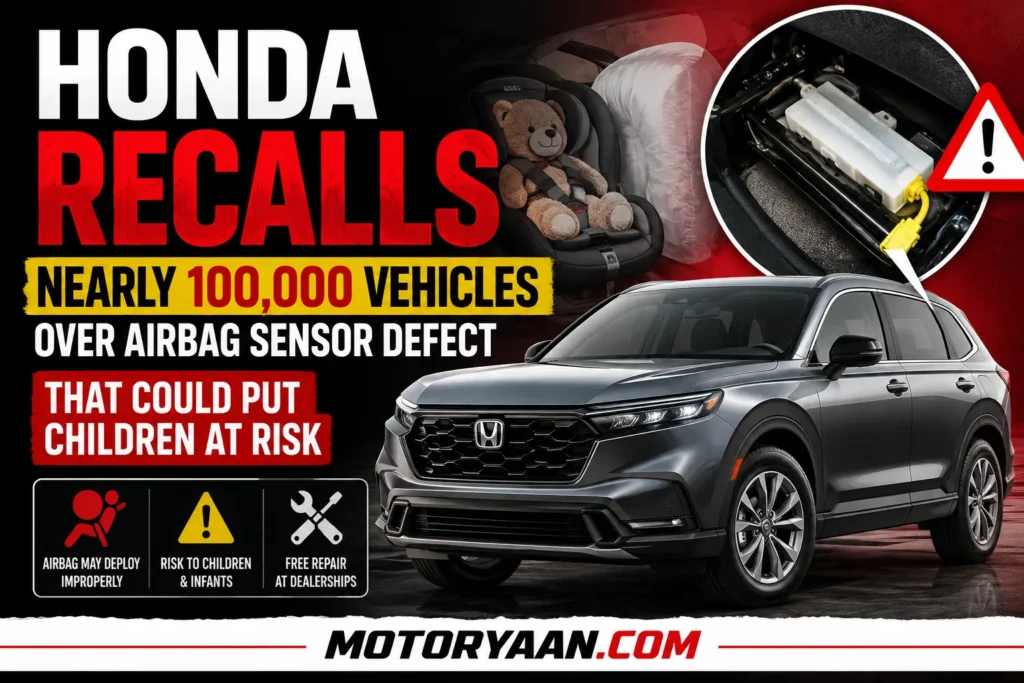
Honda has issued a major safety recall covering nearly 100,000 vehicles across its Honda and Acura brands after discovering a defect that could cause the front passenger airbags to deploy when they should remain disabled.
The problem involves the front passenger seat weight sensor, a critical component that helps determine whether the occupant is large enough for the airbag system to activate during a crash. If the sensor fails, airbags could deploy even when a child or infant is sitting in the seat, increasing the risk of injury.
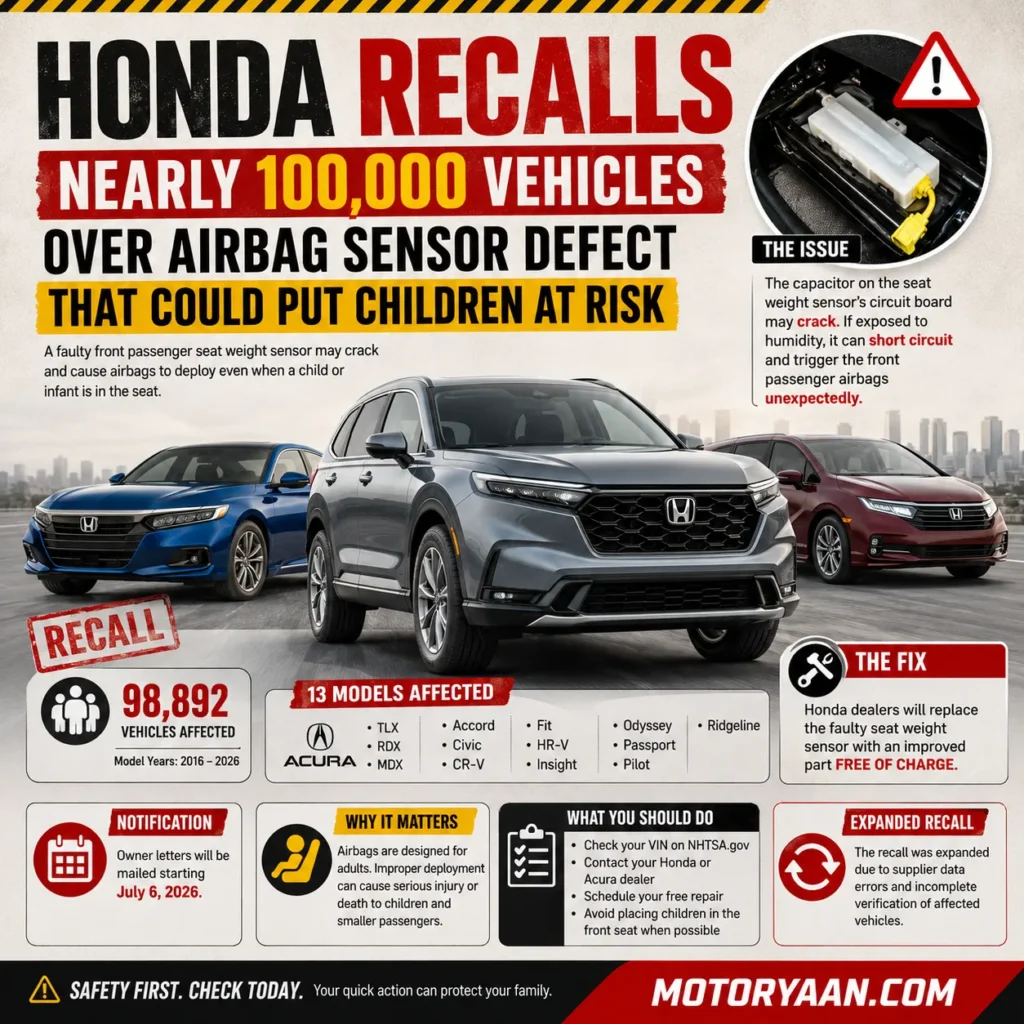
The recall affects 98,892 vehicles from model years ranging from 2016 to 2026 and expands upon a previous recall campaign launched in 2024.
Which Honda and Acura Models Are Affected?
The recall spans 13 model lines across both brands.
Acura Models
- Acura TLX
- Acura RDX
- Acura MDX
Honda Models
- Honda Accord
- Honda Civic
- Honda CR-V
- Honda Fit
- Honda HR-V
- Honda Insight
- Honda Odyssey
- Honda Passport
- Honda Pilot
- Honda Ridgeline
The affected vehicles cover a broad mix of sedans, SUVs, minivans, and pickup trucks, making this one of Honda’s larger safety campaigns in recent years.
The wide range of affected vehicles suggests the issue is tied to a shared component used across multiple platforms rather than a vehicle-specific engineering problem. This is increasingly common as automakers standardize parts across large portions of their lineup.
What Is Causing the Problem?
According to documents filed with the National Highway Traffic Safety Administration (NHTSA), the issue originates inside the front passenger seat weight sensor.
The sensor contains a printed circuit board with a capacitor that may crack over time. If the crack develops and the component is exposed to humidity, an internal short circuit can occur.
When this happens, the system may incorrectly interpret who is sitting in the passenger seat.
As a result, the vehicle’s frontal and knee airbags could deploy during a crash even when an infant in a child seat, a small child, or another lightweight occupant is present.
Why This Matters
Modern airbag systems are designed to adjust deployment strategies based on occupant size and weight. These systems are particularly important for protecting children, who can be seriously injured by airbags designed for adults.
A faulty weight sensor undermines that safety strategy and increases the risk of unintended injury during a collision.
While airbags save thousands of lives every year, they are only effective when they deploy under the correct conditions. Occupant detection systems have become just as important as the airbags themselves in modern vehicle safety engineering.
Why Honda Expanded the Recall
This recall is larger than Honda’s previous campaign addressing the same issue.
According to NHTSA documentation, the expansion was necessary because investigators discovered multiple problems during the original defect analysis process, including:
- A supplier calculation error involving the production end date of the defective part.
- Inaccurate data linking defective sensors to specific vehicles.
- Insufficient verification procedures used to determine the affected vehicle population.
As a result, additional vehicles that may contain the faulty component have now been added to the recall.
Expanded recalls are not unusual in the automotive industry. As manufacturers gather more production and supplier data, they often identify additional vehicles that may have been overlooked during the initial investigation.
What Owners Should Know
Honda will replace the defective front passenger seat weight sensor free of charge.
The replacement sensor uses the original circuit board material that is not susceptible to the cracking issue identified in the recalled units.
Owner notification letters are scheduled to begin mailing on July 6, 2026.
Owners can also verify whether their vehicle is included by checking their VIN through the NHTSA recall database or contacting a Honda or Acura dealership.
What Buyers and Current Owners Should Do
If your vehicle is included in the recall:
- Schedule the repair as soon as parts become available.
- Avoid placing children in the front passenger seat whenever possible.
- Monitor recall notifications from Honda or Acura.
- Verify your VIN through official recall channels.
The repair is expected to be straightforward, but addressing the issue promptly is important because it involves a core safety system.
Ownership Considerations
For current owners, this recall should not significantly affect long-term ownership costs since the repair will be performed free of charge.
However, it serves as a reminder of how dependent modern vehicles have become on sophisticated electronic safety systems. Components such as occupant detection sensors, radar units, cameras, and control modules now play a major role in vehicle safety performance.
Fortunately, Honda’s decision to proactively expand the recall demonstrates a willingness to address the issue before more serious incidents occur.
Recalls involving safety systems often receive significant attention, but the key factor is how quickly a manufacturer identifies the problem and provides a remedy. In this case, Honda has already developed a replacement part and outlined a repair plan.
How This Compares to Industry Trends
Occupant detection system recalls have become more common across the automotive industry as manufacturers add increasingly advanced airbag and safety technologies.
Many modern vehicles rely on weight sensors, seat position sensors, and occupant classification systems to determine how airbags deploy during a crash.
While defects involving these systems can trigger large recalls, they are generally easier to repair than structural or powertrain-related defects because the solution often involves replacing a specific electronic component.
Potential Drawbacks
Although the repair itself is free, owners may encounter:
- Temporary dealership appointment delays.
- Parts availability constraints if demand spikes.
- Reduced confidence in the affected safety system until repairs are completed.
For most owners, however, the inconvenience should be relatively minor compared to the importance of restoring proper airbag functionality.
Key Takeaways
- Honda has recalled 98,892 Honda and Acura vehicles due to a faulty front passenger seat weight sensor.
- The defect can cause airbags to deploy when a child or infant is seated in the front passenger seat.
- The recall affects 13 model lines from model years 2016 through 2026.
- Honda will replace the defective sensor free of charge.
- Owner notifications are scheduled to begin on July 6, 2026.
- The recall expands an earlier campaign after additional affected vehicles were identified.
Sources and References
Official Sources
National Highway Traffic Safety Administration (NHTSA) Recall Database
NHTSA Recall Lookup
Official U.S. government recall database where owners can check affected vehicles by VIN.
Honda Official Recall Announcement
Honda & Acura Multi-Model Seat Weight Sensor Safety Recall
Official Honda statement explaining the defect, affected models, and repair process.
Honda Recall Lookup Tool
Honda Recall Lookup
Allows Honda owners to search recalls using VIN or vehicle details.
NHTSA Safety Recall Report (PDF)
NHTSA Recall Report 26V332 PDF
Official technical defect report filed with NHTSA.
Trusted Automotive Media Sources
Car and Driver
Honda Recalls Nearly 100K Cars from 13 Model Lines over Airbag Issue
Detailed automotive industry coverage with technical explanation of the defect.
Consumer Reports
Honda and Acura Airbag Sensor Recall Coverage
Independent consumer-focused explanation of the recall and safety implications.
Autoblog
Honda Recalls Nearly 100,000 Vehicles Because Airbags Could Endanger Smaller Passengers
Provides additional context on occupant safety risks and affected models.
Business / Industry Reporting
Reuters
Honda Recalls Nearly 99,000 US Vehicles Over Airbag Issues
Reliable business reporting covering the recall announcement and NHTSA filings.
Honda airbag sensor recall
Why is Honda recalling these vehicles?
Honda is recalling these vehicles because the front passenger seat weight sensor may crack. If that happens, the sensor can short circuit and cause the airbags to deploy when they should stay disabled, including when a child or infant is in the front passenger seat.
Which Honda and Acura models are affected?
The recall covers 13 model lines, including the Acura TLX, RDX, and MDX, plus the Honda Accord, Civic, CR-V, Fit, HR-V, Insight, Odyssey, Passport, Pilot, Ridgeline, and others listed in the recall. The affected vehicles span model years from 2016 through 2026.
What can happen if the sensor fails?
If the sensor cracks and fails, the vehicle may incorrectly detect who is sitting in the front passenger seat. That can trigger the frontal and knee airbags to deploy in a way that is not intended for a child, infant, or smaller occupant.
Will Honda fix the problem for free?
Yes. Honda dealers will replace the defective weight sensor at no charge to owners. The replacement uses the original circuit board material that is not affected by the cracking issue.
When will owners be notified?
Honda plans to begin mailing owner notification letters on July 6, 2026. Owners can also check their vehicle identification number through official recall channels or contact a Honda or Acura dealer.
What should owners do right now?
Owners should verify whether their vehicle is included, schedule the repair as soon as parts are available, and avoid placing children in the front passenger seat whenever possible until the recall is completed.