GM Develops Sodium Ion Battery Cells for Energy Storage Instead of EVs: Here's Why It Matters
Table of Contents
General Motors has announced a new battery project that could quietly shape the future of electric vehicles, even though the batteries themselves will not power cars.
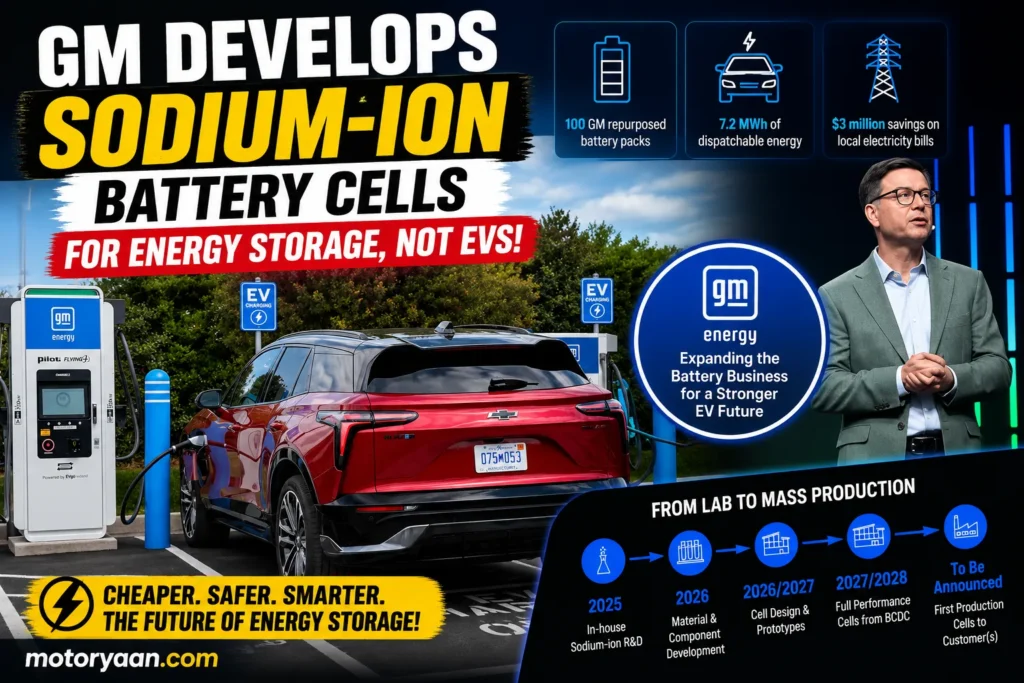
The company is developing sodium ion battery cells with startup Peak Energy, but these batteries are being designed for large scale energy storage systems rather than electric vehicles. At first glance, that may sound unrelated to the automotive industry. In reality, it could help GM lower EV battery costs and speed up battery development for future electric models.
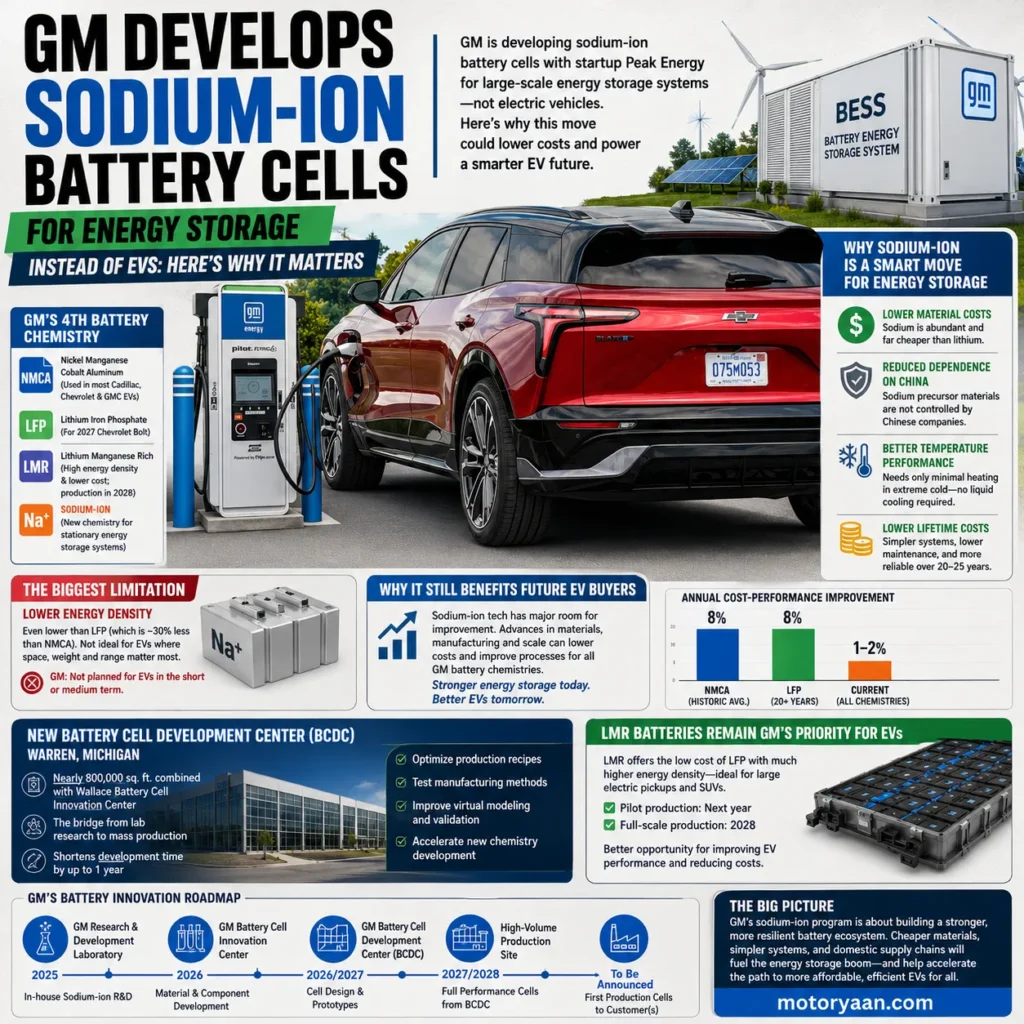
GM Adds a Fourth Battery Chemistry to Its Portfolio
General Motors already works with multiple battery technologies across its electric vehicle lineup.
Current and upcoming battery chemistries include:
- Nickel Manganese Cobalt Aluminum (NMCA) for many Cadillac, Chevrolet, and GMC EVs
- Lithium Iron Phosphate (LFP) for the upcoming 2027 Chevrolet Bolt
- Lithium Manganese Rich (LMR), which is expected to enter production in 2028
- Sodium Ion, the newest addition aimed at stationary energy storage
Rather than replacing existing EV batteries, sodium ion technology will expand GM’s overall battery business while creating opportunities to improve battery manufacturing processes.
Why GM Is Focusing on Energy Storage Instead of EVs
The new sodium ion cells are intended for Battery Energy Storage Systems, commonly known as BESS.
These are massive battery installations housed inside containers or dedicated facilities that store electricity for later use. They play an important role in balancing renewable energy sources like wind and solar while also supporting growing electricity demand from data centers.
Unlike electric cars, stationary storage systems are not limited by vehicle size or weight. That makes lower energy density much less of a concern.
For GM, this opens the door to using a cheaper battery chemistry where it makes the most sense.
Advantages of Sodium Ion Batteries
Sodium ion batteries bring several practical benefits.
Lower material costs
Sodium is one of the most abundant elements on Earth, making raw materials significantly cheaper than lithium based alternatives.
Reduced dependence on Chinese supply chains
A major advantage is that sodium precursor materials are not dominated by Chinese suppliers. This could help North American battery manufacturing reduce supply chain risks in the future.
Better temperature performance
Sodium ion batteries tolerate heat much better than current lithium based batteries.
Even affordable LFP batteries require liquid cooling systems. Sodium ion cells generally need no cooling and only require minimal heating in extremely cold conditions.
That means:
- Simpler battery systems
- Lower maintenance requirements
- Reduced lifetime operating costs
- Improved reliability over decades of use
For utilities and commercial energy storage operators, these savings can be substantial.
The Biggest Limitation Is Energy Density
Despite their advantages, sodium ion batteries still face one major challenge.
Their energy density remains lower than even LFP batteries, which themselves store around 30 percent less energy than advanced NMCA cells.
For electric vehicles, every kilogram matters. Lower energy density would require larger and heavier battery packs, reducing driving range and efficiency.
Because of this, GM has clearly stated that sodium ion batteries are not planned for its electric vehicles in the short or medium term.
While a few sodium battery powered cars are already available in China, the technology still needs significant improvement before becoming practical for mainstream North American EVs.
Why This Project Could Still Benefit Future EV Buyers
Although these batteries are not heading into vehicles, the project could indirectly improve future electric cars.
According to GM, sodium ion chemistry still offers significant room for performance improvements through chemistry refinement and manufacturing optimization.
By comparison, mature battery technologies such as NMCA and LFP have already reached a stage where yearly improvements have slowed considerably.
As engineers continue developing sodium ion technology, many manufacturing techniques and production efficiencies can be transferred to other battery chemistries, potentially lowering costs across GM’s EV lineup.
GM Opens New Battery Development Center
A key part of this strategy is GM’s newly opened Battery Cell Development Center (BCDC) in Warren, Michigan.
Working alongside the Wallace Battery Cell Innovation Center, the combined facilities now cover nearly 800,000 square feet dedicated to battery research and development.
The BCDC acts as the bridge between laboratory research and large scale manufacturing.
Its main objectives include:
- Optimising battery production recipes
- Testing manufacturing methods before mass production
- Improving virtual modelling and physical validation
- Reducing development time for new battery chemistries
GM believes this facility could shorten the journey from research to production by as much as one year.
That acceleration could help technologies like LMR batteries reach the market faster while supporting future innovations.
LMR Batteries Remain GM's Priority for Electric Vehicles
While sodium ion batteries attract attention for energy storage, GM’s immediate EV strategy continues to focus on Lithium Manganese Rich chemistry.
The company says LMR combines the affordability of LFP batteries with significantly higher energy density, making it especially suitable for larger electric pickups and SUVs.
Pilot production is expected to begin next year, with full scale manufacturing targeted for 2028.
For now, GM believes LMR offers a stronger opportunity for improving EV performance and reducing costs than sodium ion technology.
Could GM Eventually Use Sodium Ion Batteries in Cars?
Never say never.
Battery technology evolves quickly, and today’s limitations may not exist a decade from now.
However, GM executives have made it clear that current sodium ion batteries do not provide enough energy density for modern electric vehicles.
If future research dramatically improves performance, the conversation could change. Until then, sodium ion batteries will remain focused on stationary energy storage while helping GM strengthen its overall battery expertise.
Final Thoughts
General Motors’ sodium ion battery program is less about launching a new EV battery and more about building a stronger battery ecosystem.
Cheaper materials, simplified cooling requirements, and reduced dependence on overseas supply chains make sodium ion technology an attractive solution for energy storage systems. At the same time, investments in battery research and manufacturing could accelerate innovation across GM’s electric vehicle portfolio.
For consumers, the immediate impact may not be visible. But behind the scenes, projects like this could play an important role in making future EV batteries more affordable, more efficient, and quicker to develop.
Sources & References
1. General Motors Official
https://www.gm.com
Official General Motors website covering company announcements, EV technology, battery development, and corporate initiatives.
2. Peak Energy Official
https://www.peakenergy.com
Official website of Peak Energy, GM’s sodium ion battery partner focused on grid scale energy storage solutions.
3. Car and Driver
https://www.caranddriver.com/news/a71538744/gm-sodium-ion-battery-cells-plans/
Detailed report explaining GM’s sodium ion battery strategy and its potential impact on future EV development.
4. The Verge
https://www.theverge.com/transportation/946820/gm-energy-ev-v2g-storage-sodium-ion
Covers GM Energy, stationary battery storage, and the company’s broader electrification strategy.
5. Forbes
https://www.forbes.com/sites/alanohnsman/2026/06/09/gm-doubles-down-on-energy-business-to-serve-data-center-electricity-demand/
Analysis of GM’s expansion into the energy storage business and sodium ion battery investment.
6. Financial Times
https://www.ft.com/content/6a26c6e1-ec55-4a6a-8ddc-18405ca52c9a
Explains GM’s strategy to diversify battery supply chains and reduce dependence on overseas sourcing.
7. Power Engineering
https://www.power-eng.com/energy-storage/peak-energy-ships-first-grid-scale-sodium-ion-battery/
Technical coverage of sodium ion battery deployment for commercial and utility scale energy storage.
8. Volta Foundation
https://volta.foundation/assessing-the-promise-and-potential-of-sodium-ion-batteries-in-2026/
Independent industry analysis covering sodium ion battery technology, benefits, and future outlook.
9. MarketWatch
https://www.marketwatch.com/story/gm-follows-ford-by-making-a-big-energy-bet-but-heres-the-quirky-twist-eae9b5ee
Financial perspective on GM’s growing energy storage business and battery innovation strategy.
10. Business Insider
https://www.businessinsider.com/gm-general-motors-ev-battery-power-grid-ai-data-center-2026-6
Explains GM’s long term energy ecosystem vision, including vehicle to grid technology and battery storage initiatives.