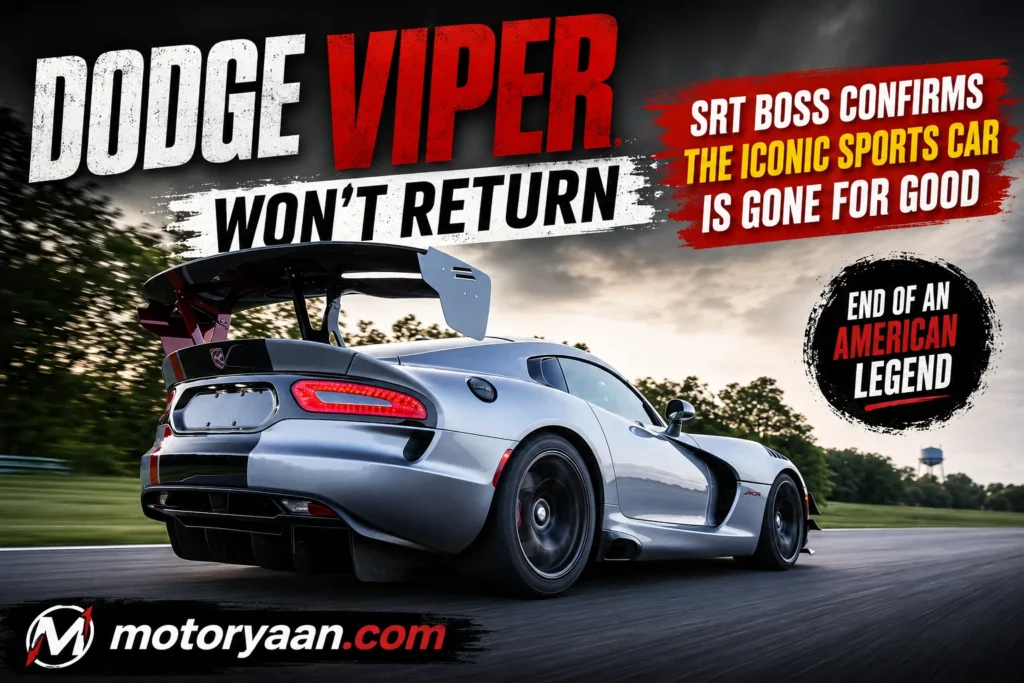
Dodge Viper Won’t Return as SRT Boss Confirms the Iconic Sports Car Is Gone for Good
Table of Contents
The dream of a sixth generation Dodge Viper is officially over.
For years, Dodge fans have hoped the legendary American sports car would make a comeback. Rumors appeared regularly, enthusiasts kept discussing possible revivals, and many believed Dodge would eventually bring back one of its most iconic performance cars.
Now, SRT boss Tim Kuniskis has put those hopes to rest.
Dodge Viper Has Reached the End of Its Life Cycle
During a recent interview with The Drive, Tim Kuniskis was asked whether the Dodge Viper still makes sense in today’s automotive world or if its era is over.
His answer was straightforward.
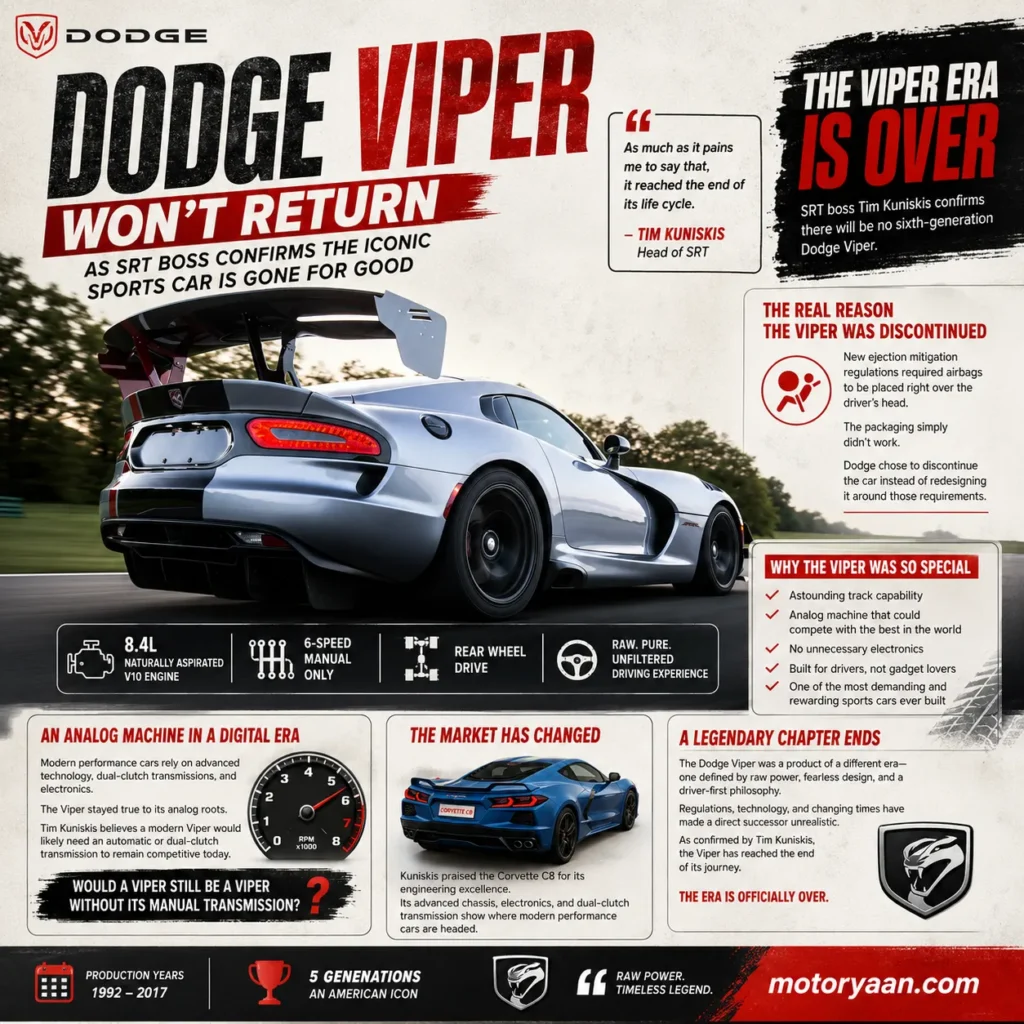
“As much as it pains me to say that, it reached the end of its life cycle.”
According to Kuniskis, the Viper is not returning, and there are no plans for a sixth generation model.
For Dodge enthusiasts, that is difficult news to hear. The Viper has long been one of the most recognizable American performance cars ever built.
The Real Reason the Dodge Viper Was Discontinued
Many people assume the Viper disappeared because of its massive V10 engine, tightening emissions regulations, or weak sales numbers.
Kuniskis says those assumptions are wrong.
The actual reason was a safety regulation known as ejection mitigation requirements.
According to Kuniskis, meeting the new safety standards would have required major changes to the vehicle’s design.
He explained that airbags would have needed to be positioned very close to the driver’s head because of the Viper’s unique cabin layout.
The packaging simply did not work.
As a result, Dodge decided to discontinue the car rather than redesign it around those requirements.
Why the Viper Was So Special
Even years after production ended, the Viper remains highly respected among driving enthusiasts.
Kuniskis praised the car’s track performance and highlighted what made it different from many modern performance vehicles.
The Viper was built around a simple formula:
- Massive naturally aspirated V10 power
- Manual transmission only
- Rear wheel drive layout
- Minimal electronic intervention
- Driver focused experience
According to Kuniskis, the car could compete with some of the world’s best performance machines despite relying on an old school approach.
That combination helped create the Viper’s reputation as one of the most demanding and rewarding sports cars ever produced.
An Analog Machine in a Digital Era
While praising the Viper, Kuniskis also acknowledged its shortcomings.
Modern performance cars have evolved significantly. Advanced electronics, dual clutch transmissions, launch control systems, and sophisticated aerodynamics now dominate the segment.
The Viper stayed true to its analog roots.
That authenticity made it special, but it also made future development increasingly difficult.
Kuniskis admitted that if a modern Viper were developed today, it would likely need a very different setup.
According to him, a new Viper would probably require an automatic or dual clutch transmission to remain competitive with today’s high performance sports cars.
For many enthusiasts, that raises an interesting question.
Would a Viper still be a Viper if it abandoned its traditional manual transmission?
The Corvette C8 Shows How the Market Has Changed
During the discussion, Kuniskis also spoke positively about the Chevrolet Corvette C8.
He said he is highly impressed by the engineering behind the mid engine sports car and has great respect for the work that went into its development.
The Corvette C8 represents the direction modern performance cars have taken.
Its advanced chassis, sophisticated electronics, and dual clutch transmission allow it to deliver supercar levels of performance.
That approach differs significantly from the raw, driver focused formula that defined the Dodge Viper.
A Legendary Chapter Comes to an End
The Dodge Viper remains one of the most unforgettable performance cars ever produced in America.
Its massive V10 engine, aggressive styling, and unapologetically raw driving experience helped it stand apart from nearly everything else on the road.
However, automotive regulations, changing technology, and evolving performance expectations have made a direct successor increasingly unrealistic.
As Tim Kuniskis confirmed, the Viper has reached the end of its journey.
For enthusiasts, that may be disappointing news. But it also reinforces what made the Viper special in the first place.
It was a product of a different era, and according to the man leading SRT, that era is officially over.
Sources and References
Official Sources
- Dodge Official Website
Official Dodge brand website with model history, brand information, and announcements. - Mopar Official Website
Official source for Dodge, Chrysler, Jeep, and Ram parts and heritage information. - Stellantis Official Website
Parent company of Dodge and SRT. Useful for corporate announcements and official statements.
Primary Source
- The Drive Article (Original Interview)
Original source containing Tim Kuniskis’ comments about the Dodge Viper’s future and discontinuation.
Trusted Automotive References
- Car and Driver
Historical reviews, specifications, and performance analysis of the Dodge Viper. - MotorTrend Dodge Viper Archive
Comprehensive Viper reviews, comparisons, and historical coverage. - Edmunds Dodge Viper Reviews
Buyer guides, reviews, specifications, and ownership information.
Useful Historical References
- NHTSA Official Website
US government source for vehicle safety regulations, including standards related to occupant protection. - IIHS Official Website
Independent vehicle safety research and regulatory information.
Dodge Viper Won't Return
Is the Dodge Viper coming back?
No. SRT boss Tim Kuniskis said the Dodge Viper reached the end of its life cycle, and there are no plans for a sixth generation model.
Why was the Dodge Viper discontinued?
Kuniskis said the main reason was ejection mitigation safety rules. The Viper’s cabin layout made it very hard to meet the new requirements without major redesign work.
Did the Viper end because of low sales or emissions rules?
According to Kuniskis, no. He said those are common assumptions, but the real issue was the safety packaging problem caused by the new regulation.
What made the Dodge Viper so special?
The Viper stood out because it stayed old school. It used a big naturally aspirated V10, a manual transmission, rear wheel drive, and very little electronic interference.
Would a modern Viper need an automatic transmission?
Kuniskis said a modern Viper would likely need an automatic or dual clutch transmission to keep up with today’s performance cars. That would change the character of the car a lot.
What did Tim Kuniskis say about the Corvette C8?
He said he is highly impressed by the engineering of the Corvette C8. He praised its mid engine layout, advanced chassis, and modern performance focus.
How many generations of Dodge Viper were made?
The Viper had five generations before production ended. The car became a true American performance icon during that run.
Why do enthusiasts still talk about the Viper?
Because it was raw, fast, and very different from most modern sports cars. The Viper delivered a simple driver focused experience that many enthusiasts still miss.