
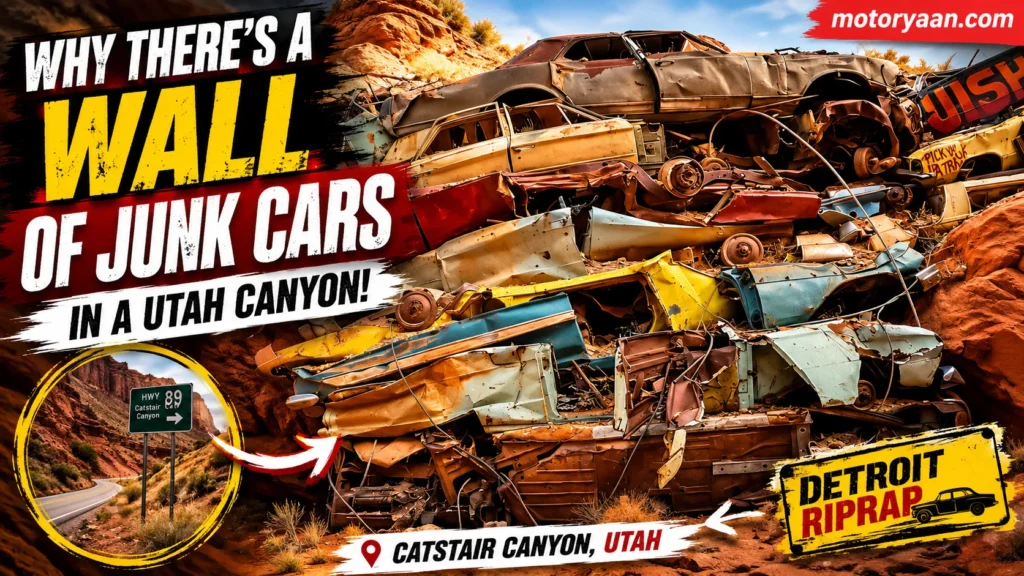
Why There's a Wall of Junk Cars in a Utah Canyon
Table of Contents
In the remote landscape of Southern Utah, hidden below Highway 89, sits one of America’s strangest roadside secrets. At first glance, it looks like a massive graveyard of crushed classic cars stacked on top of each other. Many visitors assume it is an art installation or an abandoned junkyard.
The truth is much more interesting.
These old vehicles were actually part of a real engineering project from the 1960s. What remains today is one of the most unusual examples of erosion control ever used in the United States.
The Story Behind Utah's Famous Car Wall
The site is located in Catstair Canyon, a narrow sandstone wash near Highway 89 in Southern Utah.
When highway crews were building the road through the canyon during the 1960s, they faced a challenge. The loose sand and soil in the area were vulnerable to erosion, which could threaten the stability of the roadway.
Engineers needed a solution that would hold the embankment in place and prevent the canyon walls from washing away.
Instead of using large amounts of rock, they turned to an unexpected material: old junk cars.
What Is Detroit Riprap?
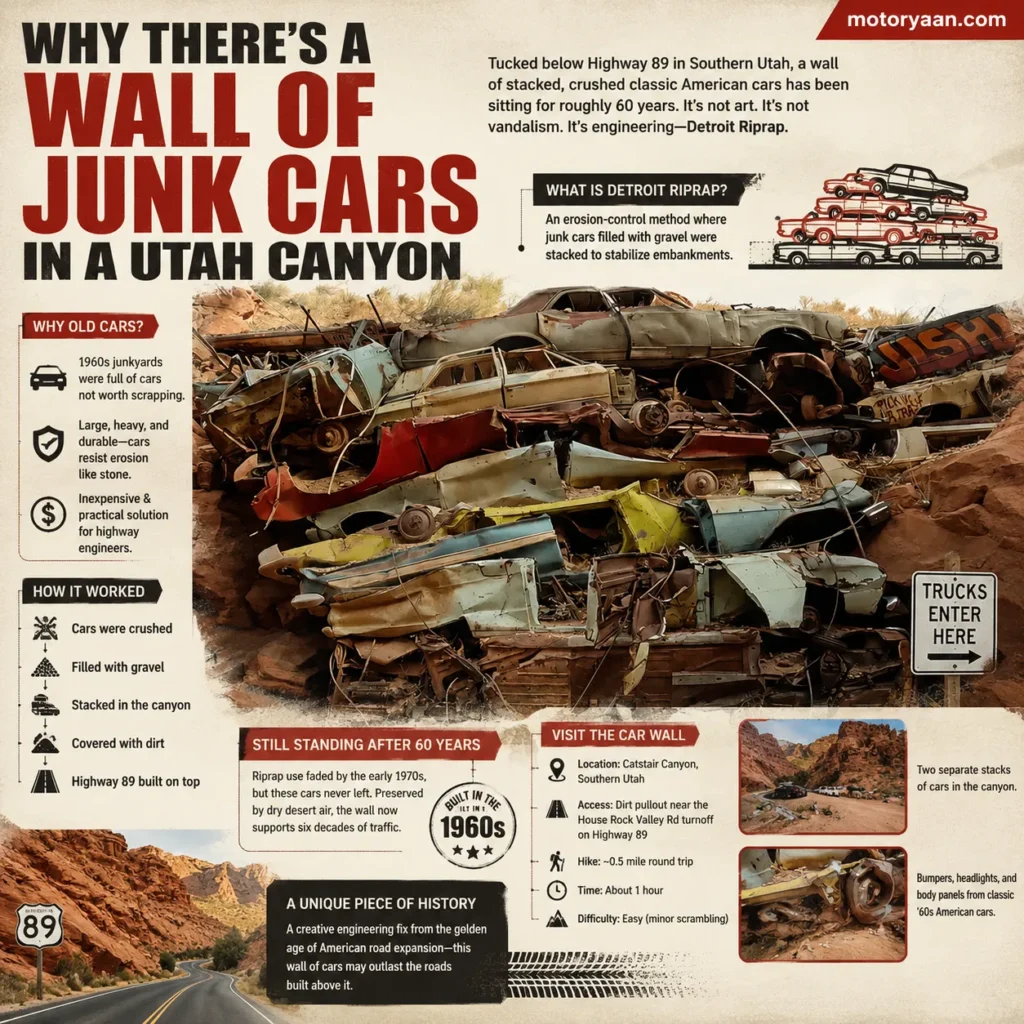
The engineering technique used at Catstair Canyon is known as riprap.
Riprap is a method used to protect banks, slopes, and embankments from erosion. Engineers typically use materials such as:
- Large rocks
- Concrete blocks
- Crushed stone
- Other durable materials
In Catstair Canyon, however, crews used crushed vehicles filled with gravel.
This unusual approach became known as Detroit riprap, a nickname inspired by the automobile industry and the large number of discarded vehicles available at the time.
According to engineering practices of the era, the cars were considered strong enough to resist erosion while their large size allowed them to be stacked tightly together.
A similar erosion-control method was also used along Nebraska’s Loup River.
Why Engineers Used Old Cars
Using junk vehicles may sound strange today, but it made practical sense during the 1960s.
Many junkyards were overflowing with old cars that had little scrap value. Recycling methods were not as advanced as they are today, and many vehicles simply sat unused.
Engineers viewed these cars as an inexpensive alternative to rock.
The process was relatively simple:
- Old vehicles were crushed.
- The cars were filled with gravel and other material.
- They were stacked together inside the canyon.
- Dirt was placed over the structure.
- Highway 89 was built above it.
The result was a stable embankment capable of supporting traffic while helping control erosion.
A Hidden Piece of American Highway History
The Catstair Canyon car wall is a fascinating reminder of the massive road-building projects that transformed America during the mid-20th century.
The period saw rapid highway expansion across the country and eventually led to the growth of the interstate highway system.
While many construction techniques from that era have disappeared, this unusual structure remains largely intact, making it a rare piece of engineering history.
What Remains Today?
Riprap made from vehicles largely disappeared by the early 1970s, but the cars in Catstair Canyon were never removed.
Southern Utah’s dry desert climate helped preserve the structure for decades.
Today, visitors can still see:
- Rusted bumpers
- Old headlights
- Body panels from classic American cars
- Layers of crushed steel compressed by decades of traffic
More than sixty years of vehicles driving above the site have compressed the cars into a dense mass of rusted metal.
One of the more amusing features visitors notice is a weathered sign that reads “Trucks Enter Here,” adding a bit of humor to the unusual landmark.
Visiting the Catstair Canyon Car Wall
The site has become a popular destination for adventurous travelers and automotive enthusiasts.
Visitors can reach the location from a dirt pullout near the House Rock Valley Road turnoff along Highway 89.
The canyon contains two separate stacks of vehicles, both accessible through a short hike.
What to Expect
| Details | Information |
|---|---|
| Location | Catstair Canyon, Southern Utah |
| Access | Short hike from Highway 89 |
| Hiking Distance | Approximately half a mile |
| Difficulty | Easy with minor scrambling |
| Time Required | Around one hour round trip |
| Main Attraction | Stacked and crushed classic American cars |
Drivers should use caution when stopping because the pullout is located near a blind curve on the highway.
A Unique Landmark That May Last for Generations
The car wall has already survived more than six decades of weather, erosion, and traffic.
Because the vehicles are deeply embedded within the hillside, they are unlikely to move anytime soon. In fact, the structure may continue standing long after many modern roads have been rebuilt or replaced.
What began as a practical engineering solution has become one of Utah’s most unusual hidden attractions and a remarkable reminder of a time when highway builders were willing to think far outside the box.
Sources and References
Jalopnik (Original Story)
https://www.jalopnik.com/2195068/castair-detroit-riprap-car-utah-canyon-graveyard/
Automotive news website that covered the history of the Catstair Canyon car wall and Detroit Riprap.
Federal Highway Administration (FHWA)
https://www.fhwa.dot.gov/
Official U.S. government source for highway engineering, road construction, and erosion control practices.
National Park Service
https://www.nps.gov/
Provides information about the geology, landscapes, and environmental conditions found throughout the American Southwest.
Utah Office of Tourism
https://www.visitutah.com/
Official tourism resource with travel information for visitors exploring Utah’s unique attractions and highways.
Bureau of Land Management (BLM)
https://www.blm.gov/
Federal agency responsible for managing public lands across the western United States, including areas near Highway 89.
Geological Society of America
https://www.geosociety.org/
Trusted source for geology, erosion, and landform research relevant to riprap and canyon environments.
American Society of Civil Engineers (ASCE)
https://www.asce.org/
Professional organization providing engineering standards and information about infrastructure and erosion-control methods.
Frequently Asked Questions
The wall of junk cars in Catstair Canyon was built during the 1960s as an erosion control solution. Engineers used crushed vehicles filled with gravel to stabilize the embankment while constructing Highway 89 in Southern Utah.
Detroit riprap is a nickname for an erosion control method that used old automobiles instead of rocks or concrete. At Catstair Canyon, crushed cars were stacked together and covered with dirt to help prevent erosion.
The car wall is located in Catstair Canyon near Highway 89 in Southern Utah. Visitors can access the site from a dirt pullout near the House Rock Valley Road turnoff.
During the 1960s, many junkyards were filled with vehicles that had little scrap value. Engineers considered the cars a low-cost and practical alternative to traditional riprap materials because they were large, durable, and easy to stack.
The vehicles were crushed, filled with gravel and other materials, stacked tightly together inside the canyon, covered with dirt, and then used as part of the foundation beneath Highway 89.
Yes. Visitors can still see rusted body panels, bumpers, headlights, and other parts from classic American cars. More than six decades of traffic have compressed the vehicles into a dense mass of steel.
The hike is relatively easy and involves only minor scrambling. The round trip is about half a mile and usually takes around one hour to complete.
There are two separate stacks of crushed vehicles in the canyon. Both can be reached from the same hiking area near Highway 89.