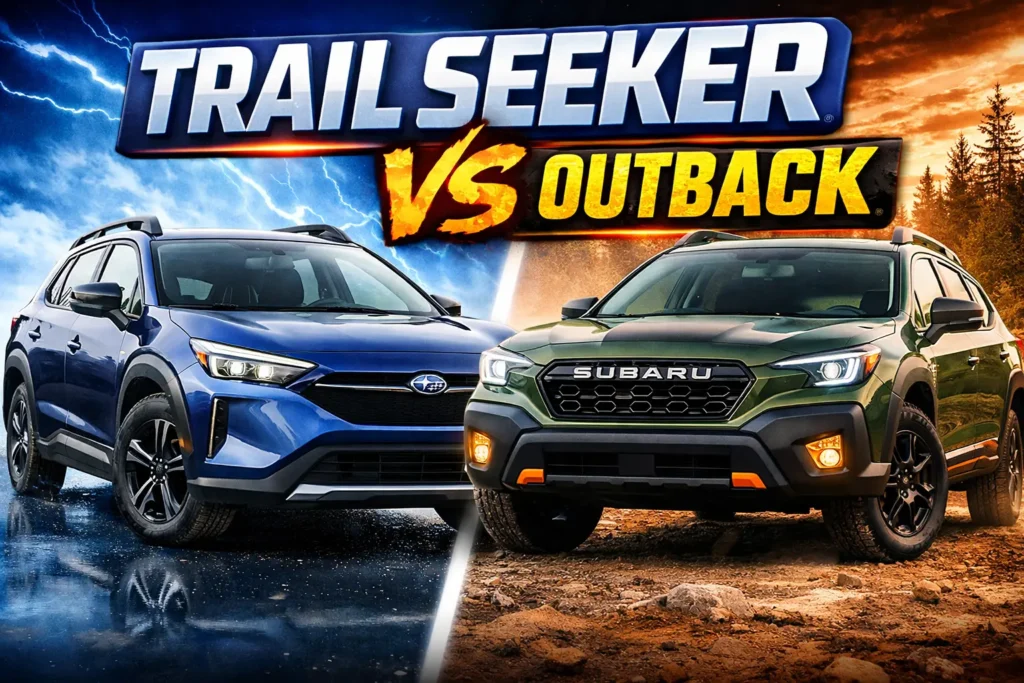
2026 Subaru Trail Seeker vs Outback: Electric Wagon Meets the Original
Table of Contents
Subaru finally has what many buyers have been asking for. An electric wagon that feels like an Outback.
The new 2026 Subaru Trail Seeker sits right next to the 2026 Subaru Outback in terms of size, pricing, and purpose. Subaru calls it a new model. Spend five minutes around it and you will understand what it really is. This is the electric Outback many people expected.
I spent time comparing both side by side. Same day. Same place. Tape measure in hand. Here is how they stack up based strictly on specs, space, hardware, and pricing.
Exterior Design and Dimensions
Classic Wagon vs Modern SUV Look
The current Outback generation leans more SUV than wagon. In Wilderness trim, it looks especially upright and boxy.
The Trail Seeker pulls things back toward a more classic Subaru wagon silhouette.
Bold front with large Subaru lettering
Split headlight and DRL setup
Heavy black body cladding
9.5 inches of ground clearance
Orange Wilderness accents
Trail Seeker highlights
Lower and more tapered nose for aerodynamics
Six element signature EV lighting
No fog lights
Prominent rear light bar
Rear wiper still present
Dimensionally, they are shockingly close.
| Specification | Trail Seeker | Outback |
|---|---|---|
| Length | 190.8 inches | 191.7 inches |
| Width | Slightly narrower by 0.8 inch | Slightly wider |
| Ground Clearance | 8.5 inches | 9.5 inches Wilderness |
| Roof Height | Lower | Taller, more upright |
The biggest visual difference is vertical height. The Outback stands taller. The Trail Seeker looks sleeker.
Powertrain and Performance
Here is where things get interesting.
Outback Engine Options
180 horsepower naturally aspirated engine
260 horsepower turbocharged boxer
0 to 60 mph in 6.5 seconds for the turbo
CVT transmission
414 miles of range in Wilderness trim
Trail Seeker Electric Setup
Dual identical electric motors
About 167 kW each
Combined 375 horsepower
0 to 60 mph in 4.4 seconds
Single reduction gear, no traditional transmission
280 plus miles range base
Around 275 miles in most trims
28 minutes DC fast charging from 10 to 80 percent
Subaru uses identical motors front and rear. That matters off road. If one axle loses traction, the other can deliver equal torque. Many competitors use a larger rear motor and smaller front motor. Subaru chose symmetry.
For daily driving, the Trail Seeker is dramatically quicker than any Outback ever built.
For road trips, the gasoline Outback wins easily. Refueling takes minutes. Charging takes longer, even at fast chargers.
Interior Technology and Layout
The cabins show two different philosophies.
Outback Interior
New Subaru native infotainment software
Large central screen
Physical climate controls
Big LCD instrument cluster
Traditional shifter
Heated steering wheel
Familiar Subaru steering wheel design
This layout previews future gasoline Subaru interiors.
Trail Seeker Interior
14 inch tablet style touchscreen
Mostly touch based climate controls
Two wireless charging pads
Rotary shifter
No traditional glove compartment
LCD cluster positioned higher, almost HUD style
Flat top and flat bottom steering wheel
This interior borrows heavily from the Toyota partnership. The Trail Seeker shares development roots with the Subaru Solterra, though Subaru tunes the off road systems and builds this model in its own factory.
It feels more modern, but less traditionally Subaru.
Rear Seat and Passenger Space
Subaru buyers care about headroom. Both models deliver, but differently.
Front Row
Outback
Excellent headroom, even with moonroof
Traditional Subaru seats with solid bolstering
Manual tilt and telescopic steering
Familiar Subaru layout
Trail Seeker
Slightly higher seating feel due to battery underfloor
Slightly less headroom up front
Different seat design influenced by Toyota partnership
Rear Seat Measurements
Front seats set to identical position for comparison.
| Measurement | Trail Seeker | Outback |
|---|---|---|
| Knee Room | 7.5 inches | 6.5 inches |
| Headroom | Slightly less | More generous |
| Floor Height | Higher | Lower |
The Trail Seeker offers more knee room thanks to its long wheelbase. However, the higher floor pushes passengers’ knees upward. Adults may notice reduced thigh support.
If you choose a panoramic glass roof in the Trail Seeker, you lose roughly one inch of rear headroom.
The Outback remains the airier cabin overall.
Cargo Space Comparison
Cargo space defines an Outback. So this part matters.
What Is Similar
Cargo length from hatch to rear seatbacks is almost identical.
Cargo height measures about 31 inches in both.
Overall usable space feels very close.
What Is Different
Outback has wider spacing between wheel wells.
Outback offers slightly more vertical cargo room.
Outback includes a full size spare tire under the floor.
Trail Seeker uses a two stage load floor with additional storage.
No spare tire in the Trail Seeker.
The EV packaging narrows the cargo floor between wheel wells, likely due to rear suspension layout and battery placement.
Still, for flat luggage and everyday hauling, the Trail Seeker mirrors the Outback surprisingly well.
Safety and Driver Assistance
Both offer Subaru EyeSight. The hardware differs.
Outback
New trinocular three camera setup
Radar in top trims
Hands free highway driving available in higher trims
Trail Seeker
Single camera plus radar behind Subaru badge
No hands free driving system
The Outback Touring trim offers hands off highway driving. The Trail Seeker does not. If that feature matters to you, this is a key difference.
For more on Subaru EyeSight technology, Subaru provides detailed breakdowns on its official global and US websites.
Pricing Breakdown
Here is where Subaru made a bold move.
2026 Subaru Outback Pricing
Starts at 36,445 dollars including destination
Wilderness starts at 46,445 dollars
Tops out at 49,445 dollars
2026 Subaru Trail Seeker Pricing
Starts at 41,445 dollars
Limited at 45,445 dollars
Touring at 48,005 dollars
Now compare like for like.
Limited vs Limited: Trail Seeker is about 370 dollars cheaper.
Touring vs Touring: Trail Seeker is roughly 1,400 dollars less.
Wilderness vs Trail Seeker: Turbo Outback costs about 4,000 dollars more than the 375 horsepower EV.
That changes the conversation. Usually EVs cost significantly more. Here, Subaru priced the electric model directly inside the Outback range.
Road Trip Reality Check
This is simple math.
Gasoline Outback 10 to 80 percent equivalent refill time: around 4 minutes at a pump.
Trail Seeker 10 to 80 percent fast charge: about 28 minutes.
If you drive to a distant national park every weekend, the Outback makes life easier today.
If your daily commute fits inside 250 miles and you charge at home, the Trail Seeker makes strong sense.
Subaru has hinted through industry reporting that hybrid options may arrive in the future. That could eventually split the difference.
Final Thoughts: Which Subaru Wagon Makes More Sense?
If you want:
Maximum range
Fast refueling
Traditional Subaru feel
Hands free highway driving
The Outback still holds strong.
If you want:
375 horsepower
4.4 second 0 to 60
Lower running costs
Real wagon practicality in an EV
The Trail Seeker looks like one of the most logical electric wagons on sale.
Subaru did something clever here. They did not price the EV like a luxury experiment. They priced it like an Outback.
For the first time, choosing electric does not automatically mean paying more for less space.
The only real compromise is road trip convenience. Everything else feels surprisingly familiar.
And honestly, that is the biggest compliment you can give an electric Subaru.
Sources and reference
The information in this comparison is based on official manufacturer data, product briefings, and publicly available specifications. For transparency and fact checking, here are the primary sources you can rely on:
Official Manufacturer Sources
Subaru of America – 2026 Subaru Outback
Official specifications, trims, pricing, and features
Engine outputs, range estimates, EyeSight details
Subaru Global / Subaru Media
Corporate announcements
Product specifications and technology explanations
Subaru of America – 2026 Subaru Trail Seeker
Official horsepower figures
Range estimates
Charging time claims
Trim pricing breakdown
Subaru EyeSight Driver Assist Technology
Hardware explanation
Trinocular camera system details
Radar integration in higher trims
Technical and Industry Context
US EPA Fuel Economy and Range Data
Official range certification standards
Comparison framework for EV and gasoline models
Toyota Subaru EV Collaboration Background
Development partnership information
Production and platform details related to Subaru electric models
Subaru corporate press releases
Toyota global newsroom
2026 Subaru Trail Seeker vs Outback – FAQs
1. Is the 2026 Subaru Trail Seeker basically an electric Outback?
Yes, in many ways it is. The Trail Seeker matches the Outback very closely in overall size, cargo length, and practicality. The dimensions are shockingly similar, and the cargo height is almost identical at around 31 inches. It feels like Subaru built an EV that mirrors the Outback’s real world usability rather than chasing sporty crossover trends.
2. How similar are the exterior dimensions of the Trail Seeker and Outback?
The Outback measures 191.7 inches in length, while the Trail Seeker comes in at 190.8 inches. Width is nearly the same, with the Trail Seeker being slightly narrower by about 0.8 inch. The biggest visible difference is roof height. The Outback stands taller and looks more upright, especially in Wilderness trim.
3. Which one has more ground clearance?
The Outback Wilderness offers 9.5 inches of ground clearance. The Trail Seeker provides 8.5 inches. While the EV sits one inch lower, 8.5 inches is still generous compared to many electric SUVs in the market.
4. How does cargo space compare between the two?
The Outback has a slightly wider cargo floor between the wheel wells and a bit more vertical space. However, overall cargo length and height are very close between both vehicles. The Trail Seeker includes a two stage load floor with extra underfloor storage, while the Outback offers a full size spare tire under the cargo floor.
5. Does the Trail Seeker have a front trunk?
No, it does not. Under the hood you will find the electric drivetrain components including the heat pump, DC DC converters, AC charger, 12 volt battery, and fuses. There is no dedicated front storage compartment.
6. Which vehicle offers more rear seat space?
The Trail Seeker offers more knee room in the rear, around 7.5 inches in the tested setup, compared to about 6.5 inches in the Outback. However, the Outback provides more rear headroom and better thigh support due to a lower floor height. If you choose a panoramic glass roof in the Trail Seeker, you lose about one inch of headroom.
7. What are the engine and power differences?
The Outback offers gasoline engines with 180 horsepower or 260 horsepower in turbo form. The turbo version reaches 0 to 60 mph in about 6.5 seconds. The Trail Seeker delivers 375 horsepower from dual identical electric motors and claims 0 to 60 mph in 4.4 seconds. It uses a single reduction gear instead of a traditional transmission.
8. What is the driving range comparison?
The Outback Wilderness offers up to 414 miles of driving range on a full tank. The Trail Seeker provides just over 280 miles in base form and about 275 miles in most trims. Refueling the Outback takes a few minutes, while the Trail Seeker requires around 28 minutes to charge from 10 percent to 80 percent using DC fast charging.
9. Does the Trail Seeker support hands free highway driving?
No, it does not offer the hands off highway system available in top trims of the Outback. The Outback uses Subaru’s latest EyeSight setup with a trinocular camera system and optional radar hardware in higher trims. The Trail Seeker uses a different camera and radar configuration and does not support that feature.
10. How is the pricing structured for both models?
The 2026 Outback starts at 36,445 dollars including destination and goes up to 49,445 dollars. The Trail Seeker starts at 41,445 dollars, with Limited at 45,445 dollars and Touring at 48,005 dollars. In some trim comparisons, the Trail Seeker is actually slightly less expensive than an equivalent Outback, while offering significantly higher performance.
11. Which one makes more sense for long road trips?
If you regularly drive long distances or visit remote national parks, the gasoline Outback is easier to live with due to fast refueling and longer range. The Trail Seeker works well for daily driving and home charging, but you will need to plan charging stops for extended trips.